Jan. 27, 2026
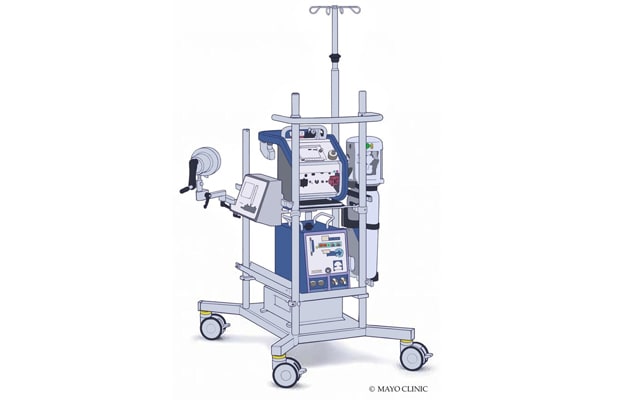 An ECMO station
An extracorporeal membrane oxygenation (ECMO) station can play a role in some trauma patients' care.
Extracorporeal membrane oxygenation (ECMO) is a lifesaving tool. But in trauma care, its use in pediatric patients remains limited compared with adults.
At Mayo Clinic in Rochester, Minnesota, specialists operate up to 15 ECMO machines simultaneously. Annually, the incidence of ECMO deployment for all indications is approximately 20 to 30 times for children and 175 to 200 times for adults, according to Devon O. Aganga, M.D., an anesthesiologist, pediatric critical care specialist and pediatric ECMO director. For neonates, ECMO is most often deployed for congenital diaphragmatic hernia, sepsis and congenital heart disease. Pediatric cases typically involve congenital heart disease, myocardiopathy or acute respiratory distress, while adult cases often center on cardiogenic shock.
ECMO: A team sport
Providing ECMO to patients implies the involvement of a significant group of healthcare professionals.
"ECMO is a team sport," says Troy G. Seelhammer, M.D., an anesthesiologist and medical director for Mayo's Rochester-based ECMO program. "Placement usually occurs in the ICU with an ECMO specialist, ICU nurse, perfusionist, physician or advanced practice professional and often a learner present."
Dr. Seelhammer emphasizes that ECMO is supportive, not curative — temporarily replacing heart or lung function, often for minutes or hours, similar to bypass surgery. Patients cannot go home on ECMO, and the therapy is resource intensive.
Key questions before ECMO
Before initiating ECMO, specialists should ask:
- What is the etiology?
- Is the situation acute?
- Is the condition reversible?
- Are there any contraindications to ECMO in this patient?
- Will ECMO truly save this patient?
"ECMO is a bridge," says Dr. Aganga. "It buys time to let the heart and lungs rest. It does not fix the patient's problem. Instead, it's a bridge to recovery, transplant, ventricular assist device — or a decision to donate organs."
Exit strategies
Dr. Seelhammer elaborates on the concept of ECMO serving as a bridge, laying out three potential paths or exit strategies:
- Bridge to decision. Continue aggressive support to allow time to assess viability.
- Bridge to recovery. Support until organ recovery means the patient no longer needs ECMO.
- Bridge to an alternative. Transition to an alternative to organ recovery, such as a ventricular assist device or an organ transplantation.
Trauma-specific considerations
For trauma patients, ECMO may help if cardiac failure is reversible and no devastating brain injury exists.
"You don't bring back the heart if the brain is never going to come back," says Dr. Aganga.
Contraindications include:
- Vascular trauma.
- Severe anoxic brain injury or hemorrhage.
- Recent stroke.
- Incurable cancer.
- Ethical objections or refusal of blood transfusion.
Challenges for rural trauma centers
Early recognition and referral are critical.
"Start making phone calls early before the patient gets to the point where we can't help them," advises Dr. Aganga.
He poses some key questions for rural trauma teams:
- Is this an emergency or urgent evaluation?
- Is the patient stable enough for transfer?
- Can we get the patient to Mayo Clinic quickly — or to another ECMO-capable center?
Difficult realities
Dr. Aganga warns of pitfalls when considering ECMO use:
- False hope. ECMO should not be used when survival is impossible.
- Resource strain. ECMO is costly, including the equipment, blood products, medications and ICU staffing required.
- Emotional decision-making. This factor can be especially challenging in pediatric arrests.
"Expense has no bearing on whether ECMO will be used, " says Dr. Aganga. "It depends on whether the patient will benefit."
To manage gray areas, Mayo Clinic uses a two-physician team for ECMO decisions.
Timing matters
If ECMO is indicated, earlier is better.
"Think about ECMO in the first five minutes," Dr. Aganga advises trauma professionals.
For institutions external to Mayo Clinic's campus in Rochester, early referrals are key.
"Do call the ECMO team to discuss the option of using this device," he urges. "Don't rule it out. We can evaluate and advise. ECMO is an awesome tool, but it needs to be deployed in the right circumstances with the right patients."
Addressing objections
Critics question ECMO's impact on survival.
"Some populations benefit, but others don't," says Dr. Seelhammer, noting that recent clinical trials demonstrate mixed results, underscoring the need for careful patient selection. ECMO offers the potential to save lives, but resource utilization remains extremely high. This spans physical, personnel and financial resources, demanding careful allocation of this advanced support modality.
"At Mayo Clinic, survival for respiratory ECMO is 60% to 70% while 50% to 60% for cardiac support," says Dr. Seelhammer. "These are among the best ECMO outcomes in the world."
Bottom line
ECMO can be lifesaving for select trauma patients, but its use demands rapid decision-making, multidisciplinary coordination and strict patient selection.
Dr. Seelhammer says: "We need to ask ourselves, 'Are we applying heroic effort and not making meaningful headway?' ECMO is not for everyone — but for the right patient, it can make all the difference."