Overview
AVM blood flow
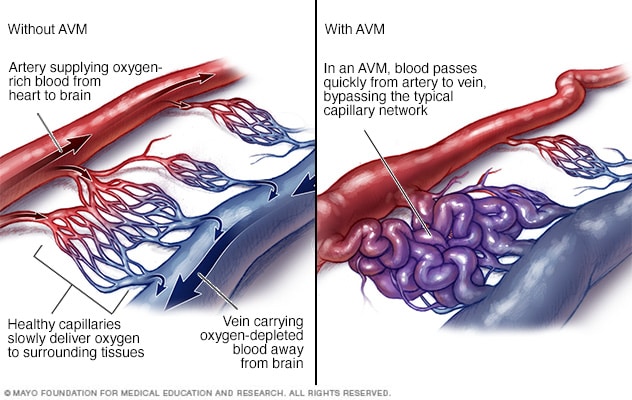
AVM blood flow
In an arteriovenous malformation (AVM), blood passes quickly from the arteries to the veins, disrupting the typical blood flow and depriving the surrounding tissues of oxygen.
A pulmonary arteriovenous malformation is a rare, unusual connection between an artery and a vein in the lungs. It also is called a pulmonary AVM or PAVM. One estimate suggests that about 1 person in 2,630 has a PAVM.
Some people with PAVMs have no symptoms. But a PAVM can cause serious health complications, including stroke, bleeding and an increased risk of developing an infection in the brain called a brain abscess.
A PAVM can be treated with a procedure called embolization. This procedure blocks blood flow through the PAVM. It can be an effective treatment for PAVMs.
Types
An artery that carries blood into a PAVM is called a feeding artery. A vein that carries blood away from it is called a draining vein.
There are different types of pulmonary arteriovenous malformations (PAVMs). PAVMs are grouped as simple, complex or diffuse based on the structure of the blood vessels.
- Simple PAVM. This type has one artery that carries blood into the PAVM.
- Complex PAVM. This type has two or more feeding arteries that carry blood into the PAVM.
- Diffuse PAVMs. These PAVMs involve blood vessels in a larger area of the lung.
- Multiple PAVMs. These PAVMs involve multiple sites within the lung rather than multiple blood vessels.
You can have one or more PAVMs. Having more than one PAVM is different from having a complex PAVM.
The size and number of PAVMs and how much blood flows through them can affect whether you have symptoms. Having larger PAVMs or having several PAVMs can allow more blood to pass through the lungs without picking up enough oxygen. This may lower your blood oxygen level and make symptoms more noticeable.
Symptoms
Many people with pulmonary arteriovenous malformations (PAVMs) have no symptoms. When symptoms occur, some are related to lower oxygen levels because blood is bypassing the tiny blood vessels in the lungs where it typically picks up oxygen.
Symptoms may include:
- Trouble breathing.
- Tiredness or trouble with physical activity.
- Low oxygen levels in the blood.
- A change in skin or lip color caused by low oxygen levels.
- Chest pain.
- Coughing up blood.
- Clubbing.
Some PAVM symptoms may affect the whole body, not just the lungs.
Causes
To understand what causes a pulmonary arteriovenous malformation (PAVM), it can be helpful to know how the blood usually flows. Typically, blood flows through tiny blood vessels called capillaries into the lungs. There, the blood picks up oxygen before it goes back to the heart.
In a PAVM, some blood flows straight from a lung artery, called a pulmonary artery, to a lung vein, called a pulmonary vein. In a PAVM, some blood skips the capillaries and goes back to the heart without picking up enough oxygen in the lungs. This is called a right-to-left shunt. A right-to-left shunt can affect the whole body due to less oxygen in the blood.
Common causes of PAVMs include:
- Congenital occurrence. The unusual blood vessel connection may develop before birth or after surgery to correct some congenital heart conditions.
- Hereditary hemorrhagic telangiectasia (HHT). HHT is an inherited condition that affects blood vessels in different parts of the body. Not everyone with a PAVM has HHT.
- Cirrhosis. Long-standing liver disease may result in a PAVM.
- Injury to the chest. Trauma to the chest area may cause a PAVM.
- Fanconi syndrome. This uncommon kidney disease may result in a PAVM.
Risk factors
Pulmonary arteriovenous malformations (PAVMs) are more common in people with a condition called hereditary hemorrhagic telangiectasia (HHT), also known as Osler-Weber-Rendu syndrome. HHT is an inherited condition that affects the links between arteries and veins.
If you have HHT and have children, ask your child's healthcare team whether your child should be checked for HHT. HHT can affect children even if they do not have symptoms.
Complications
A pulmonary arteriovenous malformation (PAVM) can cause serious complications even when you have few or no breathing symptoms. In a PAVM, some blood bypasses the tiny blood vessels in the lungs that typically help your blood pick up oxygen and filter material from your bloodstream. As a result, your blood may carry less oxygen, and material that usually would be filtered out can travel to other parts of your body.
Complications may include:
- Stroke or transient ischemic attack (TIA). A blood clot can pass through a PAVM and travel to the brain. A TIA is a short-lasting interruption of blood flow to the brain. It causes strokelike symptoms that go away and do not cause long-term damage.
- Brain abscess. Bacteria can pass through a PAVM and lead to a serious infection in the brain called an abscess.
- Low blood oxygen. A PAVM can allow blood to return to the heart without picking up enough oxygen in the lungs. As a result, this can lower the oxygen level in the blood and may cause symptoms such as shortness of breath.
- Serious bleeding. A PAVM can bleed into the lung or chest and may cause coughing up of blood.
Some PAVM complications can be life-threatening.
Oct. 06, 2026