Diagnosis
An extranodal marginal zone lymphoma of mucosa-associated lymphoid tissue (MALT) diagnosis begins with a physical exam. A healthcare professional will ask you about your symptoms and discuss your medical history with you. A physical exam will usually check for swollen lymph nodes. Other tests and procedures may include blood tests, tests for certain infections, imaging tests, lymph node biopsy and bone marrow biopsy.
If MALT lymphoma is suspected in your stomach, a healthcare professional may order a procedure called an upper endoscopy.
The healthcare team uses the results to find more information about the type of MALT lymphoma that you have.
Blood tests
Blood tests can sometimes show whether lymphoma cells are present. Blood tests also can check for infections that may increase the risk of MALT lymphoma, such as hepatitis C.
Imaging tests
An imaging test takes pictures inside the body. It can show the location and extent of the MALT lymphoma. If there is concern that the cancer cells have spread to other parts of the body, your healthcare professional might suggest imaging tests. These might include a computerized tomography scan, also called a CT scan, or a positron emission tomography (PET) scan.
Biopsy
Your healthcare professional may suggest a biopsy of the affected organ to look for cancer cells. A biopsy is a procedure to remove a sample of tissue for testing in a lab. In the lab, tests may show whether you have MALT lymphoma.
Bone marrow aspiration and biopsy
Bone marrow aspiration and biopsy are procedures that involve collecting cells from the bone marrow. The cells are sent for testing.
In a bone marrow aspiration, a needle is used to draw a sample of the fluid. In a bone marrow biopsy, a needle is used to collect a small amount of solid tissue. The samples are typically taken from the hip bone and sent to a lab. In MALT lymphoma, this procedure is done to help determine the cancer's extent.
Endoscopy
Endoscopy
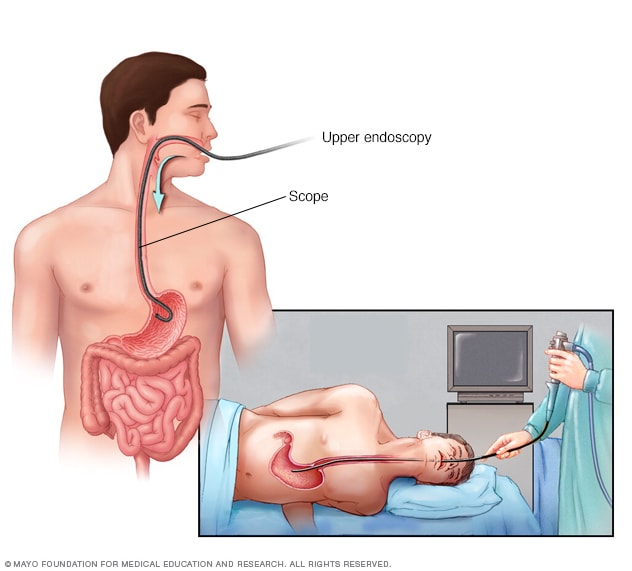
Endoscopy
An endoscopy procedure involves inserting a long, flexible tube called an endoscope down your throat and into your esophagus. A tiny camera on the end of the endoscope allows views of your esophagus, stomach and the beginning of your small intestine, called the duodenum.
An upper endoscopy uses a tiny camera on the end of a flexible tube to visually examine the upper digestive system. A healthcare professional passes the tube down your throat and into your stomach to look for signs of cancer.
Testing lymphoma cells in the lab
Lymphoma cells collected from an endoscopy, lymph node biopsy, or bone marrow aspiration and biopsy go to a lab for testing. In the lab, specialized tests look for specific things about the cells. The healthcare team uses the results to find out the type of lymphoma that you have.
To decide whether the cells are MALT lymphoma cells, the healthcare professionals in the lab look for:
- Proteins on the surfaces of the cancer cells. The cells can be identified by the presence of certain proteins on their surfaces. These proteins are known as markers.
- Changes in the cancer cells' DNA. Cancer happens when cells get changes in their DNA. A cell's DNA holds the instructions that tell a cell what to do. These changes can cause the cancer cells to multiply rapidly.
More Information
Treatment
Not all people with MALT lymphoma need treatment at first. If there are no symptoms, healthcare professionals will typically monitor their patients. MALT lymphoma is often treatable, but it is not always curable. Treating MALT lymphoma depends on its stage, the type and the part of the body where it is located.
In certain MALT lymphoma types, medicine is given to treat the underlying infection. In gastric MALT lymphoma, antibiotic medicine is given to treat the H. pylori infection.
Treatments typically include chemotherapy, immunotherapy, radiation therapy, targeted therapy and bone marrow transplant, also called bone marrow stem cell transplant.
Radiation therapy
Radiation therapy treats cancer with powerful energy beams. For MALT lymphoma, the energy beams are most often X-rays or electrons.
Medicines
Medicines to treat MALT lymphoma include:
- Chemotherapy. Chemotherapy treats cancer with strong medicines. The medicines kill the cancer cells.
- Targeted therapy. Targeted therapy for cancer is a treatment that uses medicines that attack specific chemicals in the cancer cells. By blocking these chemicals, targeted treatments can cause cancer cells to die.
- Immunotherapy. Immunotherapy for cancer is a treatment with medicine that helps the body's immune system kill cancer cells. The immune system fights off diseases by attacking germs and other cells that shouldn't be in the body. Cancer cells survive by hiding from the immune system. Immunotherapy helps the immune system cells find and kill the cancer cells.
Bone marrow transplant
A bone marrow transplant, also called a bone marrow stem cell transplant, involves putting healthy bone marrow stem cells into the body. These cells replace cells hurt by chemotherapy and other treatments. Though not used often, a bone marrow transplant might be used when MALT lymphoma is far along or comes back after other treatments.
More Information
Prognosis
The cancer prognosis tells you how likely it is that the cancer can be treated successfully. Your healthcare team can get a general sense of your outlook based on the stage of the cancer when you were first diagnosed and other factors such as your overall health and the type of treatment you received.
MALT lymphoma usually is a slow-growing lymphoma. It has a better outcome when it is found early.
The five-year survival rate for gastric MALT lymphoma is 93%. The five-year survival rate for nongastric MALT lymphoma is 88%.
The cancer typically gets harder to treat as the stage advances. MALT lymphoma also can be harder to treat if it turns into a more fast-growing type of cancer, such as diffuse large B-cell lymphoma.
Your healthcare team will speak with you about treatment options that will give you the opportunity for a desirable outcome.
Coping and support
Learning that you have MALT lymphoma can be hard. With time, you’ll find ways to cope that work for you.
Learn about MALT lymphoma
Learn enough about your cancer to feel OK making decisions about your treatment and care. Talk with your healthcare team. Ask your care team to recommend good sources to use for more information.
- Find a good listener. Finding someone who is willing to listen to you talk about your hopes and fears can be helpful as you manage a cancer diagnosis. This might be a friend or family member. A counselor, medical social worker or clergy member also may offer helpful guidance and care.
- Join a support group. Ask your healthcare team about local or online groups. Find support online through Mayo Clinic Connect, a community where you can connect with others for support, practical information and answers to everyday questions.
Preparing for your appointment
Start by making an appointment with a doctor or other healthcare professional if you have symptoms that worry you or are not going away.
Here's some information to help you get ready for your appointment.
What you can do
When you make the appointment, ask if there's anything you need to do before you go. For example, you may be told not to eat before you have a certain test. Make a list of:
- Your symptoms, including any that don't seem related to the reason for your appointment, and when they began.
- Key personal information, including major stresses, recent life changes and family medical history.
- All medicines, vitamins and other supplements you take, including doses.
- Questions to ask your healthcare professional.
Bring a family member or friend with you, if possible, to help you remember the information you're given in case you feel overwhelmed at the appointment.
For MALT lymphoma, some basic questions to ask include:
- What's likely causing my symptoms?
- Other than the most likely cause, what are other possible causes for my symptoms?
- What tests do I need?
- What's the best course of action?
- I have other health conditions. How can I best manage them together?
- Are there restrictions I need to follow?
- Should I see a specialist?
- Are there brochures or other printed material I can have? What websites do you suggest?
Be sure to ask any other questions you may have to understand what is ahead.
What to expect from your doctor
Your healthcare professional may ask you questions, such as:
- When did your symptoms first begin?
- Do you have symptoms all the time? Or do they come and go?
- How bad are your symptoms?
- What, if anything, seems to make your symptoms better?
- What, if anything, seems to make your symptoms worse?