Overview
Iritis is inflammation of the colored part of the eye, called the iris, and nearby tissues. Iritis (i-RYE-tis) is the most common type of a condition called uveitis (u-vee-I-tis).
Iritis symptoms often come on suddenly and get worse quickly. The condition can affect one or both eyes. It can affect people of all ages, even children.
Possible causes of iritis include infection, injury or immune system conditions. Often, the cause of iritis is not known. Early diagnosis and treatment are important to prevent vision loss.
Products & Services
Symptoms
Symptoms of iritis often come on suddenly. These may include:
- Eye pain.
- Pain that worsens with bright light or reading.
- Sensitivity to light.
- Decreased vision.
- Eye redness.
- Watery discharge.
Sometimes people feel discomfort or achiness in the affected eye before other symptoms appear.
Sometimes people have very mild symptoms or no symptoms. This happens most often when the condition develops gradually over a long time. This is called chronic iritis.
When to see a doctor
Contact your healthcare team if you think you have symptoms of iritis. You may be referred to an eye specialist, called an ophthalmologist. If you're having severe eye pain and sudden vision problems, get emergency care.
Eye with uvea
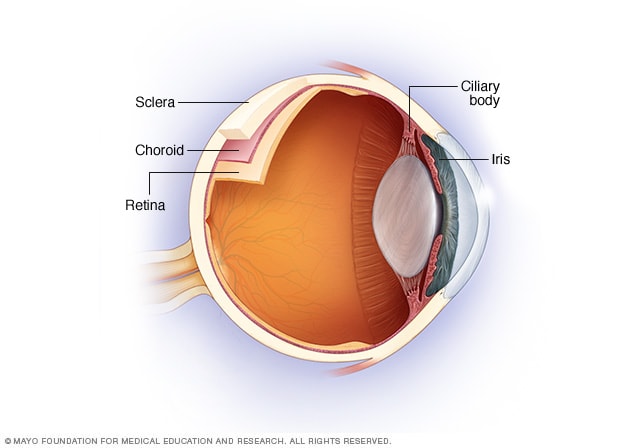
Eye with uvea
The uvea consists of structures of the eye beneath the white of the eye, called the sclera. The uvea has three parts: (1) the iris, which is the colored part of the eye; (2) the ciliary body, which is the structure in the eye that secretes the transparent liquid within the front of the eye; and (3) the choroid, which is the layer of blood vessels between the sclera and the retina.
Causes
Iritis is the most common type of uveitis. Uveitis is a general term for inflammation of the layer of the eye called the uvea (U-vee-uh).
Inflammation is typically the immune system's reaction to disease or injury. An inflammatory reaction increases blood flow, releases proteins that help defend cells and delivers disease-fighting cells.
Inflammation is usually a part of a healing process. But long-term inflammation from untreated disease or injury can damage tissues. Inflammation also can happen when the immune system attacks healthy tissues. This is called an autoimmune disease. All of these factors are possible causes of uveitis.
Uveitis is inflammation in part or all of the uvea. The uvea is the layer of tissue between the white outer part of the eye, called the sclera, and the inner layer of light-sensitive tissue called the retina. The uvea has three parts:
- Iris.
- Ciliary body.
- Choroid.
In iritis, inflammation is mostly in the iris and the front of the ciliary body.
In many cases, the cause of the inflammation cannot be found. There are a number of conditions that can cause iritis.
- Injury to the eye from trauma or surgery can cause inflammation.
- Infections that most often cause iritis include:
- Herpes.
- Chicken pox and shingles.
- Syphilis.
- Lyme disease.
- Bacterial infection after surgery on the eye may cause inflammation.
- Juvenile rheumatoid arthritis is an autoimmune disease that's the most common cause of iritis in children.
- Autoimmune diseases linked to a particular gene may cause iritis. These include diseases of the bones and joints called ankylosing spondylitis and reactive arthritis.
- Sarcoidosis is an autoimmune disease that can cause inflammation throughout the body, including in the eyes.
Risk factors
Infections and autoimmune diseases related to iritis do not always result in the inflammation of the iris, but the chance of developing iritis increases with these diseases.
Smoking may increase the risk of iritis and increase the risk of more-severe disease.
Complications
If not treated, iritis can lead to:
- Cataracts. A cataract is clouding of the lens of the eye. Cataracts can be a complication of iritis or corticosteroid treatment for inflammation.
- Glaucoma. Glaucoma is a type of damage to the optic nerve. This condition can be a complication of iritis or corticosteroid treatment for inflammation.
- An irregular pupil. The inflamed iris can stick to the clear outer covering of the eye, called the cornea. Or it may stick to the capsule holding the eye's lens. This can cause the pupil to lose its typical shape and not adjust to light.
- Calcium deposits on the cornea. Calcium can be deposited on the cornea in a condition called band keratopathy. This complication causes clouding of the corneal tissue and can decrease vision.