Ganglion cyst Symptoms and causes
Overview
A ganglion cyst is a small, round lump filled with a jellylike fluid. It most often forms near a joint or tendon in the wrist or fingers. Ganglion cysts also can occur in ankles, feet and knees. They are not cancer.
Small ganglion cysts can be pea-sized. They can change size. Ganglion cysts can be painful if they press on a nearby nerve. Sometimes they affect joint movement.
If a ganglion cyst is causing symptoms, a healthcare professional might drain the cyst with a needle or remove it with surgery. But if there are no symptoms, no treatment is necessary. Often, the cysts grow and shrink. Some go away on their own.
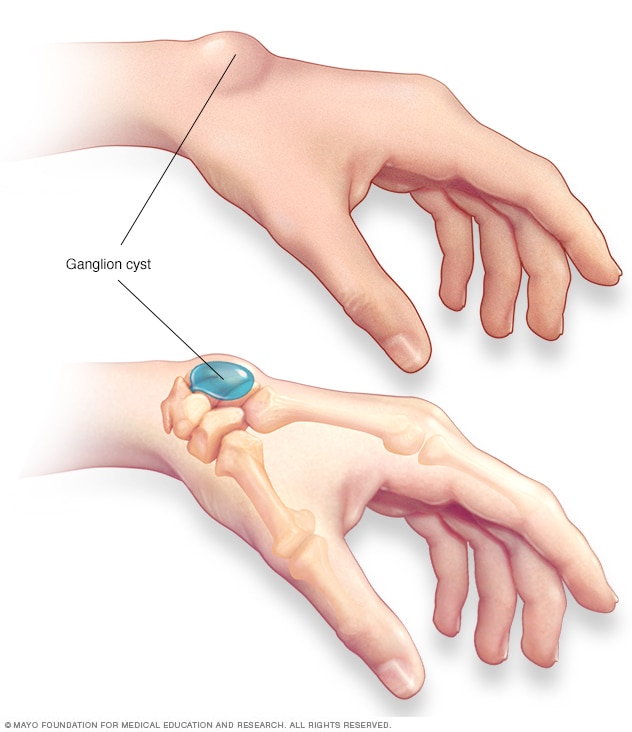
Ganglion cyst
Ganglion cysts are lumps that most commonly develop in the wrist. They're typically round or oval and are filled with a jellylike fluid.
Symptoms
Common symptoms and features of a ganglion cyst are the following:
- It is a small bump or swelling. Ganglion cysts most often develop along the tendons or joints of wrists or hands. The next most common locations are the ankles and feet. These cysts can grow near other joints too.
- The lump may feel firm but movable. Ganglion cysts are usually round or oval. Some are too small to feel.
- It may form near the fingernail. Called a mucous cyst, this type of ganglion cyst can cause the skin to become thin. The cyst may leak fluid if it bursts.
- Size may change. The size of a cyst can change, often getting larger over time. Some people notice that cysts get larger with activity and smaller with rest.
- It is often painless. Ganglion cysts usually do not cause pain. But if a cyst presses on a nerve or other structures, it can cause aching, tingling or weakness.
When to see a doctor
See a healthcare professional if you notice a lump or pain in your wrist, hand, ankle or foot. You can get a diagnosis and find out whether you need treatment.
Causes
No one knows what causes ganglion cysts. They appear to grow from the lining of a joint or tendon. A cyst looks like a tiny water balloon on a stalk. The fluid inside the cyst is similar to typical joint fluid, just thicker, like jelly. Repeated motions may cause ganglion cysts to grow, but most do not come from a single injury.
Risk factors
Factors that may increase the risk of ganglion cysts include:
- Age and sex. Ganglion cysts can develop in anyone, but they most often happen between the ages of 20 and 40 and are more common in women.
- Osteoarthritis. People who have wear-and-tear arthritis in the finger joints closest to the fingernails are at higher risk of having mucous cysts, the type of ganglion cyst that forms near those joints.
- Loose ligaments. People who have loose joints have a higher chance of having ganglion cysts.
From Mayo Clinic to your inbox
Sign up for free and stay up to date on research advancements, health tips, current health topics, and expertise on managing health. Click here for an email preview.
Top ranked in the U.S.
Mayo Clinic in Rochester, Minnesota, Mayo Clinic in Phoenix/Scottsdale, Arizona, and Mayo Clinic in Jacksonville, Florida, are ranked among the Best Hospitals for orthopedics by U.S. News & World Report.
CON-20155452
Mayo Clinic does not endorse companies or products. Advertising revenue supports our not-for-profit mission.
Advertising & Sponsorship
Mayo Clinic Press
Check out these best-sellers and special offers on books and newsletters from Mayo Clinic Press.
