Overview
Dysphagia (dis-FAY-jee-uh) is the medical term for trouble swallowing. You may feel like you're having a hard time getting food sent on its way from the mouth and throat. Or you may feel like food gets stuck on the way down.
Trouble swallowing now and then, such as when you eat too fast or don't chew your food well enough, usually isn't cause for concern. Ongoing dysphagia needs treatment to prevent choking, poor nutrition and other serious complications.
Dysphagia can happen at any age, but it's more common in older adults. The causes of dysphagia vary, and treatment depends on the cause.
Swallowing anatomy
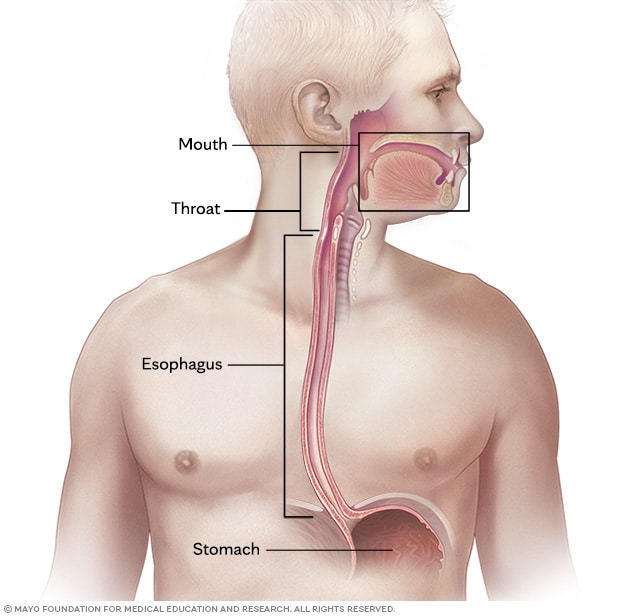
Swallowing anatomy
Swallowing is a complex process involving the nerves and muscles of the mouth, throat and esophagus. Oropharyngeal dysphagia is trouble with the beginning of swallowing — moving food from the mouth to the throat and into the esophagus. Esophageal dysphagia is the result of conditions that narrow the esophagus or limit its ability to move food.
Products & Services
Symptoms
Symptoms of dysphagia can include:
- Needing increased effort to swallow food.
- Pain or discomfort with swallowing.
- Not being able to swallow.
- Feeling as if food is stuck in the throat or chest.
- Drooling or spilling food from the mouth.
- Food or stomach acid backing up into the throat or the nasal passage.
- Coughing or gagging when swallowing.
- Frequent heartburn.
- A hoarse voice.
- Weight loss that happens without trying.
When to see a doctor
See a healthcare professional if you often have trouble swallowing. Also, get medical care if weight loss, regurgitation or vomiting happens with your dysphagia.
If a blockage makes it hard to breathe, call for emergency help immediately. If you can't swallow because you feel that food is stuck in your throat or chest, go to the nearest emergency room.
Causes
Swallowing is a complex process involving the nerves and muscles of the mouth, throat and esophagus (uh-SOF-uh-gus).
During swallowing, the back of the roof of the mouth rises to prevent food in the throat from going up into the nasal passages. A flap in the throat prevents food from going into the airway to the lungs.
The esophagus is the muscular tube that connects the throat and stomach. A muscular ring at the top of the esophagus, called the upper esophageal sphincter, controls the flow of food from the throat to the esophagus. It prevents air from entering the stomach when you aren't eating and prevents contents of the esophagus from backing up into the throat.
The lower esophageal sphincter controls the flow of food from the esophagus to the stomach. It prevents the stomach contents from backing up into the esophagus.
In general, there are two causes of dysphagia:
- Damage to nerves or muscles limits the ability to swallow.
- A physical structure or object limits the passage of food.
There are two general types of dysphagia based on where the trouble with swallowing happens:
- Oropharyngeal (ohr-oh-fuh-RIN-jee-ul) dysphagia.
- Esophageal (uh-sof-uh-JEE-ul) dysphagia.
Oropharyngeal dysphagia
Oropharyngeal dysphagia is trouble with the beginning of swallowing — moving food from the mouth to the throat and into the esophagus. Conditions that cause oropharyngeal dysphagia include:
- Nervous system conditions. Conditions of the brain and nervous system — such as multiple sclerosis, muscular dystrophy and Parkinson's disease — affect the nerves and muscles that control swallowing.
- Nervous system damage. Sudden nervous system damage — such as a stroke or a brain or spinal cord injury — can affect the ability to swallow.
- Past treatments. Treatments for other conditions — such as chemotherapy, surgery or radiation treatment for cancer — may damage nerves or muscles used in swallowing.
- Cancer. Cancerous tumors of the mouth or throat may limit the passage of food.
- Zenker diverticulum. A small pouch of food particles in the throat, called a Zenker diverticulum, can develop and block food from entering the esophagus. It also causes gurgling sounds, bad breath, and repeated throat clearing or coughing.
Esophageal dysphagia
Esophageal dysphagia is trouble swallowing due to conditions in the esophagus. This type of dysphagia often results in the feeling of food sticking or getting caught in the base of the throat or in the chest.
In general, esophageal dysphagia is the result of conditions that narrow the esophagus or limit its ability to move food. Narrowing of the esophagus is called a stricture. Poor movement of food through the esophagus is called a motility disorder. A person may have more than one cause of esophageal dysphagia. These causes include:
- Nervous system conditions. Nervous system conditions, such as Parkinson's disease, or nervous system damage from stroke or trauma can result in poor muscle function in the esophagus.
- Achalasia. Achalasia (ak-uh-LAY-zhuh) is a nerve condition that affects the wave of muscle activity that moves food down the esophagus. Also, the lower esophageal sphincter does not open, stopping passage of food into the stomach. This condition gradually worsens over time.
- Esophageal spasm. With this condition, changes in contraction and relaxation of the esophagus muscles prevent food from moving through the esophagus and into the stomach.
- Gastroesophageal reflux disease (GERD). GERD is the frequent backflow of stomach acid into the esophagus. GERD-related damage to the esophagus causes scar tissue that narrows the passage and limits the movement of food.
- Cancerous tumors. Tumors progressively narrow the esophagus. Trouble swallowing food may worsen to difficulty swallowing liquids.
- Foreign bodies. Sometimes food or another object can partially block the throat or esophagus. Older adults with dentures and people who have difficulty chewing their food may be more likely to have a piece of food become stuck in the throat or esophagus.
- Esophageal ring. An esophageal ring is a ledge of tissue at the lower end of the esophagus that narrows the passageway. It also may be called an esophageal web. There may be multiple causes of this condition. An esophageal ring may sometimes slow the passage of food into the stomach.
- Eosinophilic esophagitis. Eosinophilic esophagitis (e-o-sin-o-FILL-ik uh-sof-uh-JIE-tis) is a disease of the immune system. An increase in white blood cells, called eosinophils, causes inflammation that narrows the esophagus.
- Radiation therapy. This cancer treatment can lead to inflammation and scarring of the esophagus that limits the passage of food.
Risk factors
The following are risk factors for dysphagia:
- Aging. Older adults are at higher risk of having trouble swallowing.
- Certain health conditions. People with certain nervous system conditions, such as stroke and Parkinson's disease, are more likely to have trouble swallowing.
- Cancer treatment. Radiation therapy or head and neck surgery increases the risk of dysphagia.
- Long-term care. The risk of dysphagia is high among people who live in nursing homes or have long hospital stays.
Complications
Trouble swallowing can lead to:
- Malnutrition, weight loss and dehydration. Dysphagia can make it difficult to take in enough food and fluids.
- Aspiration pneumonia. Dysphagia can result in food or water entering the lungs. Aspiration pneumonia is infection in the lungs when food or water introduces bacteria.
- Choking. Food stuck in the throat can cause choking. If food completely blocks the airway, death can occur if action to force out the blockage isn't taken right away.
Prevention
Although you can't prevent dysphagia, you can reduce your risk of sometimes having trouble swallowing by eating slowly and chewing your food well. However, if you have symptoms of dysphagia, see a healthcare professional.
If you have GERD, see a healthcare professional for treatment.