Cervicitis Diagnosis and treatment
Diagnosis
To diagnose cervicitis, your healthcare professional does a physical exam. The exam includes:
- A pelvic exam. Your healthcare professional checks your pelvic organs for swelling and tenderness. An instrument placed in the vagina to hold it open, called a speculum, helps your healthcare professional see the upper, lower and side walls of the vagina and the cervix.
- Getting a sample of fluid. Your healthcare professional uses a small cotton swab or a brush to remove a sample of cervical and vaginal fluid. The sample goes to a lab to test for infections. A sample of your urine also may go to a lab for testing.
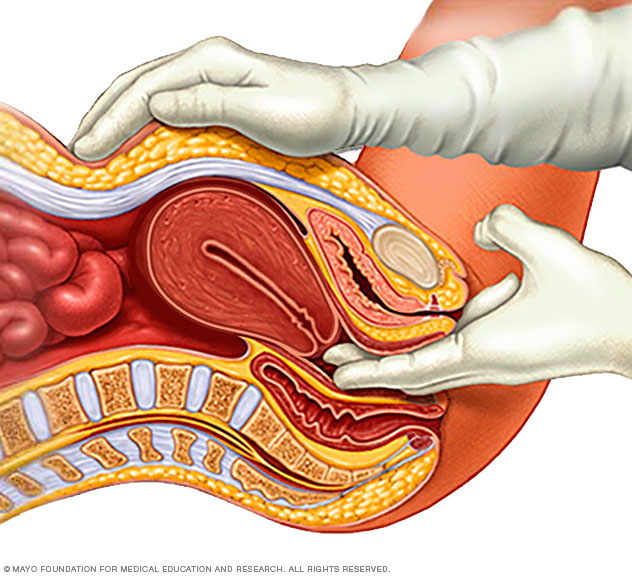
Pelvic exam
During a pelvic exam, a healthcare professional puts two gloved fingers inside the vagina. Pressing down on the belly at the same time, the healthcare professional can check the uterus, ovaries and other pelvic organs.
Treatment
You won't need treatment for cervicitis caused by a reaction to products such as spermicide or feminine hygiene products. Instead, you stop using the product causing the reaction to clear the irritation.
But for cervicitis caused by a sexually transmitted infection (STI), both you and your partner will need treatment, often with antibiotic medicine. Healthcare professionals prescribe antibiotics for STIs such as gonorrhea, chlamydia and trichomoniasis.
Your healthcare professional may offer antiviral medicine if you have genital herpes. This helps cut the time you have cervicitis symptoms. But there is no cure for herpes. Herpes is a long-term condition that you can pass to your sexual partner.
Your healthcare professional also may suggest repeat testing for cervicitis caused by gonorrhea or chlamydia to be sure the infection has cleared.
To keep from passing an infection to your partner, wait to have sex until you complete the treatment your healthcare professional prescribes.
Preparing for your appointment
If you have symptoms of cervicitis, make an appointment with your main healthcare professional or a doctor who specializes in the female reproductive system, called a gynecologist.
Here's some information to help you get ready for your appointment.
What you can do
Take note of:
- Your symptoms and when they began.
- Your sex partners and when you had sex.
- Your allergies.
- All medicines, vitamins and supplements you take, including doses.
- Questions you have.
Some basic questions include:
- How did I get this condition?
- Do I need medicine?
- Is there anything I can get without a prescription to treat my condition?
- Does my partner also need tests or treatment?
- What should I do if my symptoms return after treatment?
- How can I keep from getting cervicitis again?
Be sure to ask all the questions you have.
What to expect from your doctor
Your healthcare professional may ask you questions, such as:
- Are you sexually active?
- Have you or your partner ever had a sexually transmitted infection?
- Do you have pain or bleeding during sex?
- Do you douche or use feminine hygiene products?
- Do you use a birth control method that kills sperm, called spermicide?
- Might you be pregnant?
What to do in the meantime
Until you see your healthcare professional:
- Don't have sex.
- Use pads, not tampons.
- Don't douche.
CON-20370797
Mayo Clinic does not endorse companies or products. Advertising revenue supports our not-for-profit mission.
Advertising & Sponsorship
Mayo Clinic Press
Check out these best-sellers and special offers on books and newsletters from Mayo Clinic Press.
