Overview
Fibrocystic breast changes

Fibrocystic breast changes
Fibrocystic breast changes can cause small, fluid-filled sacs called cysts and areas of thickened breast tissue. These changes can make the breasts tender, and breast tissue may feel lumpy or ropelike.
Fibrocystic breasts are a common condition that causes changes in breast tissue. Fibrocystic breasts are not cancer. The breast changes make breast tissue feel lumpy or like a rope in texture. Healthcare professionals call this nodular or glandular breast tissue.
Many women have fibrocystic breasts. Because this is so common and not an illness, healthcare professionals no longer call it a disease. Instead, they use the terms "fibrocystic breasts" or "fibrocystic breast changes." These changes often happen as part of the menstrual cycle. After a period, the breasts usually feel less lumpy.
Not everyone with fibrocystic breasts has symptoms. Some people feel breast pain or tenderness, which may feel aching or throbbing and last for a short time. The pain is often in the upper, outer part of the breast, where the lumpiness is felt. Symptoms are usually worse before a period and get better afterward. Simple self-care steps can often help ease the discomfort.
Products & Services
Symptoms
Signs and symptoms of fibrocystic breasts may include:
- Breast lumps or areas of thickening that blend into nearby breast tissue.
- Breast pain, tenderness or discomfort in the upper, outer part of the breast that often lasts for a few minutes to an hour. Pain may bother you most during the 5 to 7 days that you have your period.
- Green or dark brown nipple discharge that isn't bloody and that tends to leak without pressure or squeezing.
- Breast changes that are similar in both breasts.
- Breasts feel more lumpy from around the time you ovulate, halfway through the menstrual cycle, to just before your period starts. The lumpiness usually gets better after your period starts.
Fibrocystic breast changes occur most often between 30 and 50 years of age. These changes happen rarely after menopause unless you're using hormone medicine such as estrogen or progesterone.
When to see a doctor
Most fibrocystic breast changes are common and not a cause for concern. But make an appointment with your healthcare professional if:
- You find a new or persistent breast lump or area of breast tissue that suddenly feels very thick or firm and lasts over 2 to 3 menstrual cycles.
- You have specific areas of constant or worsening breast pain that goes on throughout your menstrual cycle.
- Your healthcare professional checked a breast lump, but now the lump seems to be bigger or otherwise different and doesn't go away. The lump may not be painful.
Causes
Breast anatomy
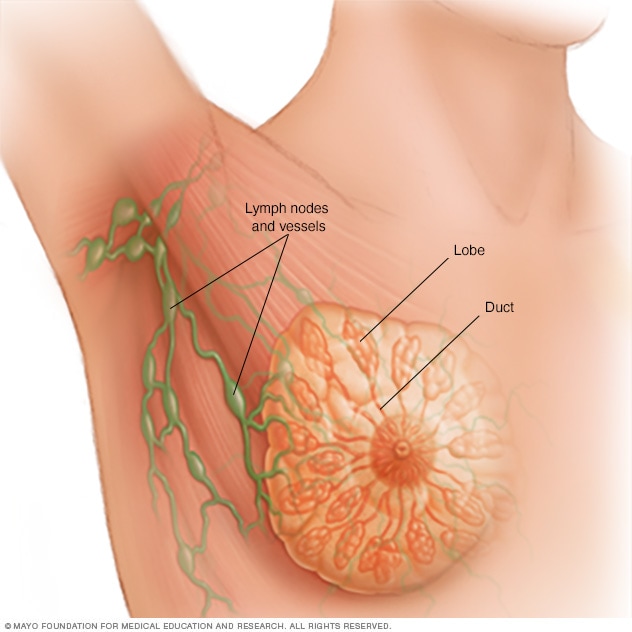
Breast anatomy
Each breast contains 15 to 20 lobes of glandular tissue, arranged like the petals of a daisy. The lobes are further divided into smaller lobules that produce milk for breastfeeding. Small tubes, called ducts, conduct the milk to a reservoir that lies just beneath the nipple.
The exact cause of fibrocystic breast changes isn't known. Experts think that hormone changes, especially changes in estrogen during the menstrual cycle, may play a role.
Hormone changes during the menstrual cycle can cause breast discomfort and areas of breast tissue that feel lumpy, tender, sore or swollen. Fibrocystic breast changes often feel worse before a period and usually get better after the period starts.
When fibrocystic breast tissue is looked at under a microscope, it may show several types of changes, including:
- Small fluid-filled sacs, called cysts.
- Areas of thicker, scarlike fibrous tissue, also called fibrosis.
- Extra growth of cells that usually line the milk ducts or milk-producing areas of the breast, called breast lobules.
- Enlarged breast lobules, a change known as adenosis.
Risk factors
The risk of having fibrocystic breasts is highest among women between 30 and 50 years old. It's rare for people who have gone through menopause to have fibrocystic breast changes, unless they're on hormone therapy. Fibrocystic breast changes are common. Having fibrocystic breasts doesn't typically increase your risk of breast cancer.
Complications
Simple cysts and fibrosis don't raise your risk of breast cancer. However, certain changes such as hyperplasia, where too many cells grow at once, could very slightly raise your breast cancer risk. You may wish to talk with your healthcare professional about your breast changes and possible risks.
Oct. 07, 2026