Urinary diversion
Urinary diversion is surgery that creates a new way to store urine or let urine leave your body.
Your kidneys continue to make urine after urinary diversion. But instead of traveling to your bladder, urine follows a new path.
Where the urine goes depends on the type of urinary diversion. It may drain into a pouch outside your body. Or it may collect inside your body in a pouch you empty with a thin tube called a catheter. Another option uses part of the intestine to make a new bladder.
There isn't one type of urinary diversion that's best for everyone. If you need a permanent diversion after bladder removal, you and your healthcare team can talk about which options may work for you and how each could affect your daily life.
Why urinary diversion is done
Bladder cancer is the most common reason for having a urinary diversion. Some people with bladder cancer need surgery to remove the bladder. This surgery is called a cystectomy. After the bladder is removed, the body needs another way to store urine or carry it out of the body.
Urinary diversion also may be needed for other conditions that damage the bladder or urinary tract or keep urine from draining safely. These may include:
- Nerve damage that affects the bladder, such as from spina bifida, spinal cord injury or multiple sclerosis.
- Long-lasting bladder inflammation or repeated urinary tract infections.
- Trouble fully emptying the bladder. This is called urinary retention.
- Severe loss of bladder control, also called urinary incontinence, that hasn't responded to other treatments.
- Damage to the bladder from radiation therapy.
- Injury to the bladder, urethra or pelvis. The urethra is the tube that carries urine out of the body.
- Tumors that affect the urinary tract or nearby tissues.
- Certain conditions present at birth.
Urinary diversion after bladder removal is permanent because the body needs another way to store urine or allow it to leave the body. In some situations, urinary diversion may be temporary and the bladder isn't removed.
Urinary diversion after bladder removal
When the bladder is removed, urinary diversion is needed to give urine a new way to be stored or leave the body.
Many permanent urinary diversions use part of the intestine. The surgeon separates the part that's needed for urinary diversion and reconnects the remaining intestine so digestion can continue.
What happens next depends on the type of urinary diversion. The surgeon may use the separated intestine to make a path to an opening in the abdomen, make a pouch inside the body or make a new bladder. Urine can then drain from the kidneys into the new path, pouch or bladder.
You may hear several terms related to urinary diversion. Urinary tract diversion is another term for urinary diversion. Urinary intestinal diversion means that part of the intestine is used to create a new path or storage area for urine.
Urinary reconstruction is closely related to urinary diversion. After the bladder is removed, these procedures create a new way to store urine or let it leave the body. They are usually done during the same surgery.
Types of urinary diversion
Several types of urinary diversion can be used after bladder removal. Common options include an ileal conduit, a continent cutaneous urinary diversion and a neobladder. A cutaneous ureterostomy is another type that may be used in some people. Your care team can talk with you about the options that may be possible for you.
One important difference is whether the diversion stores urine or lets it drain out of the body. These types also may be described as continent or incontinent. A continent diversion stores urine inside your body until you empty it. An incontinent diversion lets urine drain continuously.
Here are the main day-to-day differences:
- Ileal conduit. Urine drains by itself through an opening in your abdomen called a stoma. From the stoma, urine drains into a pouch worn outside your body. You empty the pouch as needed.
- Continent cutaneous urinary diversion. Urine is stored in a pouch inside your body. You don't need to wear a pouch outside your body. Instead, you put a thin tube called a catheter through a small stoma in your abdomen at regular times to empty the urine.
- Neobladder. Urine is stored in a new bladder made from part of the intestine. The neobladder connects to your urethra, so urine can leave your body through the urethra. You don't need to wear a pouch outside your body, but you need to learn how to empty the neobladder. Some people also need to use a catheter.
- Cutaneous ureterostomy. One or both ureters are brought directly to a stoma in the abdomen. From there, urine drains continuously into a pouch worn outside your body.
These differences may matter when you're choosing an option. You may want to avoid wearing a pouch outside your body. Or you may prefer an option that doesn't require you to use a catheter regularly. Your health also may limit which options are possible for you.
Ileal conduit
An ileal conduit is the most common type of urinary diversion used when the bladder is removed. It is an incontinent urinary diversion, which means urine drains by itself into a pouch worn outside your body.
To create an ileal conduit, the surgeon separates a short section of the ileum, which is part of the small intestine. The ureters, which are the tubes that carry urine from the kidneys, are connected to this section. The other end is brought through the wall of the abdomen to create an opening called a stoma.
Urine travels from the kidneys through the ureters and ileal conduit and then out through the stoma. A urostomy pouch worn over the stoma collects urine.
An ileal conduit also is a type of urostomy. This means that urine drains through a stoma in the abdomen. Not all urinary diversions are urostomies. For example, a neobladder connects to the urethra instead of a stoma.
With an ileal conduit, you need to wear and care for a pouch outside your body. But you don't need to use a catheter regularly to empty a pouch inside your body. Ileal conduit surgery also tends to be less complex than surgery to create a continent diversion.
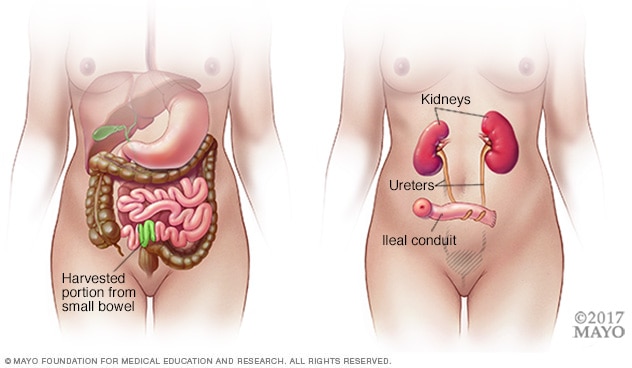
Ileal conduit
During an ileal conduit procedure, a surgeon makes a new tube from a piece of intestine. The tube allows the kidneys to drain and urine to exit the body through a small opening called a stoma.
Continent cutaneous urinary diversion
With a continent cutaneous urinary diversion, a surgeon uses part of the intestine to make a pouch inside your body that stores urine. The ureters are connected to the pouch. A narrow channel connects the pouch to a small stoma in your abdomen.
Urine stays in the pouch inside your body until you empty it. To do this, you put a catheter through the stoma at regular times to drain the urine.
An Indiana pouch is one type of continent cutaneous urinary diversion. The surgeon uses parts of the large and small intestine to make the pouch. The pouch is made to help keep urine from leaking through the stoma.
Because the pouch is made from intestine, it also makes mucus. You may need to regularly rinse the pouch with fluid to clear out the mucus. This is called irrigation.
With this option, you don't need to wear a pouch outside your body. But you need to be willing and able to use a catheter regularly to empty the pouch. Issues with the stoma or catheter channel can occur.
Neobladder
A neobladder, also called an orthotopic neobladder or bladder substitute, is a new bladder made from part of the intestine. The ureters are connected to the neobladder, which connects to the urethra. This lets urine leave your body through the urethra instead of through a stoma in the abdomen.
A neobladder doesn't work exactly like the bladder you were born with. After surgery, you need to learn a new way to empty it. This may include urinating on a schedule and using methods your care team teaches you to help empty the neobladder.
Some people can't fully empty a neobladder on their own and need to use a catheter to drain the urine that's left. Urine leakage also can happen, especially at night. Urine control may improve as you recover and learn to use the neobladder.
A neobladder isn't an option for everyone. Your healthcare team can help determine whether it's an option for you.
Cutaneous ureterostomy
With a cutaneous ureterostomy, one or both ureters are brought directly through the wall of the abdomen to create a stoma. Urine drains by itself through the stoma into a urostomy pouch worn outside your body. Unlike an ileal conduit, this type of diversion doesn't use a section of intestine to carry urine.
A cutaneous ureterostomy is a relatively simple type of urinary diversion and may involve less surgery than an ileal conduit. It may be considered for some people who are frail or who have other health factors that make a shorter or less complex operation preferable.
One drawback is that the opening where the ureter reaches the skin can narrow. Some people need a stent to help keep the ureter open. Urinary tract infections and kidney complications also can occur.
With a cutaneous ureterostomy, you need to wear and care for a urostomy pouch and the skin around the stoma.
How you and your care team choose a urinary diversion
Choosing a urinary diversion is both a medical decision and a personal decision. First, your healthcare team decides which options are medically possible for you. Then you can think about how the day-to-day differences fit your life and what matters to you.
The choice may depend on:
- Where the cancer is and how far it has spread if your bladder needs to be removed because of cancer.
- The condition of your urethra.
- Surgery or radiation therapy you've had in the past.
- How well your kidneys and liver work.
- The health of your intestines and how much intestine can be used for urinary diversion.
- Other medical conditions.
- Your ability to move and use your hands for daily care.
- Your ability and willingness to use a catheter if needed.
- Your daily life and what matters to you.
- Your surgeon's experience with the different types of diversion.
Not everyone can have a neobladder. How well your kidneys and liver work, the condition of your urethra, how much intestine can be used, and your ability to care for the neobladder after surgery can affect whether it's an option. A neobladder generally isn't used if cancer involves the outer edge of your urethra.
There isn't clear evidence that one option gives everyone a better quality of life. Research suggests that each type has different benefits and drawbacks, and the best fit depends partly on what matters to you. Learning about your options before surgery also may help reduce regret about your decision later.
You may want to ask your care team:
- Which urinary diversion options are medically possible for me, and why?
- What are the main benefits and drawbacks of each option for someone in my situation?
- Will I need to wear a pouch outside my body or use a catheter?
- What will I need to learn, and what daily care will I need for each option?
- How might each option affect urine control, sleep and my usual activities?
- How could surgery affect my body image and sexual function?
- Which complications are most important for me to know about?
- How often do you perform each type of urinary diversion?
- Could anything you find during surgery change which type of urinary diversion I receive? (3p27)
- Who will teach me how to care for my diversion after surgery?
Risks and complications
Urinary diversion is major surgery. Complications can develop soon after surgery or years later. Your risks depend on the type of urinary diversion, your overall health and other factors.
Possible complications include:
- Surgical complications, such as infection, bleeding, bowel complications and urine leakage.
- Urinary tract and kidney complications, such as blockage or narrowing where the ureters join the intestine, urinary tract infections, urinary stones, and changes in how well the kidneys work.
- Stoma and pouch complications in diversions that use a stoma in the abdomen. Complications can include skin irritation, narrowing or retraction of the stoma, a hernia next to the stoma, and urine leakage.
- Trouble emptying a continent diversion. A continent cutaneous diversion can develop narrowing that makes it hard to use a catheter. Some people with a neobladder have trouble emptying it and need to use a catheter.
- Changes in body chemistry. Using part of the intestine to store or carry urine can change the balance of certain substances in your body. These changes are called metabolic complications.
- Vitamin B-12 deficiency. Vitamin B-12 levels can become too low in some people when part of the ileum is used during surgery. Your care team may need to check your vitamin B-12 level over time.
- Urinary incontinence. Some people with a neobladder experience urine leakage, especially at night.
All types of urinary diversion have some long-term risks. Regular follow-up helps your care team check how well your kidneys are working and watch for complications over time.
Recovery after urinary diversion surgery
Recovery depends on the reason for surgery and the type of urinary diversion. After bladder removal and permanent urinary diversion, your body needs time to heal from surgery. You'll also need time to learn how your new urinary diversion works and how to care for it.
Your care team begins teaching you how to manage your diversion before you leave the hospital. What you need to learn depends on the type you have.
Temporary ureteral stents are thin tubes that may be used around the time of surgery to help keep urine flowing. Whether you need stents and when they are removed depends on your surgery and surgeon.
You'll slowly become more active as you regain strength. Walking soon after surgery is encouraged as part of recovery. Heavy lifting and some vigorous activities need to wait while your body heals. Your care team can tell you when it's safe to return to specific activities.
You'll slowly return to eating and drinking as your intestines recover after surgery. Most people return to their usual diet over time. Your care team may give you specific instructions based on your surgery and health.
Recovery also means getting used to a new way of urinating. Some people also need time to adjust to changes in body image or sexual function.
Living with a urinary diversion
Living with a urinary diversion means getting used to a new way of urinating. The daily care you need depends on the type of urinary diversion you have.
With an ileal conduit, you'll learn how to empty and change the urostomy pouch and care for the stoma and skin around it. Because urine drains by itself, you also may use a drainage system at night.
With a continent cutaneous diversion, you'll need to put a catheter through the stoma at regular times to empty the pouch inside your body. You'll also learn to care for the stoma. Because the pouch is made from intestine, it makes mucus. You may need to rinse the pouch as your care team instructs.
With a neobladder, you'll learn to empty it on a schedule and use methods your care team teaches you to help empty it fully. Some people need to use a catheter. You also may need to manage mucus and urine leakage, especially during recovery and at night.
With a cutaneous ureterostomy, you'll learn how to empty and change the urostomy pouch and care for the stoma and surrounding skin.
Having a urinary diversion doesn't mean you have to give up the activities that matter to you. After recovery, when your care team says it's safe, most people can return to many of their usual activities, including work, exercise, swimming and travel.
Getting used to life with a urinary diversion can take time. It may affect how you feel about your body, relationships or sexual activity. Many people continue to have satisfying relationships. Your care team can help if you have concerns about sexual function, intimacy or changes in how you feel about your body.
The options differ in the surgeries involved, urine control and daily care. Learning about these differences before surgery can help you and your care team choose a urinary diversion that fits your health needs and what matters to you.
