Overview
Barrett's esophagus
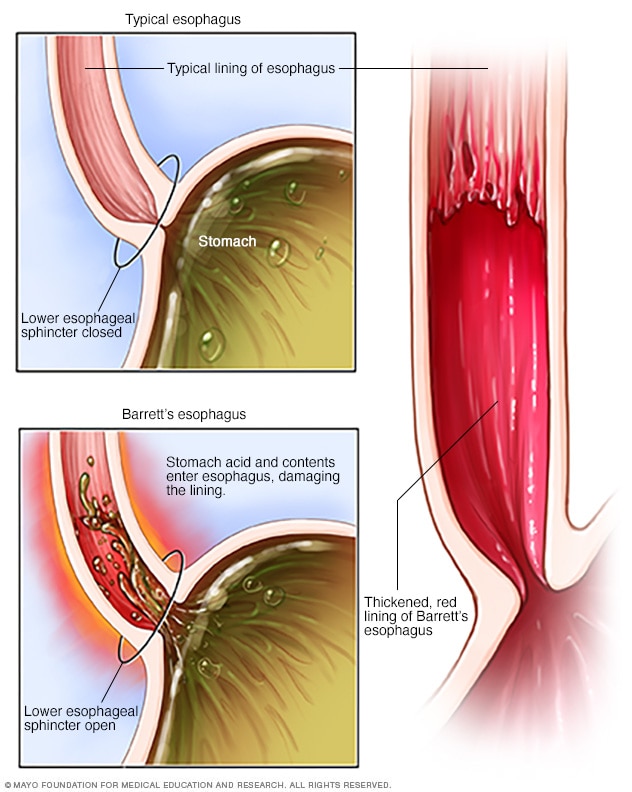
Barrett's esophagus
In Barrett's esophagus, the typically pink, smooth lining of the esophagus is replaced with thick, red tissue, likely triggered by long-standing gastroesophageal reflux disease (GERD).
Barrett's esophagus is a condition in which the lining of the tube between the mouth and stomach changes due to repeated backflow of stomach acid. This process is known as acid reflux.
The esophagus (uh-SOF-uh-gus) has a valve at its lower end that typically helps keep stomach contents from flowing upward. When this valve weakens or does not function as intended, stomach contents, including acid, can move back into the esophagus.
Unlike the stomach, the esophagus is not designed to tolerate repeated exposure to acid. Over time, this ongoing irritation can damage the esophageal lining and prompt it to change into a different type of tissue. The typically smooth, pink lining becomes thick and red.
Barrett's esophagus increases the risk of developing a rare form of cancer called esophageal adenocarcinoma. Because of this increased risk, people with Barrett's esophagus are often monitored with regular screening exams.
Treatments for Barrett's esophagus include medicines to reduce stomach acids, changes in diet and lifestyle, and procedures that remove or treat the altered tissue in the esophagus.
Symptoms
Barrett's esophagus doesn't itself have symptoms. But people with Barrett's esophagus may experience the symptoms of the condition that likely triggers it.
Gastroesophageal reflux, also called acid reflux, is the backflow of acid and other contents of the stomach into the esophagus. When symptoms are serious and long-lasting, the condition is called gastroesophageal reflux disease (GERD). GERD may trigger changes to the lining of the esophagus seen in Barrett's esophagus.
Symptoms of GERD include frequent episodes of:
- A burning sensation in your chest, called heartburn.
- Bitter or sour tasting fluid that travels up the esophagus to the mouth.
- Pain in the chest or below the chest.
- Trouble swallowing.
Nearly half of people diagnosed with Barrett's esophagus report that they haven't had heartburn or other symptoms of GERD.
When to see a doctor
If you often have episodes of acid reflux or a diagnosis of GERD, talk to your healthcare professional about screening for Barrett's esophagus.
Seek immediate help if you experience:
- Chest pain, which may be a symptom of a heart attack.
- Difficulty swallowing.
- Weight loss that isn't intended.
- Vomit that contains blood, looks yellow or green, or looks like coffee grounds.
- Black, tarry or bloody stools.
Causes
The cause of Barrett's esophagus is related to the backflow of stomach contents into the esophagus. Between the esophagus and the stomach is a valve called the lower esophageal sphincter. Typically, this valve opens to allow food and drink to move from the esophagus to the stomach. The valve then closes to keep acids and other things that help digest food in the stomach.
The valve may weaken or fail to work properly. When this happens, the stomach contents can flow in the wrong direction into the esophagus. For reasons that are not clear, the cells of the tissue lining the esophagus change. The result is a tissue not typically found in the esophagus, and it looks more like the tissue lining the small intestine.
Risk factors
The risk of Barrett's esophagus is linked to the following factors:
- Family history. A family history of Barrett's esophagus increases the risk of the condition.
- Sex. Men are far more likely to develop Barrett's esophagus than women.
- Race. People who are white have a greater risk of Barrett's esophagus.
- Age. Barrett's esophagus is more common in adults over 50.
- GERD. GERD — especially when it isn't treated, requires long-term treatment or doesn't get better with treatment — increases the risk of Barrett's esophagus.
- Smoking. Current or past smoking is linked to a higher risk.
- Weight. Being overweight, especially having extra weight around the belly, is a risk factor.
Complications
Esophageal cancer
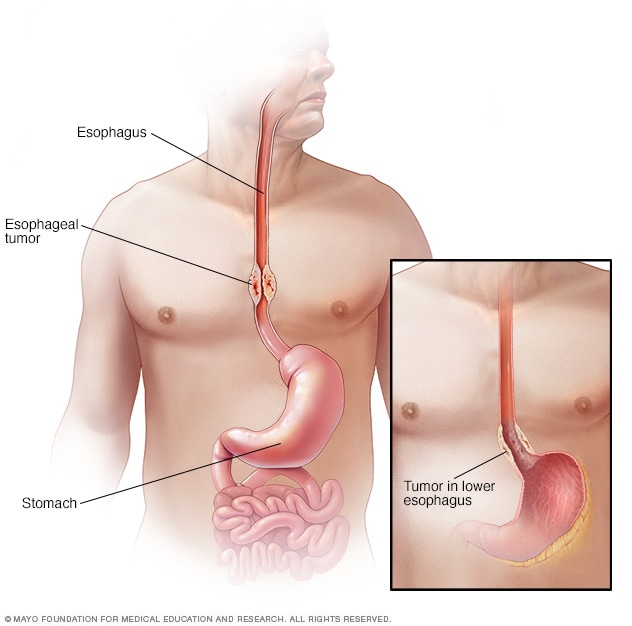
Esophageal cancer
Esophageal cancer most often occurs in the cells that line the inside of the esophagus.
People with Barrett's esophagus have an increased risk of developing a rare type of esophageal cancer called esophageal adenocarcinoma. Screening for cancer is a regular part of Barrett's esophagus care.
Oct. 07, 2026