Overview
Coronary artery bypass surgery is a type of heart surgery. It creates a new path for blood to go around a blocked or partly blocked heart artery due to coronary artery disease. A surgeon uses a healthy blood vessel from another part of the body to make the new path, called a bypass graft. This helps more blood reach the heart muscle.
Other names for this surgery include:
- Coronary artery bypass grafting.
- Coronary artery bypass graft surgery.
- CABG — pronounced "cabbage."
- Heart bypass surgery.
Coronary artery bypass surgery doesn't cure the coronary artery disease that caused the blockage. But it can ease symptoms such as chest pain and shortness of breath. For some people, CABG also may lower the risk of death from coronary artery disease.
Coronary artery bypass surgery
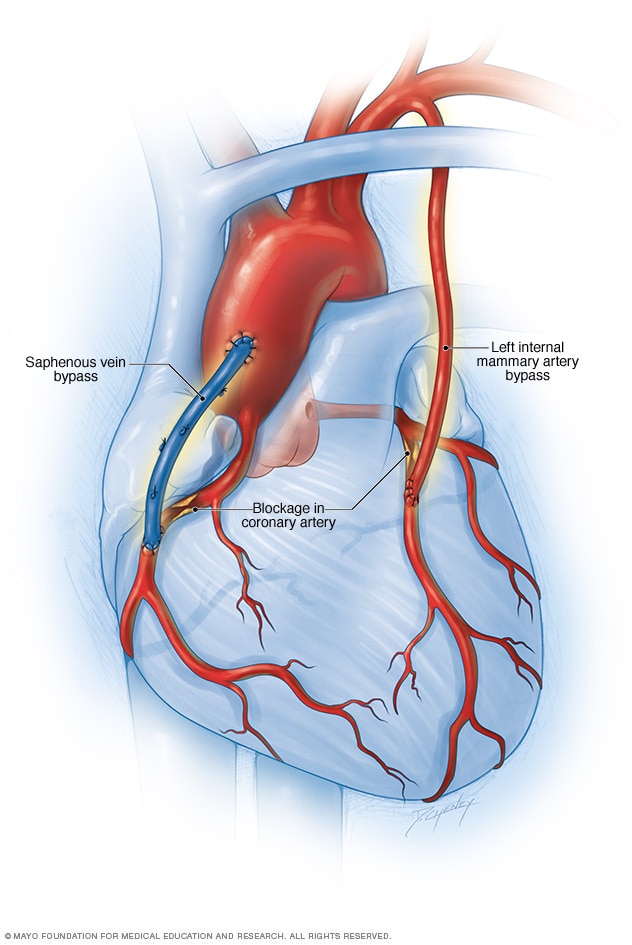
Coronary artery bypass surgery
Coronary artery bypass surgery creates a new path for blood to flow to the heart. A healthy blood vessel from another part of the body is used to send blood around a blocked area of an artery. The blood vessel usually comes from an artery in the chest, called the internal mammary artery. Sometimes it's taken from a leg vein, called the saphenous vein.
Types
There are different types of coronary artery bypass surgery, also called coronary artery bypass grafting (CABG). The type is described by how the surgery is done.
- On-pump coronary bypass. During this type of CABG, a heart-lung machine keeps blood and oxygen flowing through your body. On-pump surgery is the most common way to do CABG.
- Off-pump coronary bypass. In this type of CABG, a heart-lung machine is not used during heart bypass surgery. This surgery can be hard to do because the rest of the heart is still moving.
- Minimally invasive coronary artery bypass surgery. This surgery also may be called port-access or keyhole bypass surgery. A surgeon does the surgery through small cuts in the chest.
- Total endoscopic coronary artery bypass (TECAB). This is a type of robot-assisted heart surgery. It is available mainly at medical centers with teams experienced in robotic heart surgery.
Hello, this is Yazan Al-Jamal, a cardiovascular surgeon at Mayo Clinic. My interest is robotic cardiac surgery, with my main focus is robotic revascularization or coronary bypass surgery.
Coronary artery disease remains one of the leading causes of death worldwide, but the way we treat it is rapidly evolving.
Traditionally, this required opening the chest through the breastbone and performing coronary artery bypass surgery. This can increase recovery time and the risk of complications.
But today, we have a less invasive and more precise option. Total endoscopic coronary artery bypass, or T-CAB, is a completely closed -chest robotic -assisted procedure.
Using advanced robotic technology, we perform the operation through small keyhole incision without opening the breastbone.
The robotic system allows us to harvest arteries and perform a precise coronary bypass with excellent visualization and control.
The surgeon operates from a console using a high-definition three-dimensional view. The instruments move like the human hand, but with a greater precision and stability.
This level of precision is especially important when working in very small coronary vessels.
These arteries are delicate and even small movement matter. The robot system allows control, steady motion beyond what the human hand alone can provide. This helps us create very precise connections between the graft and the coronary artery.
With better visualization and control, we can work safely in tight spaces inside the chest.
For patients, this means real benefits. Smaller incision, less pain, faster recovery, and shorter hospital stay. And in many cases, we avoid opening the breastbone completely.
Most patients return to the normal activity within weeks instead of months.
This approach is a major step forward in heart surgery.
It combines surgical experience with advanced technology to improve patient outcomes.
Our goal is simple, to provide safer, less invasive, and more effective treatment for patients with coronary artery disease.
Products & Services
Why it's done
Coronary artery bypass surgery, also called coronary artery bypass grafting (CABG), is done to improve blood flow around a blocked heart artery.
CABG may be done as an emergency treatment for a heart attack when a procedure called coronary angioplasty and stenting can't be done or doesn't work. Coronary angioplasty and stenting also is called percutaneous coronary intervention (PCI). It uses a thin, soft tube called a catheter to open a narrowed or blocked artery. Usually, a mesh tube called a stent is used to keep the artery open.
Your healthcare professional also might recommend CABG if you have:
- A blockage in the left main heart artery. This artery sends a lot of blood to the heart muscle.
- Severe chest pain from more than one heart artery that is narrowed.
- More than one diseased heart artery and your lower left heart chamber doesn't work well.
- An artery that gets narrow again after angioplasty with or without stenting.
In general, the way a blocked heart artery is treated depends on many things. These include:
- How many blocked arteries you have.
- Where and how complex the blockages are.
- How serious the symptoms are.
- How your heart is working.
- Your overall health and whether you have other health conditions.
- Whether past treatments worked.
Together, you and your healthcare team decide whether CABG or coronary angioplasty and stenting is right for you.
Risks
Coronary artery bypass surgery, also called coronary artery bypass grafting, is heart surgery. All surgeries have some risks. Possible complications of coronary artery bypass surgery are:
- Bleeding.
- Heart attack due to a blood clot after surgery.
- Infection at the site of the chest wound.
- Need for a breathing machine for longer than expected.
- Irregular heartbeats, called arrhythmias.
- Kidney injury or failure.
- Memory loss or trouble thinking clearly.
- Stroke.
The risk of complications is higher if the surgery is done as an emergency treatment. Your risk of complications also depends on your health before surgery. These health conditions may make complications more likely:
- Blocked arteries in the legs.
- Chronic obstructive pulmonary disease (COPD).
- Diabetes.
- Kidney disease.
Your risk of complications also may depend on:
- Whether you smoke. Smoking can slow healing after surgery and raise the risk of infection and other complications.
- Your overall strength before surgery. A low level of strength is sometimes called frailty.
Before surgery, your healthcare professional may give you medicines to lower the risk of bleeding and infection. You also may get medicines to help control your heartbeat and blood pressure. If you have diabetes, you may get medicine to control blood sugar during surgery.
How you prepare
Your healthcare team tells you how to get ready for coronary artery bypass surgery. You may need to change your activities, diet or medicines. If you smoke, stop. The care team tells you when to stop smoking. Plan to have someone drive you home after your hospital stay. Also plan to have help at home during your recovery.
If coronary artery bypass surgery is done as an emergency treatment, you may not have time to prepare.
What you can expect
Before the procedure
If coronary artery bypass surgery, also called coronary artery bypass grafting (CABG), is a scheduled procedure, you are usually admitted to the hospital the day of the surgery. You may have heart tests and blood tests before surgery. Your healthcare team also reviews the medicines that you take.
During the procedure
Coronary artery bypass surgery is major surgery and is done in a hospital. Doctors trained in heart surgery, called cardiovascular surgeons, do the surgery. Heart doctors, called cardiologists, and other healthcare professionals help care for you.
When you are in the operating room, you can expect these things:
- Medicines. You get a combination of medicines through an IV and a face mask. These medicines put you in a pain-free, sleeplike state. This is called general anesthesia.
- Breathing tube and machine. A healthcare professional puts a breathing tube into your mouth. This tube connects to a machine called a ventilator. The machine breathes for you during and right after surgery.
On-pump coronary artery bypass surgery is the most common way to do CABG. To do that type of CABG, a surgeon makes a long cut down the center of the chest along the breastbone. The surgeon opens the rib cage to reach the heart. After the chest is opened, medicine is used to temporarily stop the heart. A heart-lung machine keeps blood and oxygen flowing through your body during the surgery.
In all types of CABG, the surgeon takes a part of a healthy blood vessel, often from inside the chest wall or from the lower leg. This piece of healthy blood vessel is called a graft. The surgeon attaches the graft above and below the blocked heart artery. The graft creates a new path for blood to flow around a blockage.
More than one graft may be needed. The surgery often is described by the number of bypass grafts used.
- Single bypass. One bypass graft is created.
- Double bypass. Two bypass grafts are created.
- Triple bypass. Three bypass grafts are created.
- Quadruple bypass. Four bypass grafts are created.
- Quintuple bypass. Five bypass grafts are created.
The number of bypass grafts doesn't tell you how serious the surgery is. It tells you how many grafts are needed to improve blood flow. Your surgeon chooses the number of grafts and where to place them. This depends on your heart structure and which coronary arteries are narrowed or blocked.
After the grafts are in place, the healthcare team restarts your heart in the operating room and takes you off the heart-lung machine. The surgeon closes your chest bone with wire.
How long coronary artery bypass surgery takes can vary. It depends on how many arteries are blocked. But it usually takes about 3 to 6 hours.
After the procedure
After coronary artery bypass surgery, your healthcare team checks on you and makes sure you are as comfortable as possible. A breathing tube stays in your throat until you wake up and can breathe on your own. You may feel sore and confused when you wake up. You can usually expect the following:
- Breathing tube. A breathing tube stays in your throat until you wake up and can breathe on your own.
- Hospital stay. Plan to spend 1 to 2 days in a hospital intensive care unit. How long you stay in the hospital depends on your recovery and if you have complications. Some people go home within a week after coronary artery bypass surgery.
- Heartbeat and breathing checks. Your healthcare team watches you closely after surgery to check for complications and to take your temperature. Machines record your breathing, blood pressure and heartbeat.
- Medicines. You get medicines to ease pain and prevent complications such as blood clots. If you don't already take a daily aspirin, your healthcare professional may recommend you do so. You may need to take the aspirin every day for life. Aspirin therapy is not right for everyone. Talk with your healthcare professional about aspirin use.
- Movement and cardiac rehabilitation. Your care team usually asks you to move and walk while you are still in the hospital. Your healthcare professional may suggest a program of education, counseling and exercise called cardiac rehabilitation. It helps improve heart health after heart surgery. It is an important part of recovery for many people. After you leave the hospital, you may go to cardiac rehab at an outpatient medical center. Later, you may follow a program at home when it is safe.
After surgery and when you're at home, it's common to feel tired and sore while your body heals. Follow your healthcare team's instructions for caring for your wounds, taking medicines and slowly increasing activity. If your breastbone was opened during surgery, you may be told not to do some activities while it heals.
There is no week-by-week timeline for going back to activities after coronary artery bypass surgery.
Your healthcare team tells you when it is safe to drive, work, exercise or have sex. This depends on your surgery, your recovery and how much effort each activity takes.
It usually takes about 6 to 12 weeks to get better after coronary artery bypass surgery. But it depends on how the surgery is done. It also depends on your health before surgery and whether you have complications. Recovery is different for everyone. Talk with your healthcare team about what you might expect.
Results
Coronary artery bypass surgery, also called coronary artery bypass grafting (CABG), can improve blood flow to the heart. It can ease symptoms and help some people live longer.
But coronary artery bypass surgery results and long-term outcomes are different for everyone. They depend on:
- Age.
- How well the heart works.
- How much coronary artery disease there is.
- How well other conditions such as high blood pressure and diabetes are controlled.
- Whether you smoke.
- Whether surgery was planned or done as an emergency.
After CABG, the graft or other arteries may become clogged in the future. If this happens, you might need another surgery or procedure. Your healthcare team talks with you before and after surgery to help you understand your results and outlook.
Protecting your heart
Your care team may ask you to make lifestyle changes to protect your heart. Try these tips:
- Don't smoke. Not smoking is one of the best things you can do for your heart. If you need help quitting, talk with your healthcare team.
- Stay as active as safely possible. Regular exercise can help you manage diabetes, high cholesterol and high blood pressure. Talk with your healthcare team about the types of sports and activities that are safe for you after coronary artery bypass surgery.
- Manage weight. Being overweight raises the risk of heart disease. Ask your healthcare professional what a healthy weight is for you.
- Eat healthy foods. Choose plenty of fruits, vegetables and whole grains. Eat less sugar, salt, and saturated and trans fats.
- Manage blood pressure, cholesterol and blood sugar. Ask your healthcare team how often you need checkups.
- Manage stress. Find ways to help lower emotional stress. Practicing mindfulness and connecting with others in support groups might be helpful. If you have anxiety or depression, talk with your healthcare team about strategies to help.
- Get good sleep. Poor sleep may raise the risk of heart disease and other long-lasting conditions. Adults should try to get 7 to 9 hours of sleep daily.
Also take medicines as directed. Follow your heart disease treatment plan and your healthcare team's advice.
Clinical trials
Explore Mayo Clinic studies of tests and procedures to help prevent, detect, treat or manage conditions.
Oct. 07, 2026