Overview
If you swallow a foreign object, it usually will pass through your system without notice. But some objects can get stuck in the tube that connects the mouth and stomach, called the esophagus. Or they can block the airway and cause choking.
Give first aid as quickly as possible if you or someone else is choking. To prepare yourself for these situations, learn the Heimlich maneuver and CPR in a certified first-aid training course.
When to seek emergency help
If you're the only rescuer for someone who's choking, give back blows and abdominal thrusts first. Then call 911 or your local emergency number for help. If another person is there, have that person call for help while you give first aid.
If you're alone and choking, call 911 or your local emergency number right away. Then give yourself abdominal thrusts, also called the Heimlich maneuver, to remove the stuck object.
If the object is stuck in your esophagus, you may need to have it removed by your health care professional. Also see your healthcare professional right away for a swallowed object that is:
- Sharp or pointed. These objects can damage the esophagus.
- A button battery. Batteries can cause severe burns and permanent damage if not removed quickly.
- A magnet. Magnets can pull, press or wear holes through the intestines. It's especially risky if you swallow more than one.
Symptoms
If an object is stuck in your esophagus, symptoms might include:
- Pain from the throat down the middle of the chest.
- Food or drink coming back up.
Treatment
First aid for a choking person
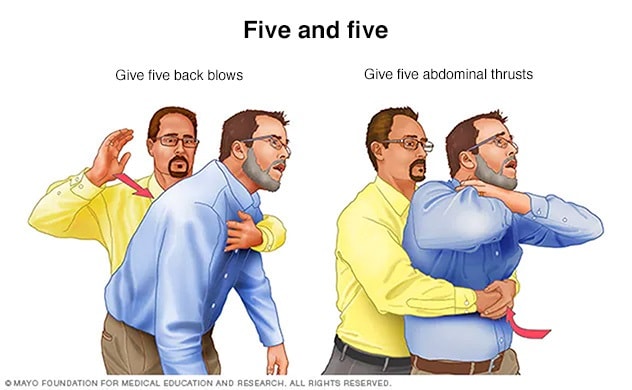
First aid for a choking person
If a person is choking and cannot talk, cry or laugh forcefully, the American Red Cross recommends this approach to delivering first aid.
How to perform abdominal thrusts, also called the Heimlich maneuver, on yourself
How to perform abdominal thrusts, also called the Heimlich maneuver, on yourself
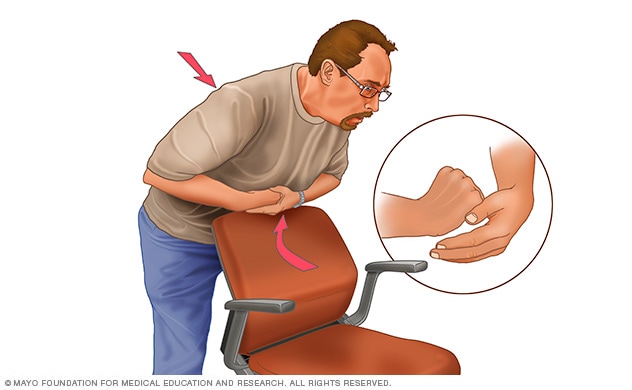
How to perform abdominal thrusts, also called the Heimlich maneuver, on yourself
To perform abdominal thrusts, also called the Heimlich maneuver, on yourself, place a fist slightly above your navel. Grasp your fist with the other hand and bend over a hard surface. Shove your fist inward and upward.
Child and adult
If you have food stuck in the esophagus, you can try to drink a carbonated beverage to see if that will help it pass.
If an object blocks the airway and causes choking, give first aid.
If a choking person can cough forcefully, let the person keep coughing. Coughing might naturally remove the stuck object.
If a person can't cough, talk, cry or laugh forcefully, give first aid to the person. The American Red Cross recommends the following steps:
- Give five back blows. Stand to the side and just behind a choking adult. For a child, kneel down behind. Place your arm across the person's chest to support the person's body. Bend the person over at the waist to face the ground. Strike five separate times between the person's shoulder blades with the heel of your hand.
- Give five abdominal thrusts. If back blows don't remove the stuck object, give five abdominal thrusts, also known as the Heimlich maneuver.
- Alternate between five blows and five thrusts until the blockage is dislodged.
If you're the only rescuer for someone who's choking, give back blows and abdominal thrusts first. Then call 911 or your local emergency number for help. If another person is there, have that person call for help while you give first aid.
Some first-aid sources only teach the abdominal thrust. It's OK not to use back blows if you haven't learned the back-blow technique. Both approaches are acceptable for adults and children older than age 1.
To give abdominal thrusts to someone else:
- Stand behind the person. For a child, kneel down behind. Place one foot slightly in front of the other for balance. Wrap your arms around the waist. Tip the person forward slightly.
- Make a fist with one hand. Put it just above the person's navel.
- Grasp the fist with the other hand. Press into the stomach, also called the abdomen, with a quick, upward thrust — as if trying to lift the person up. For a child, use gentle yet firm pressure to avoid damaging the internal organs.
- Give five abdominal thrusts. Check to see if the blockage has been removed. Repeat as needed.
If you're the only rescuer, give back blows and abdominal thrusts first. Then call 911 or your local emergency number for help. If another person is there, have that person call for help while you give first aid.
To clear the airway of an unconscious person:
- Lower the person onto the floor. Keep the person's back on the floor and arms to the sides.
- Clear the airway. If you can see the object, reach a finger into the mouth to sweep out the object. Never sweep with your finger if you can't see the object because this may push the blockage deeper into the airway. This is an especially high risk with young children.
- Begin CPR if the person still doesn't respond. If the airway is still blocked, use chest compressions such as those that are used in CPR to remove the stuck object. If the airway is clear and you give rescue breaths, only use two rescue breaths a cycle. Recheck the mouth regularly for the object.
Pregnant person or someone you can't get your arms around
If the person is pregnant or if you can't get your arms around the stomach, give chest thrusts:
- Put your hands on the chest. Place them at the base of the breastbone, just above the joining of the lowest ribs.
- Press hard into the chest with a quick thrust. This is the same action as the Heimlich maneuver.
- Repeat until the blockage is removed from the airway.
Yourself
If you're alone and choking:
Call 911 or your local emergency number right away. Then give yourself abdominal thrusts, also called the Heimlich maneuver, to remove the stuck object.
- Place a fist slightly above your navel.
- Grasp your fist with the other hand.
- Bend over a hard surface such as a countertop or chair.
- Shove your fist inward and upward.
May 14, 2024
- American Red Cross Training Services. Choking. In: First Aid/CPR/AED Participant's Manual. American Red Cross; 2021.
- Auerbach PS, et al., eds. Field Guide to Wilderness Medicine. 5th ed. Elsevier; 2019. https://www.clinicalkey.com. Accessed Aug. 25, 2022.
- Ruiz FE. Airway foreign bodies in children. https://www.uptodate.com/contents/search. Accessed Aug. 25, 2022.
- AskMayoExpert. Stridor emergency assessment. Mayo Clinic; 2021.
- Shepherd W. Airway foreign bodies in adults. https://www.uptodate.com/contents/search. Accessed Aug. 25, 2022.
- Moll V. Airway establishment and control. Merck Manual Professional Version. 2021. https://www.merckmanuals.com/professional/critical-care-medicine/respiratory-arrest/airway-establishment-and-control. Accessed Aug. 25, 2022.
- Tintinalli JE, et al., eds. Resuscitation of children. In: Tintinalli's Emergency Medicine: A Comprehensive Study Guide. 9th ed. McGraw Hill; 2020. https://accessmedicine.mhmedical.com. Accessed Aug. 25, 2022.
- Swallowed a button battery? Battery in the nose or ear? National Capital Poison Center. http://www.poison.org/battery. Accessed September 10, 2022.
- Gilger MA, et al. Foreign bodies of the esophagus and gastrointestinal tract in children. https://www.uptodate.com/contents/search. Accessed September 10, 2022.
- Munter DW. Esophageal foreign bodies. In: Robert and Hedges' Clinical Procedures in Emergency Medicine and Acute Care. 7th ed. Elsevier; 2019. https://www.clinicalkey.com. Accessed Sept. 30, 2022.
- Walker LE (expert opinion). Mayo Clinic. Sept. 24, 2022.