Aug. 14, 2026
The first point of contact for people referred to Mayo Clinic for complex spinal surgery is a board-certified spinal surgeon. Instead of initially seeing an advanced practice professional, patients spend 30 to 45 minutes discussing their care with a neurosurgeon trained in spinal disorders.
"That time is tailored to the patient. We review the imaging, and the patient can ask the surgeon all their questions," says Ian A. Buchanan, M.D., a neurosurgeon specializing in spine care at Mayo Clinic in Jacksonville, Florida. "At Mayo Clinic, we want the patient to see the person guiding their care before the actual day of surgery."
As a quaternary center, Mayo Clinic has surgeons experienced in the spectrum of approaches for treating spinal tumors and anomalies. That expertise covers endoscopic spinal surgery, keyhole microscopy, scoliosis reconstruction, en bloc tumor resection, awake spinal surgery and revision surgeries.
A multidisciplinary care team meets weekly to review complex cases and recommend treatment. "Our patients benefit from the opinion of not just one surgeon but the opinions of multiple surgeons with decades of experience," Dr. Buchanan says. The discussions also involve neuroradiologists, interventional radiologists, and physical medicine and rehabilitation professionals. A separate weekly neuro-oncology conference includes specialists in radiation oncology, neuro-oncology and medical oncology.
Cutting-edge technology further bolsters personalized care. 3D printed implants are customized to individual patients. 3D modeling with artificial intelligence (AI) also is used to plan procedures and predict outcomes before patients have surgery.
"We can immerse ourselves in the pathology and understand the nuances of the surgery before we actually enter the operating room," Dr. Buchanan says. "All of this expertise and technology is geared toward helping the patient — to creating this Mayo experience."
Comprehensive spinal surgery care is available across the enterprise.
Training and technology to meet the challenges
Mayo Clinic's large spinal surgery practice has neurosurgeons with fellowship training in spinal care. These salaried physicians strive to provide the best treatment for each patient, without bias toward any specific approach.
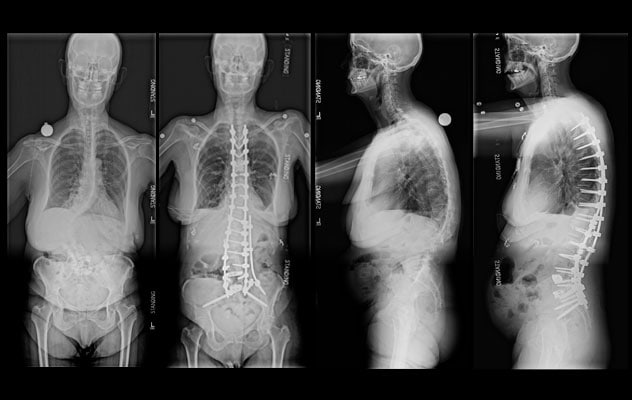 Complex correction
X-rays of a 73-year-old woman show adult idiopathic scoliosis and a 65-degree thoracolumbar curve before and after T4-pelvis fusion corrective surgery at Mayo Clinic.
 Understanding the anatomy
3D, life-size patient-specific anatomic models manufactured at Mayo Clinic shows complex spinal curvature.
"We're a one-stop shop, covering everything from the smallest procedures that take 15 or 20 minutes all the way up to major spinal reconstructions for scoliosis or large tumor resections," Dr. Buchanan says. "The treatment recommendation we provide is independent of any financial incentives and tailored instead to the patient's needs and preferences."
Expert neuroradiology helps guide decision-making. Mayo Clinic's neuroradiologists are highly subspecialized, focusing on specific conditions. "They are the backbone of what we do because so much of surgery is understanding visually what you will encounter before the surgery starts," Dr. Buchanan says.
Sophisticated technology provides further insight. A virtual reality platform allows Mayo Clinic neurosurgeons to create an interactive, 3D model of patient anatomy. Mayo Clinic's unique anatomic modeling unit also can manufacture life-sized, personalized 3D models of patient anatomy and pathology. "Looking at the blood vessels, the bony and nerve structures, helps to really understand the patient's anatomy before we go to the OR," Dr. Buchanan says.
"The treatment recommendation we provide is independent of any financial incentives and tailored instead to the patient's needs and preferences."
Minimally invasive, image-guided treatment might be an option. "Spinal robots allow us to do surgery more efficiently and with smaller incisions," Dr. Buchanan says.
For complex procedures requiring implants, Mayo Clinic often uses AI-developed, customized hardware. "Personalized implants mean we're not overfitting or underfitting," Dr. Buchanan says. "We use these customized implants not just for the interbody work but also for the final rodding during fusion surgeries."
Select patients might qualify for awake surgery using regional spinal anesthesia. As described in two studies published in World Neurosurgery, Mayo Clinic researchers have reported positive outcomes for patients having awake robot-assisted minimally invasive transforaminal lumbar interbody fusion.
"There are many advantages, including shorter operating time, lower blood loss and quicker recovery. Awake patients also can tell us when their pain is gone," Dr. Buchanan says. "Patients who qualify for awake spinal surgery don't have to undergo general anesthesia, which impacts cognitive functions to a greater degree in older patients."
Mayo Clinic specialists also have experience with revision spinal surgery. "These cases take much more time and are fraught with complications. But we don't avoid those challenges," Dr. Buchanan says. "We're happy to see patients who have had failed spinal surgery elsewhere to offer our opinion on whether additional treatment might help."
At Mayo Clinic, spinal surgeons are involved throughout the care process, even if surgical options have been exhausted. "We still attend the spinal care conference and communicate with these patients, so they know we are still with them," Dr. Buchanan says.
Compassionate care from a multidisciplinary team is the cornerstone of Mayo Clinic's approach to complex spinal surgery. "We're not siloed here. We're in the same space and we all come together," Dr. Buchanan says. "That's the power of Mayo Clinic."
For more information
Spine Care. Mayo Clinic.
3D Anatomic Modeling Laboratories. Mayo Clinic.
De Biase G, et al. Awake minimally invasive transforaminal lumbar interbody fusion under spinal anesthesia: Screw placement accuracy and 1-year follow-up. World Neurosurgery. 2025;194:123478.
De Biase G, et al. Awake robotic minimally invasive transforaminal lumbar interbody fusion under spinal anesthesia: A prospective study with 1-year follow-up. World Neurosurgery. 2024;189:e941.
Refer a patient to Mayo Clinic.