Overview
Presbyopia is the gradual loss of your eyes' ability to focus on nearby objects. This natural, age-related change in vision usually begins sometime after age 40.
The first sign of presbyopia may be the need to hold printed materials at arm's length when reading. Presbyopia is typically corrected with reading glasses. Contact lenses, medicines and surgery also can correct near vision.
Products & Services
Symptoms
Presbyopia develops gradually. You may first notice these signs and symptoms after age 40:
- A tendency to hold reading material farther away to make the letters clearer.
- Blurred vision at a typical reading distance.
- Eyestrain or headaches after reading or doing close-up work.
When to see a doctor
See an eye doctor if blurry near vision keeps you from reading, doing close-up work or enjoying other everyday activities.
Seek immediate medical care if you:
- Have a sudden loss of vision in one eye with or without eye pain.
- Experience sudden hazy or blurred vision.
- See flashes of light, black spots or halos around lights.
- Have double vision.
The symptoms may indicate more-serious vision or health conditions.
Causes
Anatomy of the eye

Anatomy of the eye
Your eye is a complex and compact structure measuring about 1 inch (2.5 centimeters) in diameter. It receives millions of pieces of information about the outside world, which are quickly processed by your brain.
Presbyopia
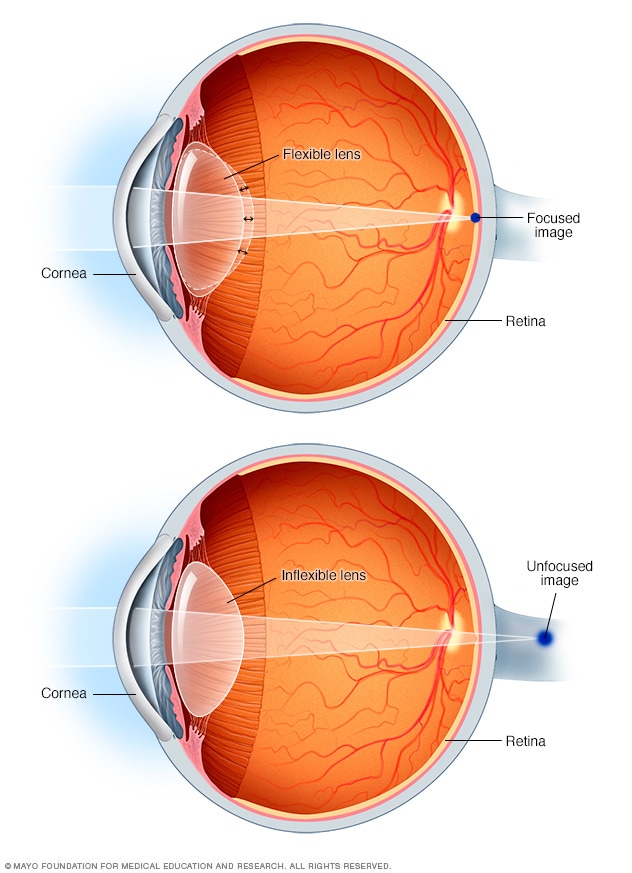
Presbyopia
With normal vision, an image is sharply focused onto the retina (top image). If you have presbyopia, your inflexible lens doesn't adjust to focus light properly, so the point of focus falls behind the retina (bottom image). This makes close-up objects appear blurry.
The cornea and lens of the eye bend light rays to meet at a single point on the back of the eye. This area, called the retina, translates the light into signals to the brain that allow a person to see a clear image.
The cornea is the clear, dome-shaped front surface of the eye. Its shape is fixed.
The lens is a clear structure about the size and shape of an M&M's candy. The lens is somewhat flexible and can change shape with the help of a circular muscle that surrounds it.
When you are looking at something in the distance, the muscle is relaxed. When you look at something nearby, the muscle contracts, making the lens more rounded. This ensures that light is still focused on a single point on the retina.
Presbyopia happens because the lens gradually becomes less flexible with age. This lack of flexibility causes light to reach the retina before it meets at a single point. As a result, nearby things, such as words on a page, look blurry.
Risk factors
The primary risk factor for presbyopia is age. Nearly everyone develops blurry near vision sometime after age 40.
Other factors may increase the risk of developing presbyopia before age 40. These include:
- Farsightedness.
- Long-term diseases such as diabetes, multiple sclerosis, and heart and blood vessel diseases.
- Prolonged work or reading at near distances.
- Medicines such as antidepressants, antihistamines and diuretics.