An automated external defibrillator (AED) is a device that can be used to treat a person whose heart has suddenly stopped beating and pumping blood. This condition is called sudden cardiac arrest.
AEDs are available in many public places, such as schools, airports and other community spaces. Small, lightweight AEDs are available without a prescription for use at home.
People who are at risk of sudden cardiac arrest might think about having an AED at home. Talk with your healthcare professional about whether you should buy an AED for your home.
When is an AED needed?
An AED is used to help restart the heart when someone has sudden cardiac arrest. Sudden cardiac arrest is the sudden loss of all heart activity due to an irregular heartbeat. The changed heartbeat prevents the heart from pumping blood as it should. This causes the heart to stop.
Emergency treatment is needed for sudden cardiac arrest to prevent sudden cardiac death. Getting help fast and starting the heart again as soon as possible can help save a person's life and protect the brain and other organs.
AEDs give clear, step-by-step instructions on how to use them. Training on how to use an AED is recommended. But even without training, you can follow the AED's instructions to help someone during sudden cardiac arrest. Using an AED quickly might help save a life.
If someone has sudden cardiac arrest, giving cardiopulmonary resuscitation (CPR) can help keep blood moving to the brain and heart for a time. Using CPR along with an AED as soon as possible can improve a person's chance of survival.
How to use an AED
Sudden cardiac arrest happens without warning. A person will suddenly collapse, stop breathing, have no pulse and lose consciousness.
Follow these steps if someone has sudden cardiac arrest and an AED is nearby.
- Check to see if the person is breathing and if they have a pulse.
- If there is no breathing or pulse, call 911 or local emergency services right away. If you are alone, call for help first. Then get an AED if one is nearby. If someone else is there, one person can start CPR and another can call for help and get the AED.
- Turn on the AED. The AED gives you step-by-step voice instructions. It tells you how to check for breathing and a pulse. It tells you how and where to put the AED pads on the person's chest.
- Stand clear and deliver the shock. After placing the pads, step away from the person. If the AED says a shock is needed, make sure no one is touching the person. Say "stand clear" loudly, and push the shock button. The AED gives a shock only when needed.
- Start CPR after the shock, if needed. The AED guides you through the CPR steps. You can repeat these steps until emergency medical help arrives.
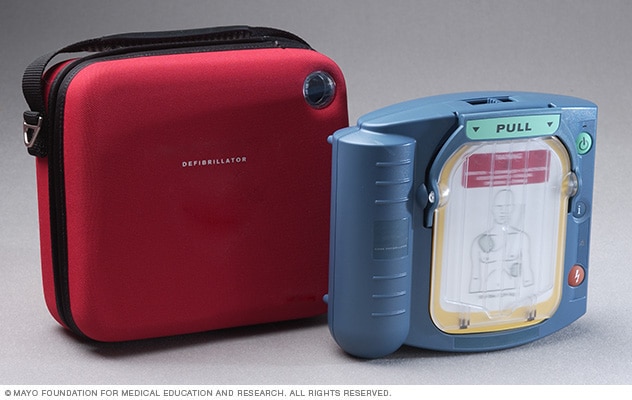
Home automated external defibrillator (AED)
An AED for home use is easy to carry.
Where you can find an AED
Emergency responders such as police and ambulance crews have AEDs. The devices often are found in public places, such as schools, airports and other buildings.
But many sudden cardiac arrests happen at home. Because of this, some people choose to have an AED at home so it can be used right away. Experts do not all agree on how helpful home AEDs are. More research is needed. Also, some AEDs aren't meant to be used at home. Don't be tempted by sellers offering AEDs not intended for home use.
Deciding if an AED is right for the home
Here are some questions to think about before deciding to get an AED at home.
- Who would use the AED? If sudden cardiac arrest happens at home, someone needs to be with you to use the device. That person needs to place the pads and follow the instructions. If you live alone, or no one nearby can help, a home AED may not be right for you. Always keep the AED nearby and unlocked. Make sure others know where it is.
- Are you trained? If you decide to get an AED, learn how to use it. Groups such as the American Red Cross offer training. It is important to practice using the device. Also learn how and when to replace the batteries and parts.
- What does it cost? Home AEDs can be expensive. They may not be covered by insurance.
- Is an AED the right device for you? For some people at high risk of sudden cardiac arrest, an AED may not be the right device. A healthcare professional may suggest an implantable cardioverter-defibrillator (ICD) instead. An ICD is placed in the chest during a minor surgery. It can give a shock to the heart when needed.
An AED is the only way to start the heart again when someone has sudden cardiac arrest. (6p1)Before buying one, talk with your healthcare professional and learn more about how to use one. It is also important to learn basic skills such as CPR.
Tips for proper use and maintenance of AEDs
If you are thinking about getting an AED for your home, here are some steps to keep in mind.
- Buy the right AED for you. Some AEDs aren't intended for home use. They are made for use by emergency workers or in public places such as airports. Before buying one, talk with your healthcare professional and learn more about how to use one.
- Register the AED with the manufacturer. If there are safety alerts and recall notices, you will be alerted. Also, check the manufacturer's website from time to time to keep current on information about your device.
- Take a class. Consider enrolling yourself and others who might need to use your home AED in a class. The American Red Cross, for example, teaches how to use an AED properly and how to do CPR.
- Practice using the AED. People who may need to use the AED should practice checking for breathing and a pulse, following the directions, and putting the pads on. It also is important for them to know what to do if a shock isn't needed.
- Store your AED in a place that's easy to get to. Make sure family, friends and visitors know where it is.
- Keep the AED working properly. Put in new batteries as needed, typically every four years. Replace pads as needed. Keep extra pads nearby. Follow the manufacturer's instructions.
- Know what an AED alarm means. Home AEDs check themselves to make sure they work. Make sure you can hear the alarm. If the AED beeps or a light starts flashing, call the company that made it. Keep the phone number close by.
An AED is the only way to start the heart again when someone has sudden cardiac arrest. It is also important to learn basic skills such as CPR.
