Baker cyst Symptoms and causes
Overview
A Baker cyst is a fluid-filled growth behind the knee. It causes a bulge and a feeling of tightness. Also called a popliteal (pop-luh-TEE-ul) cyst, a Baker cyst can be painful. The pain can get worse with activity or when fully straightening or bending the knee.
A Baker cyst typically is caused by an issue with the knee joint, such as arthritis or a cartilage tear. Both conditions can cause the knee to produce too much synovial fluid. This fluid lubricates joints to reduce friction for pain-free motion. But the fluid can build up and move into a bursa, which is a small, fluid-filled sac that cushions the joint and reduces friction. In the case of a Baker cyst, the fluid collects behind the knee, causing it to swell and form a cyst.
While a Baker cyst may result in swelling and discomfort, treating the root cause — such as managing arthritis or repairing cartilage damage — typically leads to improvement.
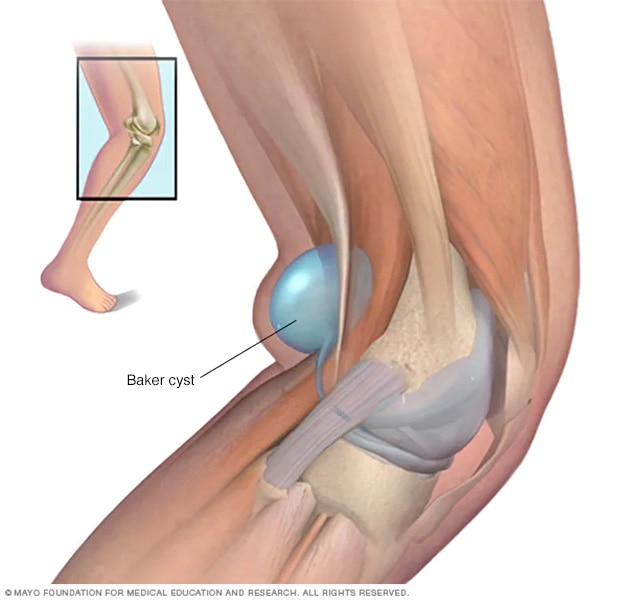
Baker cyst
Swelling on the back of one knee may be a Baker cyst. This can form when synovial fluid fills a cushioning sac, called a bursa, at the back of the knee.
Mayo Clinic Health Letter & Books
Join thousands of readers who trust Mayo Clinic Health Letter for reliable health tips and insights. Start your journey to better health today.
From Mayo Clinic to your inbox
Sign up for free and stay up to date on research advancements, health tips, current health topics, and expertise on managing health. Click here for an email preview.
Symptoms
Sometimes, a Baker cyst causes no symptoms. You may not notice it. If you do have symptoms, they may include:
- Swelling behind the knee, and sometimes in the leg.
- Knee pain.
- Stiffness that can make it hard to fully bend the knee.
These symptoms may worsen after you've been active or after you've been standing for a long time.
When to see a doctor
Seek medical care right away if you have pain and swelling behind your knee. Though it's rare, these symptoms may be a sign of a blood clot in a vein in the leg.
Causes
A lubricating fluid called synovial fluid lessens friction between the moving parts in the knee. It helps the leg swing smoothly. But some conditions may cause the knee to make too much synovial fluid. This excess fluid can build up in the back of the knee, forming a Baker cyst.
A baker cyst can be caused by:
- Inflammation of the knee joint, which typically is caused by certain types of arthritis, such as osteoarthritis or rheumatoid arthritis.
- A knee injury, such as a cartilage tear.
Complications
Rarely, a Baker cyst bursts and synovial fluid leaks into the calf region. This may cause:
- Sharp pain in the knee.
- Swelling in the calf.
- A change in skin color of the calf or a feeling of water running down the calf. The change in color may be a shade of red, purple or brown depending on your skin color.
CON-20369936
Mayo Clinic does not endorse companies or products. Advertising revenue supports our not-for-profit mission.
Advertising & Sponsorship
Mayo Clinic Press
Check out these best-sellers and special offers on books and newsletters from Mayo Clinic Press.
