April 28, 2026
Male stress urinary incontinence is most often treated with an artificial urinary sphincter (AUS). However, for a subset of men with complex clinical histories, standard approaches are often insufficient. Prior urethroplasty, pelvic radiation or failed AUS placement significantly increase the risk of complications such as urethral erosion and device failure, leaving patients with limited and often discouraging options.
Nick Warner, M.D., Katie T. Anderson, M.D., and Boyd R. Viers M.D. — urologists at Mayo Clinic in Rochester, Minnesota — are advancing surgical strategies for these high-risk patients. They offer individualized solutions where few previously existed.
Defining the high-risk incontinence population
High-risk male urinary incontinence typically occurs in men with one or more of the following:
- Prior urethral reconstruction, known as urethroplasty.
- History of pelvic radiation.
- Previous AUS erosion or failure.
- Any combination of the above, often referred to as a "fragile" or compromised urethra.
"In these patients, the urethral tissue has often been significantly altered," Dr. Warner says. "That changes the risk profile entirely and requires a different surgical mindset."
Reinforcing the urethra to reduce erosion risk
For many high-risk patients who remain candidates for AUS placement, Drs. Warner and Anderson frequently use transcorporal cuff placement. This is a well-established technique that redistributes cuff pressure away from the most vulnerable urethral tissue. However, even with a transcorporal approach, the risk of ventral urethral erosion remains elevated. To address this, the team has incorporated additional urethral support techniques tailored to individual anatomy and surgical history.
 المَصَرّة الاصطناعية عبر الجسم الكهفي
تُنشئ غُرز التثبيت مساحة خلف الإحليل لوضع المَصَرّة الاصطناعية عبر الجسم الكهفي.
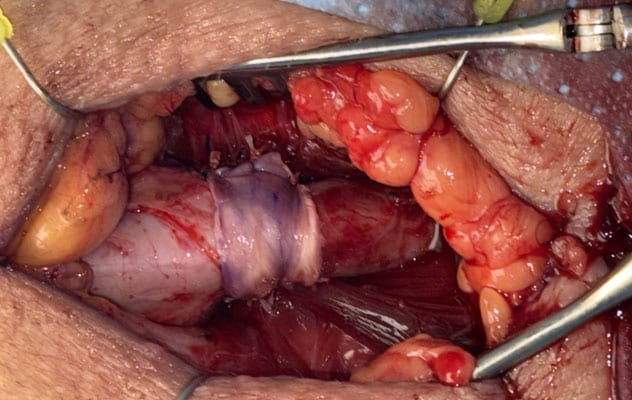 دعم الإحليل
يوفر الغلاف اللفافي المحيط بالجزء الأمامي من الإحليل دعمًا إضافيًا للإحليل أسفل المَصَرّة الاصطناعية.
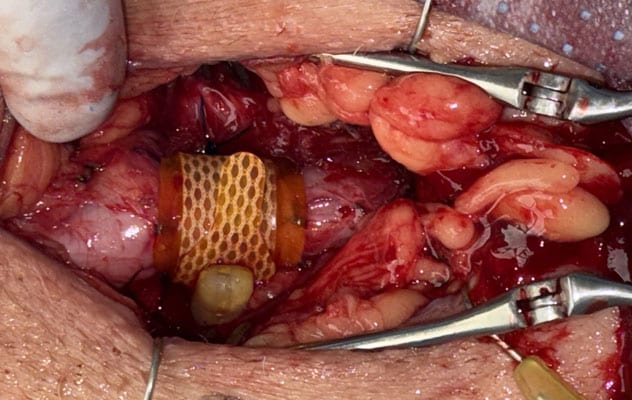 التكوين النهائي للمَصَرّة الاصطناعية
يَظهر في الصورة الشكل النهائي للمَصَرّة الاصطناعية حول الإحليل.
These include:
- Gull-wing corporal flaps, created from the corporal bodies to provide robust ventral and lateral urethral reinforcement.
- Autologous ventral rectus fascial wraps, offering biologic support and pressure distribution in patients with severely compromised tissue.
"These adjunctive techniques allow us to better protect the urethra while still offering the benefits of an artificial sphincter," Dr. Anderson says. "They can make the difference between success and repeated failure in this population."
Expanding options for devastated urethra
In patients with devastated urethra, where further AUS placement is no longer feasible or safe, the team has introduced another option: the ProACT adjustable continence balloon system. Traditionally underused in the United States, ProACT balloons can offer meaningful improvement in continence for carefully selected men who otherwise have no remaining surgical alternatives.
"For patients who have been told there is nothing left to try, this can be life-changing," Dr. Warner says. "It's not about forcing one solution — it's about having multiple tools and knowing when to use each one."
Restoring quality of life through tailored care
For men living with complex urinary incontinence, the physical burden is often matched by significant emotional and social distress. By combining reconstructive expertise with advanced continence strategies, Drs. Warner and Anderson are redefining what is possible for these patients.
"Even in the most challenging cases, our goal is to restore dignity, confidence and quality of life," Dr. Anderson explains.
Through thoughtful surgical innovation and individualized care planning, Mayo Clinic continues to expand treatment possibilities for men with high-risk urinary incontinence — offering renewed hope where options were once limited.
For more information
Refer a patient to Mayo Clinic.