March 24, 2026
Chiari malformation type 1 is a common pediatric disorder. Mayo Clinic's multidisciplinary approach strives to ease patients' symptoms while minimizing physical and psychosocial complications.
"Chiari malformation is a complex condition. It's frequently asymptomatic and might not be the root cause of the symptoms patients experience," says Edward S. Ahn, M.D., a pediatric neurosurgeon at Mayo Clinic in Rochester, Minnesota. "We rely on our multidisciplinary approach to tease out whether symptoms are attributable to the malformation. There are lots of situations where patients have the diagnosis but don't need surgery. Our threshold for offering an operation is usually pretty high, as it should be."
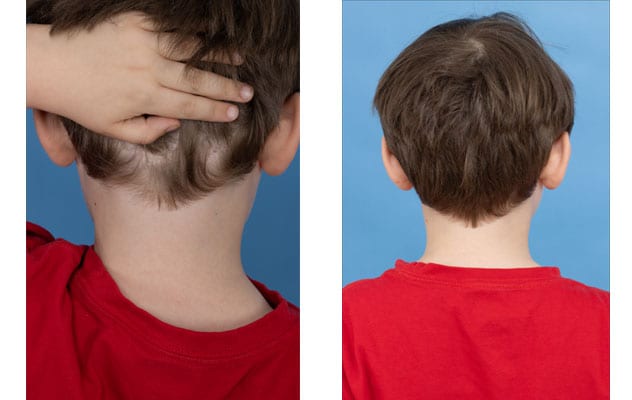 ندبة مخفية
صور ما بعد العملية لصبي خضع لترميم تشوه خياري عبر شق مستعرض تحت القذال. تظهر ندبة الجراحة باهتةً عند رفع شعره، ولا تظهر بخلاف ذلك.
Specific steps taken to safeguard patients include:
- Avoiding unnecessary MRI.
- Using a novel surgical approach that keeps scarring above the patient's hairline.
- Administering nonopioid medication intraoperatively to control postoperative pain.
Incomplete decompression or postoperative complications can sometimes lead to repeat surgery. "The need for revision surgery in our patient group is very low," Dr. Ahn says. "What we do the first time around usually works long term."
Compassionate diagnosis and treatment
Up to 1.5% of people have Chiari malformation type 1. Each year, Mayo Clinic specialists treat more than 2,000 people — children and adults — with Chiari malformation.
Symptoms usually appear in late childhood or early adulthood. The classic symptom is bad headaches occurring after sudden coughing, sneezing or straining. But Chiari malformation also can cause neck pain, motor weakness, sensory loss, neuropathic pain and trouble swallowing.
Pediatric neurologists work closely with neurosurgeons to assess children with symptoms of Chiari malformation. Brain MRI is generally used to diagnose the condition. Additional spinal MRI has been routinely used to identify Chiari-related syrinx, which is found in up to 46% of patients with Chiari malformation.
"By the time that incision heals, it's essentially invisible because the hair covers it."
But Mayo Clinic researchers have demonstrated that this spinal imaging has low diagnostic yield. In a study published in Child's Nervous System, the researchers found that brain MRI alone had 93% sensitivity for detecting syrinxes in children. Spinal MRI in patients with syrinx-negative brain MRI had a diagnostic yield of just 6.7%.
"We no longer have the knee-jerk reaction of ordering spinal MRI," Dr. Ahn says. "The issue is that many children require anesthesia to obtain MRI. Sparing children that extra trip to the MRI machine avoids the risks of anesthesia and also lowers costs." He notes that spinal MRI is generally obtained for children with scoliosis and symptoms affecting the arms and legs.
When surgery is needed, Mayo Clinic pediatric neurosurgeons use a novel approach. Posterior fossa decompression with duraplasty is performed through a transverse suboccipital incision that is hidden above the patient's hairline.
"By the time that incision heals, it's essentially invisible because the hair covers it. That's cosmetically favorable — a nice plus for children and adults," Dr. Ahn says. The surgical approach was described in Operative Neurosurgery.
Mayo Clinic physician-scientists also pioneered a strategy for controlling pain after surgical repair of Chiari malformations. A single dose of a slow-release, nonopioid local anesthetic is administered intraoperatively. In a study published in the Journal of Neurosurgery: Pediatrics, Mayo Clinic researchers found that patients given that intraoperative medication had significantly lower opioid use and mean pain scores in the first 24 hours after surgery compared with patients who didn't receive the anesthetic.
"Chiari malformation surgery has traditionally been a pretty painful operation that has kept children in the hospital for four or five days afterward," Dr. Ahn says. "We've lowered that to two or three days. Besides intraoperative bupivacaine, we've adopted an aggressive postoperative pain protocol that schedules medication, so patients don't have to ask for it. We've really enhanced our pain control."
Mayo Clinic is committed to this type of innovation. "That's the spirit of Mayo Clinic," Dr. Ahn says. "We are open to finding ways to improve the patient experience."
For more information
Mekbib KY, et al. Diagnostic utility of additional spine imaging for syrinx detection in the pre-operative assessment of pediatric Chiari malformation type 1. Child's Nervous System. 2025;41:387.
Naylor RM, et al. Above-the-hairline suboccipital transverse approach for the treatment of Chiari I malformation. Operative Neurosurgery. 2023;24:542.
Lu VM, et al. Effects of intraoperative liposomal bupivacaine on pain control and opioid use after pediatric Chiari I malformation surgery: An initial experience. Journal of Neurosurgery: Pediatrics. 2021;27:9.
Refer a patient to Mayo Clinic.