July 21, 2026
Mayo Clinic's multiple sclerosis (MS) program offers timely care across multiple medical specialties. Often within half a day, patients can be seen by an MS neurologist, rehabilitation specialists and other medical professionals.
"Together, we can address the full spectrum of the disease and develop an individualized treatment plan," says Vanessa V. Marin Collazo, M.D., an MS neurologist at Mayo Clinic in Jacksonville, Florida. "Our comprehensive approach provides convenience for patients and helps them maintain function and quality of life."
Sophisticated imaging and laboratory testing can differentiate MS from its many mimics. Cutting-edge treatment, including stem cell therapy, might be an option for select patients.
"MS can cause a wide range of physical and mental symptoms. Many patients come to Mayo Clinic after a long and uncertain journey," Dr. Marin Collazo says. "Our goal is to provide clarity, confidence and hope to these patients."
Multidisciplinary, efficient care for MS is available across the enterprise.
Technology for accurate diagnosis
Mayo Clinic specialists manage care for patients with newly diagnosed MS as well as patients seeking second opinions. Research has found that around 10% to 20% of patients referred to MS centers had been misdiagnosed. "Also, not every patient with worsening symptoms is experiencing disease progression. A comprehensive evaluation can lead to an alternate diagnosis," Dr. Marin Collazo says.
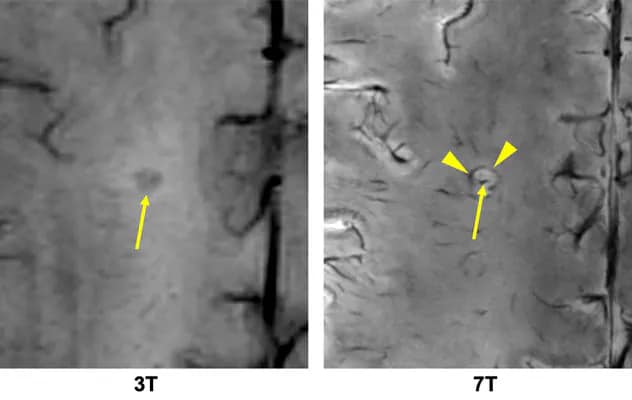 تقنية للكشف عن المؤشرات الحيوية لمرض التصلّب المتعدد (MS)
على اليسار، يظهر التصوير بالرنين المغناطيسي المرجح بالحساسية بقوة 3 تسلا، وجود آفة غير معروفة في المادة البيضاء (يُشار إليها بالسهم). على اليمين، تُظهر صورة الرنين المغناطيسي عند قوة 7 تسلا، بوضوح وجود وريد مركزي (يُشار إليه بالسهم) داخل الآفة، بالإضافة إلى حافة منخفضة الشدة (رؤوس الأسهم) تشير إلى حافة بارا مغناطيسية.
7T MRI, which provides more than twice the resolution of conventional 3T MRI, is an important tool. Mayo Clinic uses 7T MRI to identify novel MS biomarkers, such as paramagnetic rim lesions and the central vein sign. Those biomarkers were added to the McDonald criteria for the diagnosis of MS in 2024.
"Incorporating these two highly specific markers was a paradigm shift that highlights the profound impact of 7T MRI on MS," says Erik H. Middlebrooks, M.D., a neuroradiologist at Mayo Clinic's campus in Florida. "MRI has often been limited in its ability to differentiate MS from common mimics. But 7T MRI is significantly better at identifying these important biomarkers." Mayo Clinic researchers demonstrated 7T MRI's superior ability in detecting the central vein sign in MS in a study published in the American Journal of Neuroradiology.
Optical coherence tomography is used to identify MS-related damage in the optic nerve, which can be apparent before vision changes occur. The optic nerve was added to the McDonald criteria as a location for dissemination in space in MS diagnosis.
"Clarifying what is truly happening helps us develop a treatment plan that will be most effective for a particular patient."
Patients also have access to testing for kappa free light chains, another biomarker recently added to the McDonald criteria. Kappa free light chain testing is available through Mayo Clinic Laboratories. The Laboratories' neurofilament light chain blood test is used for ongoing assessment of neuroaxonal injury. That assay provides valuable information about disease activity, treatment response and long-term prognosis.
"Our expertise allows us to carefully integrate imaging, laboratory testing, clinical history and long-term follow-up to reach the most accurate diagnosis," Dr. Marin Collazo says. "Incorrect diagnosis can delay treatment or lead to therapy that's ineffective or even harmful. Clarifying what is truly happening helps us develop a treatment plan that will be most effective for a particular patient."
Multidisciplinary and innovative treatment
Mayo Clinic's multidisciplinary specialists work together to manage the spectrum of physical and mental health issues experienced by patients with MS. The team includes sleep medicine specialists, neuro-ophthalmologists, urologists, neuropsychologists, nurses specializing in MS care, and physical and occupational therapists.
Mayo Clinic's MS neurologists have experience with the full range of treatments for MS attacks and disease-modifying therapies. Patients with active inflammatory or treatment-refractory disease might qualify for autologous hematopoietic stem cell transplantation. "That's an emerging treatment option that can provide durable disease control in certain patients," Dr. Marin Collazo says.
Mayo Clinic's commitment to studying new diagnostic and treatment options supports clinicians' efforts to provide optimal care. "We want our patients to leave Mayo Clinic with a clear understanding of their condition and a personalized plan that helps them move forward with confidence to improve the quality of their lives," Dr. Marin Collazo says.
For more information
Okromelidze L, et al. Central vein sign in multiple sclerosis: A comparison study of the diagnostic performance of 3T versus 7T MRI. American Journal of Neuroradiology. 2023;45:76.
Refer a patient to Mayo Clinic.