Aug. 26, 2026
Mayo Clinic offers endoscopic ultrasound (EUS) ablation for select patients with pancreatic tumors and cysts. The emerging treatment can be an option for patients who aren't surgical candidates or who wish to avoid surgery.
"Ablation is a minimally invasive, organ-sparing approach. Historically, patients may not have had any options besides pancreatic resection, which carries significant morbidity and mortality," says Jad P. AbiMansour, M.D., an advanced endoscopist in the Pancreas Clinic at Mayo Clinic in Rochester, Minnesota.
Surgery remains the gold standard for definitive treatment in many cases. But EUS ablation can be considered after multidisciplinary evaluation of a patient and review of the patient's treatment goals. Mayo Clinic offers EUS ablation for the treatment of precancerous pancreatic cysts, pancreatic tumors and cancer that has spread to the pancreas.
"The goal is often to treat the entire lesion. The treatment can be curative for some," Dr. AbiMansour says. "In others, the goal is symptomatic improvement or stimulation of an immune response."
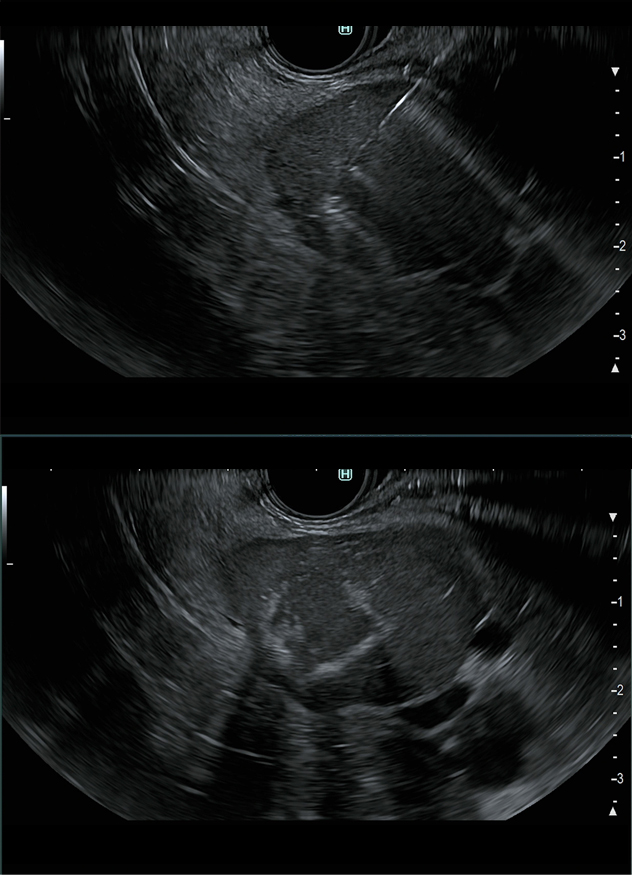 Radiofrequency ablation
On the top, endosonographic image of a radiofrequency needle treating a pancreatic mass. On the bottom, endosonographic images show postablation changes.
Mayo Clinic pioneered the use of EUS ablation for pancreatic lesions. The late Michael J. Levy, M.D., performed some of the first procedures, using alcohol injections, at Mayo Clinic in the 1990s. Based on Dr. Levy's work and advances in devices, Mayo Clinic now primarily uses radiofrequency ablation.
"EUS pancreatic ablation is offered only in select centers, and a multidisciplinary approach is key," Dr. AbiMansour says. "We have expert pancreatologists, oncologists, endoscopists and surgeons to determine if EUS ablation is the best treatment modality for an individual patient."
Experience and expertise
Pancreatic tumors represent a wide spectrum of disease, ranging from extremely aggressive to slow growing. Radiofrequency ablation has direct cytotoxic effects and disrupts the tumor microenvironment.
The overall complication rate for the procedure is 10% to 20%, with mild to moderate abdominal pain the most common risk. "A few patients will go on to experience pancreatitis, which can be severe but is usually mild to moderate," Dr. AbiMansour says. "The vast majority of patients undergo this procedure without any problems."
Data on long-term outcomes are limited. "But some data suggest that EUS ablation may reduce pain medication requirements, improve quality of life and stimulate an immune response, which may enhance the effect of other treatments," Dr. AbiMansour says.
For insulinomas, data has shown that EUS ablation is highly effective in more than 90% of patients. "It was equivalent to surgery's effectiveness, with a more favorable safety profile," Dr. AbiMansour says. "But the downside is a higher rate of recurrence after ablation — about 15% — compared with 0% after surgery."
For all EUS pancreatic ablations, endoscopic expertise is key. Applying energy too quickly can lead to charring and poor effect distal to the probe. Suboptimal timing and temperature can hinder conductivity, resulting in limited tissue destruction.
The heat generated by radiofrequency ablation can cause immediate and delayed injury, up to several days after treatment. Mayo Clinic physician-researchers are working to develop alternative methods that mitigate these risks while still providing effective therapy, such as the use of microwave energy or electroporation.
"Microwave ablation may offer more-controlled heat delivery. Electroporation, which doesn't use heat, could be safer for sensitive ducts and blood vessels surrounding the pancreas," Dr. AbiMansour says. "However, continued device innovation and research are needed."
Mayo Clinic's clinical and research expertise rests upon a multidisciplinary, patient-centered approach. The Pancreas Clinic brings together specialists with deep experience in managing patients with pancreatic conditions. Care is coordinated so that patients often can receive a diagnosis and treatment plan within days. The National Pancreas Foundation has designated Mayo Clinic as a Pancreatic Cancer Center, in recognition of Mayo's commitment to whole-patient care for improved quality of life.
"At Mayo Clinic there are no barriers to providers talking to other providers. And these providers have deeply focused expertise," Dr. AbiMansour says. "Rather than performing a couple of pancreatic ablations a year, our specialists have made this procedure their clinical interest. We want to give patients a safe and effective alternative to surgery — utilizing EUS as an option for organ-sparing treatment in appropriate cases."
For more information
Pancreas Clinic. Mayo Clinic.
The National Pancreas Foundation.
Refer a patient to Mayo Clinic.