Diagnosis
Liver cancer FAQs
Liver surgeon Sean Cleary, M.D., answers the most frequently asked questions about liver cancer.
Ask Mayo Clinic: Liver Cancer
Sean P. Cleary, M.D., Hepatobiliary and Pancreatic Surgeon, Mayo Clinic: Hi. I'm Dr. Sean Cleary, a liver surgeon at Mayo Clinic, and I'm here to answer some of the important questions you may have about liver cancer.
After I am diagnosed, how should I choose a care team?
When thinking about choosing a center for liver cancer treatment, you want to think about a center that treats a lot of liver cancer and that has all the members of a team required to treat your disease. This can include hepatologists or liver doctors, liver surgeons and transplant surgeons, and medical and radiation oncologists.
How can I be the best partner to my medical team?
One of the best ways to partner with your care team is to be engaged. Ask questions. Ask them about the treatment options available. Discuss the pros and cons and benefits of any proposed treatments. And together make a decision on what's best for you. Being informed makes all the difference.
How will my diagnosis affect my diet and lifestyle?
Once you've been diagnosed with liver cancer, we want to try and avoid things that might further damage the liver. And these can include alcohol and smoking. Otherwise, we want to try and be as healthy as possible by maintaining a healthy diet and regular exercise.
Do I need a biopsy?
Liver cancer is one of the cancers where we may not need a biopsy to make decisions about your care. Sometimes, liver cancer can be reliably diagnosed on imaging studies such as CT scans or MRIs. It's important to talk to your doctor and your medical team to determine whether a biopsy is necessary as part of your care plan.
Is chemotherapy or immunotherapy appropriate for me?
We've had a lot of exciting developments in the field of chemotherapy and immunotherapy for liver cancer. It's important to talk to your doctor and your medical team to determine whether chemotherapy or immunotherapy might be right as part of your treatment plan. Thanks for your time. And we wish you well.
Diagnosing liver cancer
Liver biopsy
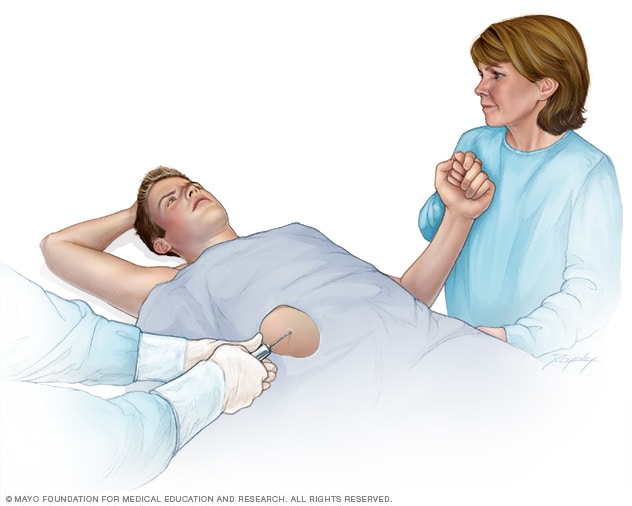
Liver biopsy
A liver biopsy removes a small sample of liver tissue for lab testing. A liver biopsy most often is done by putting a thin needle through the skin and into the liver.
Tests and procedures used to diagnose liver cancer include:
- Blood tests. Blood tests may reveal liver function abnormalities.
- Imaging tests. Your doctor may recommend imaging tests, such as an ultrasound, CT and MRI.
-
Removing a sample of liver tissue for testing. Sometimes it's necessary to remove a piece of liver tissue for laboratory testing in order to make a definitive diagnosis of liver cancer.
During a liver biopsy, your doctor inserts a thin needle through your skin and into your liver to obtain a tissue sample. In the lab, doctors examine the tissue under a microscope to look for cancer cells. Liver biopsy carries a risk of bleeding, bruising and infection.
Determining the extent of the liver cancer
Once liver cancer is diagnosed, your doctor will work to determine the extent (stage) of the cancer. Staging tests help determine the size and location of cancer and whether it has spread. Imaging tests used to stage liver cancer include CTs, MRIs and bone scans.
There are different methods of staging liver cancer. For example, one method uses Roman numerals I through IV, and another uses letters A through D. Your doctor uses your cancer's stage to determine your treatment options and your prognosis.
More Information
Treatment
Treatments for primary liver cancer depend on the extent (stage) of the disease as well as your age, overall health and personal preferences.
Surgery
Operations used to treat liver cancer include:
-
Surgery to remove the tumor. In certain situations, your doctor may recommend an operation to remove the liver cancer and a small portion of healthy liver tissue that surrounds it if your tumor is small and your liver function is good.
Whether this is an option for you also depends on the location of your cancer within the liver, how well your liver functions and your overall health.
- Liver transplant surgery. During liver transplant surgery, your diseased liver is removed and replaced with a healthy liver from a donor. Liver transplant surgery is only an option for a small percentage of people with early-stage liver cancer.
Localized treatments
Localized treatments for liver cancer are those that are administered directly to the cancer cells or the area surrounding the cancer cells. Localized treatment options for liver cancer include:
- Heating cancer cells. Radiofrequency ablation uses electric current to heat and destroy cancer cells. Using an imaging test as a guide, such as ultrasound, the doctor inserts one or more thin needles into small incisions in your abdomen. When the needles reach the tumor, they're heated with an electric current, destroying the cancer cells. Other procedures to heat the cancer cells might use microwaves or lasers.
- Freezing cancer cells. Cryoablation uses extreme cold to destroy cancer cells. During the procedure, your doctor places an instrument (cryoprobe) containing liquid nitrogen directly onto liver tumors. Ultrasound images are used to guide the cryoprobe and monitor the freezing of the cells.
- Injecting alcohol into the tumor. During alcohol injection, pure alcohol is injected directly into tumors, either through the skin or during an operation. Alcohol causes the tumor cells to die.
- Injecting chemotherapy drugs into the liver. Chemoembolization is a type of chemotherapy treatment that supplies strong anti-cancer drugs directly to the liver.
- Placing beads filled with radiation in the liver. Tiny spheres that contain radiation may be placed directly in the liver where they can deliver radiation directly to the tumor.
Radiation therapy
This treatment uses high-powered energy from sources such as X-rays and protons to destroy cancer cells and shrink tumors. Doctors carefully direct the energy to the liver, while sparing the surrounding healthy tissue.
Radiation therapy might be an option if other treatments aren't possible or if they haven't helped. For advanced liver cancer, radiation therapy might help control symptoms.
During external beam radiation therapy treatment, you lie on a table and a machine directs the energy beams at a precise point on your body.
A specialized type of radiation therapy, called stereotactic body radiotherapy, involves focusing many beams of radiation simultaneously at one point in your body.
Targeted drug therapy
Targeted drug treatments focus on specific abnormalities present within cancer cells. By blocking these abnormalities, targeted drug treatments can cause cancer cells to die.
Many targeted drugs are available for treating advanced liver cancer.
Some targeted therapies only work in people whose cancer cells have certain genetic mutations. Your cancer cells may be tested in a laboratory to see if these drugs might help you.
Immunotherapy
Immunotherapy uses your immune system to fight cancer. Your body's disease-fighting immune system may not attack your cancer because the cancer cells produce proteins that blind the immune system cells. Immunotherapy works by interfering with that process.
Immunotherapy treatments are generally reserved for people with advanced liver cancer.
Chemotherapy
Chemotherapy uses drugs to kill rapidly growing cells, including cancer cells. Chemotherapy can be administered through a vein in your arm, in pill form or both.
Chemotherapy is sometimes used to treat advanced liver cancer.
Supportive (palliative) care
Palliative care is specialized medical care that focuses on providing relief from pain and other symptoms of a serious illness. Palliative care specialists work with you, your family and your other doctors to provide an extra layer of support that complements your ongoing care. Palliative care can be used while undergoing other aggressive treatments, such as surgery, chemotherapy or radiation therapy.
When palliative care is used along with all of the other appropriate treatments, people with cancer may feel better and live longer.
Palliative care is provided by a team of doctors, nurses and other specially trained professionals. Palliative care teams aim to improve the quality of life for people with cancer and their families. This form of care is offered alongside curative or other treatments you may be receiving.
More Information
More Information
Clinical trials
Explore Mayo Clinic studies testing new treatments, interventions and tests as a means to prevent, detect, treat or manage this condition.
Alternative medicine
Alternative treatments may help control pain in people with advanced liver cancer. Your doctor will work to control pain with treatments and medications. But sometimes your pain may persist or you may want to avoid the side effects of pain medications.
Ask your doctor about alternative treatments that may help you cope with pain, such as:
- Acupressure
- Acupuncture
- Hypnosis
- Massage
- Relaxation techniques
Coping and support
Learning you have any life-threatening illness can be devastating. Each person finds his or her own ways of coping with a diagnosis of liver cancer. Although there are no easy answers for people dealing with liver cancer, the following suggestions may be of help:
- Learn enough about liver cancer to make decisions about your care. Ask your doctor about your liver cancer, including the stage of your cancer, your treatment options and, if you like, your prognosis. As you learn more about liver cancer, you may become more confident in making treatment decisions.
- Keep friends and family close. Keeping your close relationships strong will help you deal with your liver cancer. Friends and family can provide the practical support you'll need, such as helping take care of your house if you're in the hospital. And they can serve as emotional support when you feel overwhelmed by cancer.
-
Find someone to talk with. Find a good listener with whom you can talk about your hopes and fears. This may be a friend or family member. The support of a counselor, medical social worker, clergy member or cancer survivors group also may be helpful.
Ask your doctor about support groups in your area. Or check your phone book, library or a cancer organization, such as the National Cancer Institute or the American Cancer Society.
-
Make plans for the unknown. Having a life-threatening illness, such as cancer, requires you to prepare for the possibility that you may die. For some people, having a strong faith or a sense of something greater than themselves makes it easier to come to terms with a life-threatening illness.
Ask your doctor about advance directives and living wills to help you plan for end-of-life care, should you need it.
Preparing for your appointment
If you think you may have liver cancer, you're likely to start by seeing your family doctor. If your doctor suspects you may have liver cancer, you may be referred to a doctor who specializes in diseases of the liver (hepatologist) or to a doctor who specializes in treating cancer (oncologist).
Because appointments can be brief, and because there's often a lot of ground to cover, it's a good idea to be well prepared. Here's some information to help you get ready and what to expect from your doctor.
What you can do
- Be aware of any pre-appointment restrictions. At the time you make the appointment, be sure to ask if there's anything you need to do in advance, such as restrict your diet.
- Write down any symptoms you're experiencing, including any that may seem unrelated to the reason for which you scheduled the appointment.
- Write down key personal information, including any major stresses or recent life changes.
- Make a list of all medications, as well as any vitamins or supplements, that you're taking.
- Consider taking a family member or friend along. Sometimes it can be difficult to remember all the information provided during an appointment. Someone who accompanies you may remember something that you missed or forgot.
- Write down questions to ask your doctor.
Your time with your doctor is limited, so preparing a list of questions will help you make the most of your time together. List your questions from most important to least important in case time runs out. For liver cancer, some basic questions to ask your doctor include:
- What type of liver cancer do I have?
- What is the stage of my liver cancer?
- What does my pathology report say? Can I have a copy of the pathology report?
- Will I need more tests?
- What are my treatment options?
- What are the potential side effects of each treatment option?
- Is there one treatment you recommend over the others?
- How will my treatment affect my daily life?
- How much time can I take to make my decision about liver cancer treatment?
- Should I seek a second opinion?
- Should I see a liver cancer specialist? What will that cost, and will my insurance cover it?
- Are there brochures or other printed material that I can take with me? What websites do you recommend?
In addition to the questions that you've prepared to ask your doctor, don't hesitate to ask additional questions during your appointment.
What to expect from your doctor
Your doctor is likely to ask you a number of questions. Being ready to answer them may allow more time later to cover other points you want to address. Your doctor may ask:
- When did you first begin experiencing symptoms?
- Have your symptoms been continuous or occasional?
- How severe are your symptoms?
- What, if anything, seems to improve your symptoms?
- What, if anything, appears to worsen your symptoms?