Diagnosis
Your healthcare professional starts with a physical exam. They may gently press on areas of your back to check for pain and tenderness. You may be asked to lie down and move your legs in different ways to help figure out the source of your pain.
Your healthcare professional also may check your nervous system by testing:
- Reflexes.
- Muscle strength.
- How well you walk.
- How well you feel touch, pinpricks or vibration.
For many people, a physical exam and a medical history are enough to diagnose a herniated disk.
If your healthcare professional thinks something else may be causing your symptoms, or wants to see exactly which nerves are affected, you may need imaging or nerve tests.
Imaging tests
These tests create pictures of your spine and nearby structures:
- X-ray. An X-ray can't show a herniated disk, but it can help rule out other causes, such as broken bones, spinal alignment issues, tumors or infections.
- CT scan. A CT scan takes many X-rays from different angles to create detailed cross-section images of your spine. This helps diagnose a herniated disk by providing clear, detailed images of the bones and soft tissues.
- MRI. This test uses radio waves and strong magnets to show even better images of soft tissues in your spine. This helps confirm the location of a herniated disk and show which nerves are affected.
- Myelogram. This test uses a special dye that is injected into the spinal fluid before a CT scan. It helps to show if there is pressure on the spinal cord or nerves from herniated disks or other conditions.
Nerve tests
An electromyogram (EMG) measures how well your nerves and muscles work together. A small needle is placed into your muscles to measure electrical activity when your muscles are resting and when they move. This helps show which nerves may be damaged.
A nerve conduction study also is done during this test. Small patches with sensors, called electrodes, are placed on your skin. A gentle electric pulse checks how fast and strong nerve signals travel. This may help pinpoint the location of any nerve damage.
More Information
Treatment
Most people feel better with simple treatment, such as avoiding painful movements and taking medicine for pain. This is called conservative treatment, and it often helps lessen symptoms in a few days or weeks.
Medications
- Pain medicines you can buy without a prescription. If your pain is mild to moderate, your healthcare professional may suggest medicine such as acetaminophen (Tylenol, others) ibuprofen (Advil, Motrin IB, others) or naproxen sodium (Aleve).
- Nerve pain medicine. These prescription medicines help calm overactive nerves that cause pain. The medicines include gabapentin (Horizant, Neurontin), pregabalin (Lyrica), duloxetine (Cymbalta), and venlafaxine (Effexor XR).
- Muscle relaxers. If you have muscle spasms, your healthcare professional may prescribe muscle relaxers. They can cause drowsiness or dizziness.
- Opioids. These strong pain medicines are usually avoided unless other medicines haven't helped. If used, opioids are prescribed for a short time. They can cause side effects such as nausea, confusion, constipation and drowsiness.
- Steroid injections. If your pain doesn't improve with oral medicines, your healthcare professional may recommend a steroid injection near the affected nerve. Imaging typically is used to guide the needle to the affected nerve.
Therapy
Your healthcare professional may suggest physical therapy to help with your pain. A physical therapist can show you stretches and exercises to strengthen your core, lessen pain and help you move more easily.
Surgery
Diskectomy
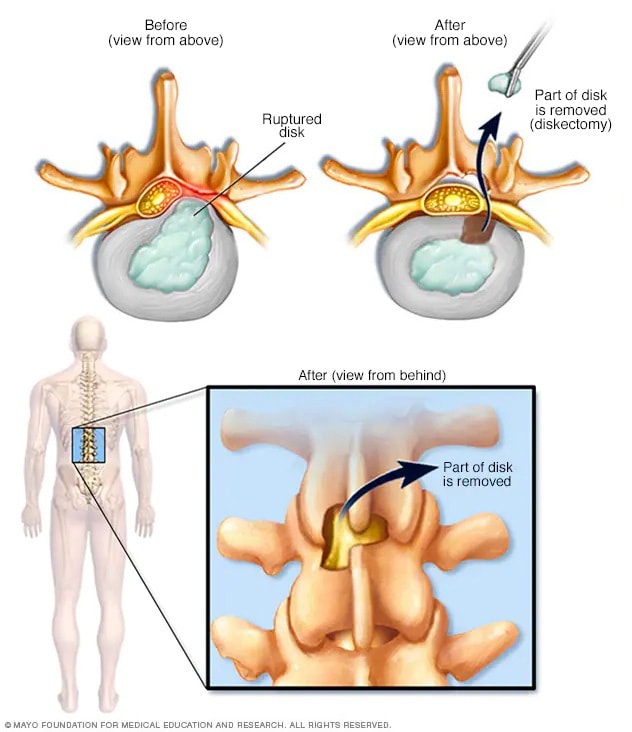
Diskectomy
Diskectomy is the surgical removal of the damaged part of a herniated disk in the spine. A herniated disk occurs when some of the softer material inside the disk pushes out through a tear in the tougher exterior. This can irritate or press on nearby nerves and cause pain, numbness or weakness.
Most people don't need surgery. But your healthcare professional may recommend it if your symptoms don't improve after six weeks or if you have:
- Ongoing or serious pain.
- Numbness or significant muscle weakness.
- Difficulty walking or standing.
- Loss of bladder or bowel control.
In most cases, a surgeon removes only the part of the disk that is pressing on a nerve. In rare cases, the whole disk is removed. If that happens, your surgeon may fuse the nearby bones together using a bone graft. Metal rods or screws often are used to keep the spine stable while it heals. This can take several months.
Rarely, an artificial disk is placed instead of doing a bone fusion. Your surgeon will talk with you about the best option for your situation.
More Information
More Information
Lifestyle and home remedies
In addition to any pain medicine your healthcare professional recommends, you can try the following:
- Use heat or cold. Cold packs may help reduce pain and swelling in the first few days. After that, you can try gentle heat for comfort and relief.
- Avoid too much bed rest. Lying in bed for long periods can make your joints stiff and your muscles weaker. This can slow down your recovery. Try resting in a comfortable position for 30 minutes, then take a short walk or do light tasks. Try gentle stretching exercises. Don't do activities that make your pain worse.
- Resume activity slowly. Let your pain guide you. Move slowly and carefully, especially when bending and lifting.
Alternative medicine
Some people find that alternative or complementary treatments help ease long-term back pain. These treatments include:
- Chiropractic care. A chiropractor may use spinal manipulation to improve movement and ease pain. This may help with low back pain that lasts more than a month. Neck adjustments are less common and in rare cases can lead to serious side effects such as certain types of strokes.
- Acupuncture. This treatment uses thin needles placed in the skin to ease pain. It may help relieve long-term pain in the back or neck, but the effects typically are modest.
- Massage. Massage therapy may provide short-term relief for people with chronic low back pain.
Preparing for your appointment
You're likely to see your primary healthcare professional first. You may be referred to a specialist in physical medicine and rehabilitation, orthopedic surgery, neurology, or neurosurgery.
What you can do
Before your appointment, be ready to answer questions such as:
- When did your symptoms start?
- Were you lifting, pushing or twisting when the pain began?
- Has the pain made it hard to do your regular activities?
- What helps make your symptoms feel better?
- What makes the pain worse?
- What medicines, vitamins or supplements do you take?
What to expect from your doctor
Your health care team might ask other questions, such as:
- Does your pain travel into your arms or legs?
- Do you feel weakness or numbness in your arms or legs?
- Have your bowel or bladder habits changed?
- Does coughing or sneezing make the pain worse?
- Is pain affecting your sleep or work?
- Does your job involve heavy lifting?
- Do you smoke or use other tobacco products?
- Has your weight changed recently?