Overview
Herniated disk
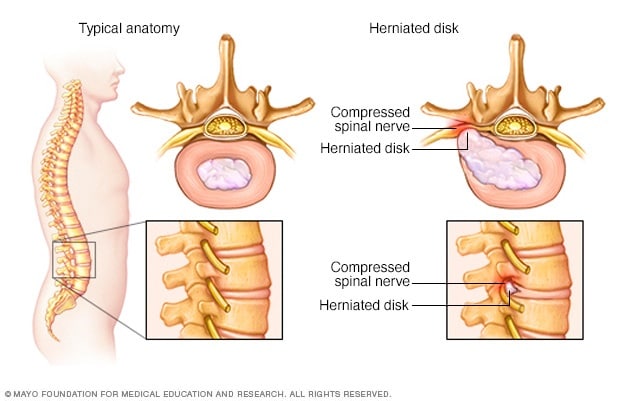
Herniated disk
The rubbery disks that lie between the bones in the spine have a soft center, called a nucleus. The nucleus is surrounded by a tougher exterior, called the annulus. A herniated disk happens when part of the soft center pushes out through a tear in the tough outer layer. If the herniated disk presses on a nerve, it may cause symptoms.
Herniated disk in the cervical spine

Herniated disk in the cervical spine
In a healthy spine, the disks between the bones in the spine cushion and support movement. A herniated disk happens when the soft inner material of a disk pushes through its outer layer. When a herniated disk happens, it can press on nearby nerves. In the cervical spine, herniated disks can cause pain, numbness or weakness in the neck, shoulders, arms or hands.
A herniated disk happens when one of the soft, rubbery cushions between the bones in your spine gets damaged. These cushions are called disks. They sit between the bones that stack to make the spine. These bones are called vertebrae.
Each disk has a soft, jelly-like center, called the nucleus, and a tougher outer layer, called the annulus. A herniated disk happens when part of the soft center pushes out through a tear in the outer layer. You also may hear this called a slipped or ruptured disk.
A herniated disk can happen in any part of the spine, but it is most common in the lower back. It can cause pain, numbness or weakness in an arm or leg, depending on where the herniated disk is.
Some people with a herniated disk don't have any symptoms. If you do have symptoms, they typically get better over time. Most people don't need surgery to treat a herniated disk.
Products & Services
Symptoms
A herniated disk typically happens in the lower back, but it also can happen in the neck. Symptoms depend on where the disk is and whether it's pressing on a nearby nerve. Most of the time, a herniated disk affects just one side of the body.
-
Arm or leg pain. A herniated disk in the lower back may cause pain in the lower back, buttocks, thigh and calf. It may cause pain in the foot as well.
A herniated disk in the neck typically causes the most pain in the shoulder and arm. You may feel sharp or burning pain that gets worse when you laugh, cough, sneeze or move a certain way.
- Numbness or tingling. A herniated disk may cause radiating numbness or tingling in the area of the body affected by the irritated nerve.
- Weakness. The muscles linked to the affected nerve may get weaker. You might drop things, have trouble lifting or feel unsteady when walking.
Some people have no symptoms and may not even know they have a herniated disk unless it shows up on an imaging test.
When to see a doctor
Call your healthcare professional if pain in your neck or back spreads to your arm or leg. Call if you have numbness, tingling or weakness.
Causes
A herniated disk typically happens over time because of the natural aging process that causes disks to wear down. As you get older, the disks in the spine become less flexible and can tear or rupture more easily, even with small movements such as bending or twisting.
Most of the time, people don't know what caused their herniated disk. Sometimes, lifting heavy things using your back muscles instead of your leg and thigh muscles can lead to a herniated disk. Twisting and turning while lifting also can cause a herniated disk. In rare cases, a fall or a hit to the back can be the cause.
Risk factors
Some factors can make you more likely to have a herniated disk, including:
- Extra body weight. Carrying too much weight puts extra stress on the disks in the lower back.
- Physically demanding work. Jobs that involve lifting, pulling, pushing, bending or twisting increase the risk of a herniated disk.
- Family history. Some people inherit a higher risk of getting a herniated disk.
- Smoking. Smoking may lessen blood flow to spinal disks, making them break down faster.
- Frequent driving. Being seated for long periods combined with the vibration from a motor vehicle engine can put pressure on the spine.
- Lack of exercise. Staying active helps protect your back and may lower your risk of a herniated disk.
Complications
Just above your waist, your spinal cord ends. Below that, a bundle of nerves continues through the spinal canal. This bundle is called the cauda equina, which means horse's tail in Latin because of the way it looks.
Rarely, a herniated disk can press on the entire bundle of nerves in this area. This is a medical emergency. Without quick treatment, you may have lasting weakness or even paralysis. Emergency surgery may be needed to prevent serious, long-term damage.
Seek emergency medical attention if you have:
- Worsening symptoms. Pain, numbness or weakness that gets worse and makes it hard to do everyday activities.
- Bladder or bowel issues. Trouble holding urine or stool, or trouble urinating even when your bladder feels full.
- Saddle anesthesia. Numbness or loss of feeling in the areas that would touch a saddle, such as the inner thighs, backs of the legs and around the rectum.
Prevention
You can lower your risk of a herniated disk by taking care of your back.
- Stay active. Exercise regularly to strengthen the muscles in your stomach and back. Strong core muscles help support and protect your spine.
- Keep good posture. Sit and stand up straight to lessen stress on your spine. When lifting something heavy, bend your knees and use your legs, not your back, to lift.
- Keep a healthy weight. Extra weight adds pressure to your spine and disks, which can make injury more likely.
- Don't smoke. Smoking and other tobacco use can weaken the disks in your spine and increase the risk of a herniated disk.