Overview
Chiari malformation
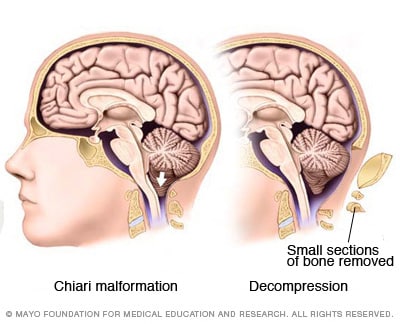
Chiari malformation
In Chiari malformation surgery, a small section of bone at the back of the skull is removed. This makes room for the part of the brain called the cerebellum. It also eases pressure on the brainstem, cerebellum and spinal cord. Sometimes the covering of the spinal cord also is opened and enlarged to make more room.
Chiari malformation (kee-AH-ree mal-for-MAY-shun) is a condition in which tissue from the lower part of the brain, called the cerebellum, goes into the spinal canal. It happens when the skull is shaped in a way that is not typical or when the skull is smaller than usual. Because of that, the skull presses on the brain and forces brain tissue down into the spinal canal.
The use of imaging tests has led to Chiari malformations being found more often and diagnosed sooner. Chiari malformations are relatively common, affecting about one out of 1,000 people. But many people with a Chiari malformation have no symptoms and don't need treatment.
There are four types of Chiari malformation. Type 1 is by far the most common. It develops as the skull and brain grow after birth. Symptoms may not appear until late childhood or adulthood. Types 2, 3 and 4 are congenital. That means they are present at birth. These types are often diagnosed during pregnancy or soon after a baby is born. Types 3 and 4 are very rare.
Treatment of Chiari malformation depends on the type and the symptoms. Sometimes no treatment is needed, and the condition is watched over time. When treatment is needed, surgery is often recommended.
Products & Services
Symptoms
Many people with Chiari malformation don't have symptoms and don't need treatment. They learn they have Chiari malformation only when it's found during tests that are done for another reason. But some types of Chiari malfunction can cause symptoms.
The more common types of Chiari malformation are type 1 and type 2. These types are less serious than types 3 and 4, which are very rare.
Type 1
In Chiari malformation type 1, symptoms typically appear during late childhood or adulthood.
Intense headaches in the back of the head are the classic symptom of Chiari malformation. The headaches typically happen after sudden coughing, sneezing or straining.
People with Chiari malformation type 1 also may have:
- Neck pain.
- Quick, uncontrollable eye movements, called nystagmus.
- Lack of coordination and balance, called ataxia.
- Trouble with fine motor skills in the hands.
- Numbness and tingling of the hands and feet.
- Dizziness.
- Trouble swallowing, which may cause gagging, choking or vomiting.
- Voice changes, such as hoarseness.
- Changes in speech patterns, such as slow speech with long pauses between words or trouble speaking clearly.
- Trouble with breathing. This includes central sleep apnea, which is when a person stops breathing during sleep.
Less often, people with Chiari malformation type 1 may have:
- Ringing or buzzing in the ears, called tinnitus.
- Blurry or shaky vision.
- Weakness.
- Slow heart rhythm, called bradycardia.
- A sudden loss of consciousness.
- Muscle stiffness or muscle contractions, called spasticity.
- A curve in the spine, called scoliosis.
Type 2
In Chiari malformation type 2, more tissue goes into the spinal canal compared to type 1. And some areas of the brain aren't fully formed. Also, people with type 2 almost always have a form of spina bifida called myelomeningocele (my-uh-lo-muh-NING-go-seel). In myelomeningocele, the spine and the spinal canal don't close correctly before birth. Many people also have fluid buildup in the brain, a condition called hydrocephalus.
Symptoms may include:
- Changes in breathing.
- Trouble swallowing.
- Quick downward eye movements, called downbeat nystagmus.
- Weakness in the arms.
Chiari malformation type 2 is often found with ultrasound during pregnancy. It also may be diagnosed after a baby is born.
Type 3
Chiari malformation type 3 is more serious. Part of the lower back section of the brain, called the cerebellum, or the brainstem goes out through an opening in the skull. This form of Chiari malformation typically is found during pregnancy with an ultrasound, or it's diagnosed soon after birth.
Chiari malformation type 3 tends to cause more significant brain and nervous system issues than type 1 and type 2, such as mental and physical delays and seizures. These health issues may be life-threatening.
Type 4
Chiari malformation type 4 is very rare. It happens when sections of the lower part of the brain, called the cerebellum, are not fully formed or are missing. This form of the condition is often fatal.
When to see a doctor
See a healthcare professional if you or your child has any symptoms that may be related to Chiari malformation.
Many symptoms of Chiari malformation also can be caused by other conditions. A full medical evaluation is important.
Causes
Chiari malformation type 1 happens when part of the skull is too small or when the skull is shaped in a way that is not typical. It affects an area in the lower part of the brain called the cerebellum. The cerebellum is a wrinkled ball of tissue below and behind the rest of the brain. As a person with type 1 Chiari malformation grows, the skull puts pressure on and crowds the brain. As a result, over time the lower part of the cerebellum is pushed into the upper spinal canal.
Chiari malformation type 2 is nearly always linked with a form of spina bifida called myelomeningocele. In myelomeningocele, the backbone and the spinal canal don't close correctly before birth. Many people with type 2 Chiari malformation also have fluid buildup in the brain, a condition called hydrocephalus.
Chiari malformation type 3 happens when part of the cerebellum or the brainstem goes out through an opening in the back of the head or neck that shouldn't be there. The exact cause of this type of Chiari malformation isn't known. But it appears to be linked to the way the skull and brain develop during pregnancy.
Chiari malformation type 4 happens when the cerebellum doesn't form correctly during pregnancy.
When the cerebellum is pushed into the upper spinal canal, it can disrupt the flow of cerebrospinal fluid that protects the brain and spinal cord. Cerebrospinal fluid may build up in the brain or spinal cord. Or it might block the signals that the brain sends to the body.
Pressure from the cerebellum on the spinal cord or lower brainstem also can cause symptoms.
Risk factors
There's some evidence that Chiari malformation may run in families. But research into a possible hereditary cause of this condition still is in the early phases.
Complications
Many people with a Chiari malformation don't have symptoms, and they don't need treatment. But in some people, Chiari malformation gets worse over time, and it may be linked to other serious health concerns, called complications, including:
- Hydrocephalus. Hydrocephalus happens when too much fluid builds up in the brain. This can cause trouble with thinking. It also may cause vision loss. People with hydrocephalus may need a flexible tube called a shunt placed in the brain. The shunt drains the extra fluid into another area of the body.
- Spina bifida. Spina bifida is a condition in which the spinal cord or its covering isn't fully developed, and part of the spinal cord is exposed. That can cause serious conditions such as paralysis. People with Chiari malformation type 2 often have a form of spina bifida called myelomeningocele.
- Syringomyelia. Some people with Chiari malformation develop a condition called syringomyelia. In people with this condition, a cavity or cyst called a syrinx forms within the spinal cord. As the syrinx grows, it can push on the spinal cord. That may cause weakness, numbness and pain in the arms and legs.
- Tethered cord syndrome. In this condition, the spinal cord attaches to the spine and causes the spinal cord to stretch. This can cause serious nerve and muscle damage in the lower body.
Prevention
Because the exact cause is unclear, it may not be possible to prevent Chiari malformation. But getting good prenatal care is important.
- Get early prenatal care, even before you're pregnant. Talk to your healthcare professional about your health before you get pregnant. Talk about any lifestyle changes that may be helpful for a healthy pregnancy.
- Take a multivitamin with folic acid. Taking 400 micrograms of folic acid daily has been shown to reduce birth defects in the brain and spinal cord.
- Review your family medical history. If you have a family history of Chiari malformation, birth defects in the brain or spinal cord, or other genetic conditions, you might talk with a genetic counselor to learn about your risks.