Overview
Congenital heart disease in adults refers to changes in the heart's structure that are present at birth. These changes often are called congenital heart defects or congenital heart anomalies. Congenital means that you're born with the condition. In adults, the term "congenital heart disease" may be used.
This article focuses on congenital heart disease in adults. This includes people who know they were born with a heart condition and may or may not have had treatment. It also includes people who find out about their congenital heart condition as adults.
Congenital heart disease can change the way blood flows through the heart. This can cause symptoms such as shortness of breath and tiredness. Some people may have blue or gray skin if oxygen levels in the blood drop. This symptom may be harder to see in some skin colors.
Some types of congenital heart disease are mild. Others are life-threatening. But better treatments are now helping more people with congenital heart disease live longer.
Treatment for congenital heart disease may include regular health checkups, medicines or surgery. If you have adult congenital heart disease, it is important to have regular follow-up care even if you feel OK. Ask your healthcare team how often you need a checkup.
Types
Congenital heart disease may be grouped by how it affects the oxygen levels in the blood.
- Cyanotic congenital heart disease causes low oxygen levels in the blood.
- Acyanotic congenital heart disease usually does not cause a drop in oxygen levels in the blood.
Types of cyanotic congenital heart disease include:
Types of acyanotic congenital heart disease include:
Not all congenital heart conditions fit neatly into the cyanotic or acyanotic types. Some may cause low oxygen levels in the blood only in some situations. Examples of these types of congenital heart disease are:
Congenital heart disease also may be grouped by how serious or complex the heart changes are.
- Critical congenital heart disease is a serious congenital heart defect that needs treatment early in life. Adults who were born with critical congenital heart disease may need more procedures or surgeries over time.
- Complex congenital heart disease means the heart has more complicated changes in its structure. Adults with complex congenital heart disease often need specialized lifelong care.
Products & Services
Symptoms
Some adults born with a congenital heart defect don't notice symptoms until later in life. Symptoms also may return years after the heart condition is treated.
Common congenital heart disease symptoms in adults include:
- Irregular heartbeats, also called arrhythmias.
- Blue or gray skin, lips and fingernails due to low oxygen levels. These color changes may be easier or harder to see depending on your skin color.
- Shortness of breath.
- Getting tired very quickly when you are active, even during everyday activities.
- Swelling in the legs, ankles, feet or belly caused by fluid buildup, called edema. This symptom may be a sign of heart failure.
Note: These symptoms can happen with other conditions. It is important to have a health checkup to learn the cause.
Congenital heart defects in children can cause other symptoms, such as trouble feeding, poor weight gain, fast breathing or sweating during feeds.
When to see a doctor
Get emergency medical help if you have unexplained chest pain or shortness of breath.
Make an appointment for a health checkup if:
Causes
Researchers don't know what causes most types of congenital heart disease. Congenital heart disease happens as an unborn baby, also called a fetus, is growing in the womb during pregnancy.
Chambers and valves of the heart
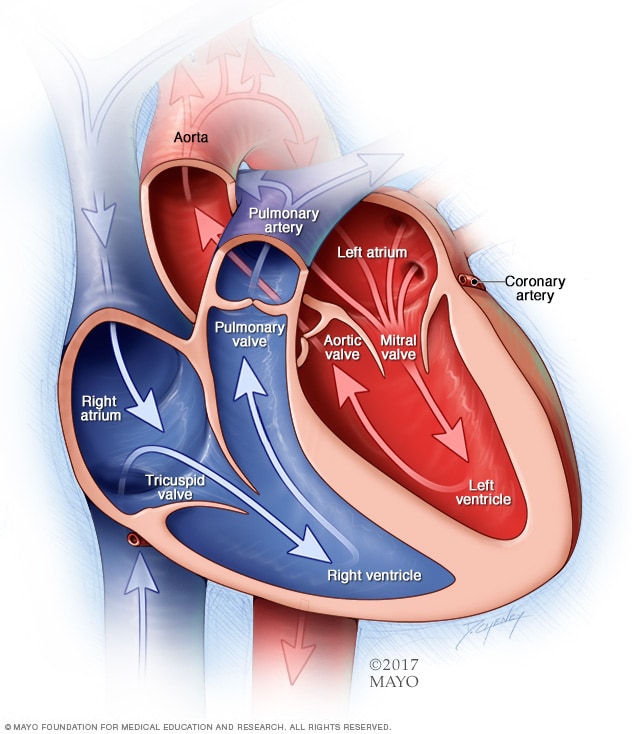
Chambers and valves of the heart
A typical heart has two upper and two lower chambers. The upper chambers, the right and left atria, receive blood as it comes into the heart. The lower chambers, the right and left ventricles, pump blood out of the heart. The heart valves act like gates at the openings of the heart chambers. They keep blood flowing in the right direction.
Atrial septal defect
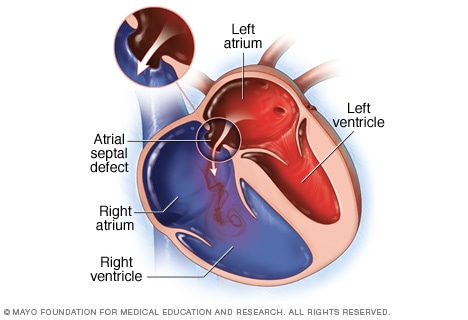
Atrial septal defect
An atrial septal defect (ASD) is a hole between the heart's upper chambers. The heart condition is present at birth. It is a type of congenital heart defect.
Risk factors
A risk factor is something that raises the chance of a health condition. During pregnancy, some factors may raise the chance of congenital heart defects in a baby. Adults with congenital heart disease also may need to know about these risks if they plan to have a child.
- Genetics. Some congenital heart diseases run in families, which means they are inherited. An example is a bicuspid aortic valve. Some people have other gene changes that commonly happen with heart conditions present at birth. For instance, people with Down syndrome may be born with congenital heart disease.
- German measles, also called rubella. Having rubella during pregnancy may affect how the baby's heart grows while in the womb. If you have adult congenital heart disease and want to get pregnant, a blood test done before pregnancy can tell if you're immune to rubella. A vaccine is available for those who aren't immune.
- Diabetes. Having type 1 or type 2 diabetes during pregnancy also may change how the baby's heart grows while in the womb. Gestational diabetes generally doesn't increase the risk of congenital heart disease.
- Medicines. Taking some medicines during pregnancy can cause congenital heart disease and other health conditions present at birth. Medicines linked to congenital heart defects in a baby include lithium (Lithobid) for bipolar disorder and isotretinoin (Claravis, Myorisan, others) for acne. Always tell your healthcare team about the medicines you take.
- Alcohol. Drinking alcohol while pregnant has been linked to congenital heart defects in the baby.
- Smoking. If you smoke, quit. Smoking during pregnancy raises the risk of congenital heart defects in the baby.
Complications
Complications of congenital heart disease may occur years after the heart condition is treated.
Complications of congenital heart disease in adults include:
- Irregular heartbeats, called arrhythmias. Scar tissue in the heart from surgeries to fix a congenital heart condition can lead to changes in heart signaling. The changes can cause the heart to beat too fast, too slow or with an irregular pattern. Some irregular heartbeats may cause stroke or sudden cardiac death if not treated.
- Infection of the lining of the heart and heart valves, called endocarditis. When not treated, this infection can damage or destroy the heart valves or cause a stroke. Some people may be told to take antibiotics before dental care to prevent this infection. Ask your healthcare team if this is right for you. Also, regular dental checkups are important. Healthy gums and teeth reduce the risk of endocarditis.
- Stroke. Congenital heart disease can let a blood clot pass through the heart and travel to the brain, causing a stroke or transient ischemic attack.
- High blood pressure in the lung arteries, called pulmonary hypertension. Some heart conditions present at birth send more blood to the lungs, causing pressure to build. Over time, this makes the heart muscle weak. A weakened heart may lead to heart failure.
- Eisenmenger syndrome. This serious complication can happen in people with pulmonary hypertension related to some congenital heart defects. It may happen years later, even after treatment for congenital heart disease. In Eisenmenger syndrome, high pressure in the lung arteries causes blood to flow the wrong way through the heart defect. This lowers the amount of oxygen in the blood.
- Heart failure. Heart failure is not the same as congenital heart disease. It is a complication that can happen when the heart can't pump enough blood to meet the body's needs. Some congenital heart conditions may lead to heart failure.
Prevention
The exact cause of most congenital heart disease is not known. Because of this, it may not always be possible to prevent congenital heart disease.
Sept. 15, 2026