Colon cancer symptoms & causes
This is Mayo Clinic’s guide to colon cancer — a cancer that starts in the large intestine. Find out about symptoms, causes and more.
Medical review by Mayo Clinic Staff
Updated: September 10, 2026
Colon cancer starts in the part of the large intestine called the colon. When you have colon cancer, it means that cells in your colon have begun to grow irregularly.
Colon cancer begins as a small clump of cells called a polyp. If you have colon polyps, they may or may not turn into cancer. They often don’t cause any symptoms. Polyps can grow for a long time — often 10 to 15 years — before they become cancerous. Finding and removing these polyps can help reduce your risk of colon cancer.
The colon is the first and longest part of your large intestine. And the large intestine is the last part of your digestive system. This system breaks down food for your body to use. The colon connects directly to the rectum. For this reason, when a person has colon cancer or rectal cancer, it is sometimes called colorectal cancer.
Until the past 20 years, colon cancer was typically thought to be a disease that mainly happened in older people. But it can happen at any age. Research has shown a recent increase in people being diagnosed with colon cancer before age 50. By 2030, as many as 1 in 10 colon cancer cases will be diagnosed in people at this younger age.
If you have colon cancer, catching it early gives you the best chance for a cure. Treatments for colon cancer can include surgery, chemotherapy, immunotherapy and very rarely radiation therapy. Some people need a combination of these treatments.
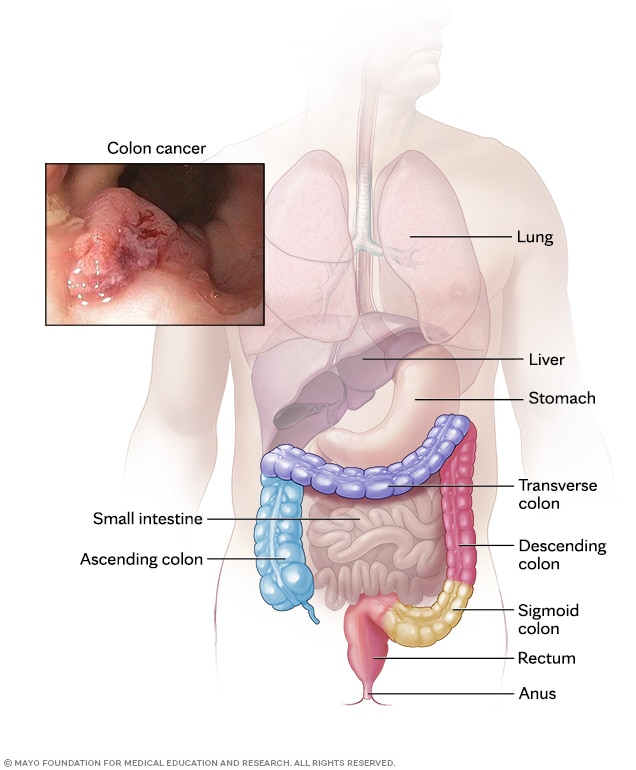
Colon cancer usually begins as small clumps of cells called polyps that form inside the colon. An exam of the whole colon using a long, flexible tube with a camera is one way to find polyps. This exam is called a colonoscopy.
Symptoms
Symptoms of colon cancer can look like symptoms of other common health issues. They can be easy to miss or mistake for something else.
If you have symptoms, talk with your healthcare team to discuss what the next steps are to find out if your symptoms are cancer. If your colon cancer screening results are not typical or you are diagnosed with colon cancer, it’s important to find a specialized team that can help you understand your diagnosis and the treatments that can help you.
Symptoms of early-stage colon cancer
Early-stage colon cancers are typically small cancers that have not spread outside of the colon. If you have an early-stage colon cancer, you may not have any symptoms. That’s why regular screenings are so important. Screening tests detect cancer before symptoms develop, when the cancer is small and easiest to treat.
Symptoms of later stage colon cancer
In later stages, colon cancer may grow beyond the colon and into nearby tissues or lymph nodes. It also can spread to distant organs and the lining of the abdominal cavity. If you have later stage colon cancer, your symptoms may vary based on the cancer’s size and where it is located in the colon.
Symptoms of colon cancer can include:
- A change in bowel habits, such as more-frequent, looser stools or diarrhea, constipation, or changes in stool shape.
- Rectal bleeding or blood in the stool.
- Dark, black-colored tarry stools.
- Iron deficiency anemia, which can cause tiredness, weakness or coldness in the hands and feet and cause skin color to become paler.
- Ongoing discomfort in the belly area, such as cramps, gas, bloating or pain.
- Feeling full soon after eating.
- A feeling that the bowel doesn’t empty all the way during a bowel movement or difficulty passing a bowel movement.
- Losing weight without trying.
- A lump in the belly button area.
It is important to not ignore these symptoms and to openly communicate with your healthcare professional.
Symptoms based on cancer location
Colon cancer symptoms can vary by location. The colon is an inverted, U-shaped organ with left and right sides.
- Left-sided cancers. The left side of the colon includes the descending colon, sigmoid colon and about one-third of the transverse colon. If you have left-sided colon cancer, you are more likely to experience bowel habit changes and blood in your stool.
- Right-sided cancers. The right side of the colon includes the cecum, the ascending colon and about two-thirds of the transverse colon. Right-sided colon cancer is less common than left-sided colon cancer. If you have right-sided colon cancer, you are more likely to have fatigue, weight loss and iron deficiency anemia due to slow blood loss.
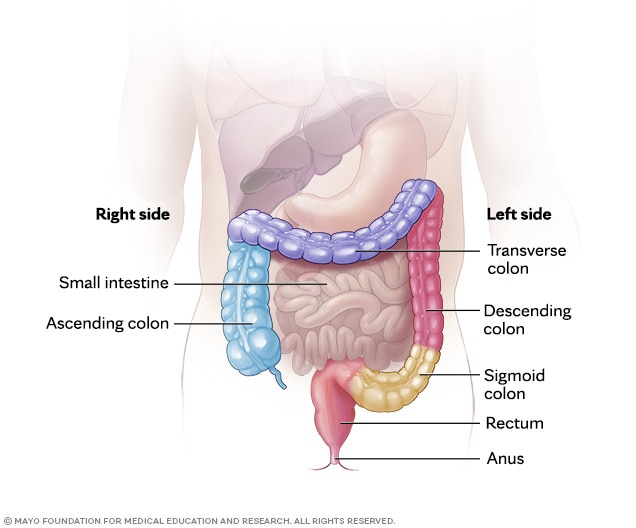
Colon cancer can develop in any part of the colon, including the ascending (right side), transverse, descending and sigmoid (left side) segments. Cancer can also grow in the rectum and, more rarely, the anus, areas that are part of the lower digestive tract.
Symptoms of young age of onset colorectal cancer
There is not yet a clear reason to explain the increase in colon cancer diagnoses for people younger than 50 years old. Even though the average risk screening age recently was moved from age 50 to age 45, many young adults are diagnosed with later stage disease. They may experience symptoms such as:
- Blood in the stool.
- Belly pain.
- A change in bowel habits, such as constipation, diarrhea or alternating between both.
- Weight loss without trying.
Care at Mayo Clinic is designed to meet the needs of young adults with colon cancer.
Young adults with colon cancer often face different challenges than older patients. Care is delivered through programs focused on adolescent and young adult (AYA) cancer, bringing together cancer specialists and supportive services that address treatment, fertility, emotional health, and life goals. This coordinated approach helps ensure care reflects both the diagnosis and the stage of life.
When to see a doctor
Regular screening is essential because early colon cancer often has no symptoms. Talk with your primary healthcare professional about your colon cancer risk to better understand the screening plan that makes the most sense for you.
If you notice bleeding in your stool — even once or twice — or if you have lasting symptoms that worry you, see a healthcare professional and have the symptoms checked out.
Colon cancer care at Mayo Clinic
Our team is standing by to help you schedule a colon cancer appointment.
At Mayo Clinic, specialists work together to evaluate symptoms and guide next steps.
Our colon cancer teams include surgeons, oncologists, gastroenterologists, and other specialists who collaborate to understand symptoms and determine their cause. Working as a team helps us arrive at clear answers and plan appropriate care when a diagnosis is made. This coordinated approach supports timely decisions and helps people understand what comes next.
Causes
The cause of colon cancer isn’t clear, but researchers are studying many of the factors that are thought to contribute to colon cancer. While colon cancer can have a genetic link, most colon cancers appear to be caused by environmental and lifestyle factors that affect cells in the colon.
The cells in your colon contain DNA that holds instructions that tell the cells what to do. Healthy cells die as part of their natural life cycle. With colon cancer, changes in the DNA tell cells to multiply quickly. The same changes let the cells continue to live, which causes too many cells to grow.
Uncontrolled cell growth leads to the formation of polyps. While most polyps stay noncancerous, some can develop into colon cancer.
There are a few different types of polyps. Adenomas, also called adenomatous polyps, and sessile serrated polyps are the types that most commonly lead to colon cancer. If you have an adenoma or sessile serrated polyp that becomes cancerous, you will be diagnosed with adenocarcinoma.
If you have a cancerous polyp, it can grow and invade deeper into the layers of the colon wall. With time, these cancerous cells can break away and spread to lymph nodes or to distant organs. Cancer that spreads is called metastatic cancer.
Mayo Clinic teams have extensive experience treating colon cancer.
Our teams care for thousands of people with colon cancer each year, giving us broad experience across different causes, genetic factors, stages, and tumor locations. This depth of experience helps inform treatment planning and supports access to a wide range of options tailored to each person’s situation.
Risk factors
There are many factors that impact your risk of colon cancer. While you can control some factors, you can’t control other factors. If you’re diagnosed with colon cancer, it’s important to remember that it’s not your fault and you did not do anything wrong to cause your diagnosis.
Factors you can’t control
- Your age. Colon cancer can happen at any age. But most people with colon cancer are older than 50. While the number of people younger than 50 who have colon cancer has been growing, 9 of 10 people diagnosed with colon cancer are older than 50.
- Your race or ethnicity. American Indian and Alaska Native people have the highest rates of colon cancer in the United States, followed by Black people. The risk also is higher for people of Ashkenazi Jewish descent.
Your sex assigned at birth. Colon cancer is more common in men than in women. This may be due to a variety of factors, such as diet, alcohol use, smoking and body fat distribution. Men tend to eat more red meat, smoke and drink more alcohol than women do. Men also have a greater tendency to store fat within the belly, called visceral fat. Visceral fat is linked to an increased risk of colon cancer.
Some data suggests that women who have colon cancer are more likely to have right-sided colon cancer, especially if they no longer have periods due to menopause.
- A personal history of colorectal cancer or polyps. Having had colon cancer or colon polyps increases the risk of colon cancer.
- Inflammatory bowel diseases. Conditions that cause pain and swelling of the intestines, called inflammatory bowel disease, can increase the risk of colon cancer. These conditions include ulcerative colitis and Crohn’s disease.
- A personal history of colorectal cancer or polyps. Having had colon cancer or colon polyps increases the risk of colon cancer.
- Inherited genes that increase colon cancer risk. Some genetic changes that increase the risk of colon cancer run in families. The most common inherited syndromes that increase colon cancer risk are Lynch syndrome and familial adenomatous polyposis, (FAP).
- Family history of colon cancer. Having a blood relative who has colon cancer increases the risk of getting colon cancer. Having more than one family member who has colon cancer or rectal cancer increases your risk more.
- Radiation therapy for cancer. Radiation therapy directed at the abdomen to treat previous cancers increases the risk of colon cancer.
- Diabetes. People with diabetes or insulin resistance have an increased risk of colon cancer.
Factors you can control
- Diet. Colon cancer might be linked with a typical Western diet. This type of diet tends to be low in fiber and high in sugar, fat and calories. Research in this area has had mixed results. Some studies have found an increased risk of colon cancer in people who eat a lot of red meat and processed meat containing nitrites or nitrates. Other studies have found that long-term consumption of sugary drinks may be linked to higher rates of colon cancer.
- Lack of exercise. People who are not active are more likely to develop colon cancer. Getting regular physical activity might help lower the risk.
- Obesity. People with obesity have an increased risk of colon cancer. Obesity also increases the risk of dying of colon cancer.
- Smoking. People who smoke can have an increased risk of colon cancer.
- Alcohol. Drinking alcohol can increase the risk of colon cancer.
Factors that need more research
Researchers continue to study colon cancer and the factors that contribute to it. Understanding these factors can help our researchers reach a place where we can predict, intercept and prevent colon cancer. More research needs to be done before these factors can be confirmed or ruled out:
- Seed oils. A recent study links ultraprocessed foods containing seed oils, such as corn, canola and soybean oils, to a higher risk of colon cancer. High in omega-6 fatty acids, these oils may promote inflammation in colon cells and potentially boost cancer growth. However, more research is needed to prove this directly leads to colon cancer.
- Constipation. The relationship between constipation and colon cancer is complex, and current research provides mixed results. While some studies suggest a potential link, others find no significant association.
- Diverticulitis. Recent research suggests that diverticulitis is linked to an increased risk of colon cancer, particularly right after diagnosis. But while these findings highlight an association, they do not prove that diverticulitis causes colon cancer. Further research is needed to fully understand the relationship between diverticulitis and colon cancer.
Preventing colon cancer
While there is no sure way to prevent colon cancer, there are things you can do to address your personal risk. Work with your healthcare professional to understand your colon cancer risk and the ways you may be able to prevent a colon cancer diagnosis.
Screening for colon cancer
The best way to prevent colon cancer is to detect and remove polyps before they turn into cancer. Healthcare professionals recommend starting colon cancer screening at age 45 if you have an average risk of colon cancer. If you have an increased risk, you may want to start screening earlier.
The best kind of colon cancer screening is the one you will do. Today, there are several different tests used for colon cancer screening.
“If we’re able to detect the colon polyps at a small and early stage, and resect them completely, we can actually prevent colon cancer from developing in the first place.”

Johanna Chan, M.D.
Mayo Clinic gastroenterologist
Research from Mayo Clinic helped advance screening options that can be done at home.
Our researchers played a role in developing colon cancer screening tests that allow some people to screen at home. This work helped expand how and where screening can happen and supports more personalized conversations about risk and screening choices. Ongoing research continues to inform how screening options are used today.
Lifestyle changes to reduce the risk of colon cancer
You can make changes in your everyday life to protect yourself from colon cancer. To lower your risk of colon cancer:
- Eat a variety of fruits, vegetables and whole grains. Fruits, vegetables and whole grains have vitamins, minerals, fiber and antioxidants, which may help prevent cancer. Choose a variety of fruits and vegetables so that you get a range of vitamins and nutrients.
- Limit red and processed meats. Eat no more than three servings of red meat a week. That’s about 12 to 18 ounces (340 to 510 grams) total for the week. Eat little, if any, processed meats containing nitrites or nitrates such as bacon, sausages or preserved deli meats.
- Drink alcohol in moderation, if at all. If you choose to drink alcohol, limit the amount you drink to no more than one drink a day for women and two drinks a day for men.
- Stop smoking and vaping. Talk to your healthcare team about ways to quit.
- Exercise most days of the week. Try to get at least 30 minutes of exercise on most days. If you’ve been inactive, start slowly and build up gradually to 30 minutes. Also, talk with a healthcare professional before starting an exercise program.
- Maintain a healthy weight. If you are at a healthy weight, work to maintain your weight by combining a healthy diet with daily exercise. If you need to lose weight, ask your healthcare team about healthy ways to achieve your goal. Aim to lose weight slowly by eating fewer calories and moving more.
Colon cancer prevention for people with a high risk
If you have a high risk of colon cancer, some medicines can reduce the risk of colon polyps or colon cancer. For instance, some evidence links a reduced risk of polyps and colon cancer to regular use of aspirin or aspirinlike medicines. But it’s not clear what dose and what length of time would be needed to reduce the risk of colon cancer. Taking aspirin daily has some risks, including ulcers and bleeding in the digestive system.
These options generally are reserved for people with a high risk of colon cancer. There isn’t enough evidence to recommend these medicines as part of a prevention plan for people who have an average risk of colon cancer.
If you have an increased risk of colon cancer, discuss your risk factors with your healthcare team to see if preventive medicines are safe for you.
Support group discussions
From Mayo Clinic Connect, our online patient community.
Find more discussions:
Mayo Clinic’s approach to colon cancer
At Mayo Clinic, colon cancer experts treat all types of the disease — from the most common to the most complex. Our teams have created new and minimally invasive screenings, improved testing with AI technology, and found new treatments that are now used around the world.
If you or someone you care about has colon cancer symptoms, our team at Mayo Clinic is here to help. We know that doing regular screenings and finding cancer early gives many patients the best outcomes. Diagnostic tests such as a colonoscopy can help you understand your symptoms and learn more about your risk of colon cancer.
You can also contact our helpful scheduling teams by calling: