Carotid artery disease Care at Mayo Clinic
Carotid artery disease care at Mayo Clinic
Your Mayo Clinic care team
Mayo Clinic carotid artery disease care brings together neurologists and neurosurgeons as well as cardiologists, vascular and endovascular surgeons, and neuroradiologists, working together to provide complete diagnosis and treatment designed for you.
This diverse, specialized expertise focused on you means you benefit from the whole team's efforts to find the best approach for your condition. Mayo Clinic's team approach means healthcare professionals can often provide diagnosis and develop a treatment plan within a few days.
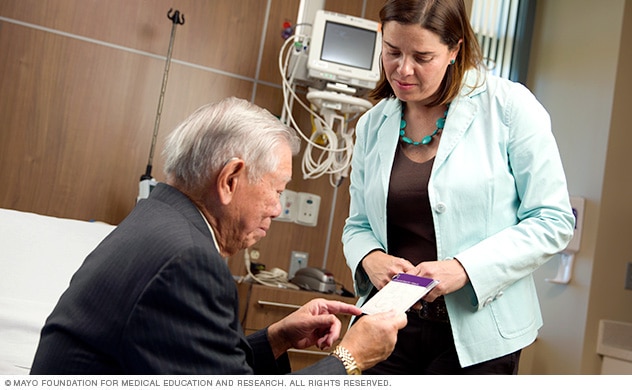
Carotid artery disease consultation
A Mayo Clinic neurologist talks with a man about his diagnosis and options for care.

Collaboration on carotid artery disease care
Mayo Clinic doctors work as a team to deliver the best possible care for carotid artery disease.
Advanced diagnosis and treatment
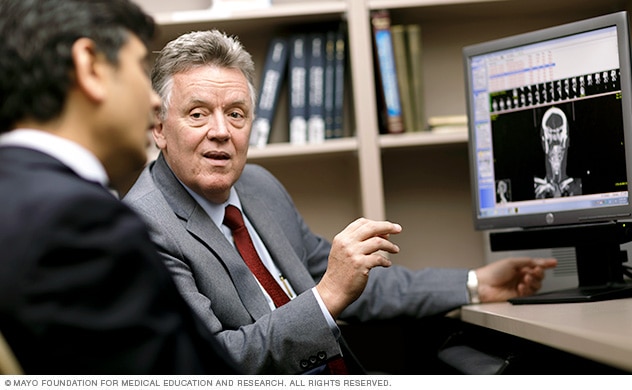
Experience and expertise in carotid artery disease
Mayo Clinic doctors are deeply experienced in advanced diagnostic and treatment approaches for carotid artery disease.
Wide experience and skill in advanced stenting techniques
Treating blocked arteries presents many challenges. It calls for various tools and surgical procedures. Mayo Clinic surgeons are skilled at using the full range of advanced stenting technologies. This means Mayo surgeons can provide the best treatment for each person based on their individual medical needs.
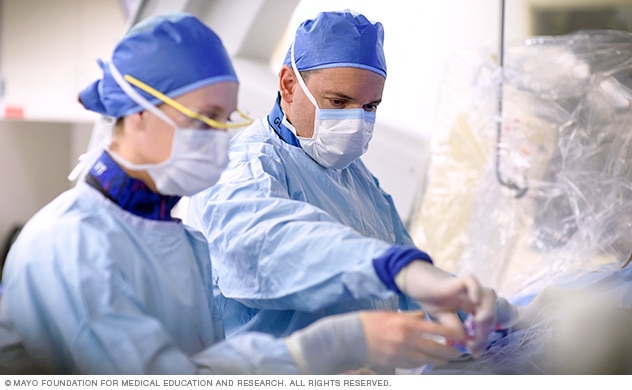
Advanced surgical technique
Mayo Clinic doctors are expert in advanced stenting techniques for carotid artery disease.
Expertise and rankings
Every year, Mayo Clinic specialists treat more than 5,800 people with carotid artery disease. This high volume means Mayo Clinic surgeons have a lot of experience doing complex procedures such as carotid endarterectomy and carotid angioplasty and stenting.
Certified stroke centers
Mayo Clinic Health System's campuses in La Crosse, Mankato and Eau Claire are certified as Primary Stroke Centers by The Joint Commission, a national organization that evaluates and accredits healthcare professionals. Mayo Clinic's campus in Rochester, Minnesota, is certified as an Advanced Comprehensive Stroke Center.
Mayo Clinic in Rochester, Minnesota, Mayo Clinic in Phoenix/Scottsdale, Arizona, and Mayo Clinic in Jacksonville, Florida, are ranked among the Best Hospitals for neurology and neurosurgery and for orthopedics by U.S. News & World Report. Mayo Clinic Children's in Rochester is ranked the No. 1 hospital in Minnesota and the five-state region of Iowa, Minnesota, North Dakota, South Dakota and Wisconsin, according to U.S. News & World Report's 2025-2026 "Best Children's Hospitals" rankings.
Locations, travel and lodging
Mayo Clinic has major campuses in Phoenix and Scottsdale, Arizona; Jacksonville, Florida; and Rochester, Minnesota. The Mayo Clinic Health System has dozens of locations in several states.
For more information on visiting Mayo Clinic, choose your location below:


Costs and insurance
Mayo Clinic works with hundreds of insurance companies and is an in-network provider for millions of people.
In most cases, Mayo Clinic doesn't require a physician referral. Some insurers require referrals or may have additional requirements for certain medical care. All appointments are prioritized on the basis of medical need.
Learn more about appointments at Mayo Clinic.
Please contact your insurance company to verify medical coverage and to obtain any needed authorization prior to your visit. Often, your insurer's customer service number is printed on the back of your insurance card.
More information about billing and insurance:
CON-20309675
