Aug. 14, 2026
Mayo Clinic Spine Center offers an efficient entry point for patients with a range of spinal conditions. Initial assessments by both medical and surgical specialists help ensure that treatment is geared to each patient's needs.
"The optimum benefit is that patients get thorough evaluations from multiple clinicians with different perspectives to figure out the best route forward," says Benjamin D. Elder, M.D., Ph.D., a neurosurgeon with fellowship training in complex spinal surgery and oncology at Mayo Clinic in Rochester, Minnesota.
The spine center team includes spinal neurologists, neurosurgeons, physical medicine and rehabilitation specialists and orthopedic surgeons. Mayo Clinic's salaried physicians have no financial incentive to recommend a particular approach.
"Our model of care removes any bias that might drive spinal treatment," says Mel D. Helgeson, M.D. an orthopedic surgeon at Mayo Clinic's campus in Minnesota. "We can communicate with other professionals on the team and focus on doing what is right for each individual patient."
Sophisticated technology — including the latest whole-body imaging platform and photon-counting detector CT — helps guide diagnosis. If surgery is recommended, expert endocrinologists can help optimize bone health before the procedure. Patients also have access to specialists in pain medicine and postoperative rehabilitation.
"We have some of the world's best expertise in every area of care that's needed — in a single center," Dr. Elder says. Mayo Clinic Spine Center care is available across the enterprise.
Technology that impacts treatment
Mayo Clinic specialists treat the full range of spinal conditions. "We have a large program of complex revisions and spinal deformity care and the latest technology, including multiple robotic and navigation platforms. But we also do very straightforward procedures, including diskectomies, single-level surgeries, and minimally invasive and endoscopic approaches," Dr. Elder says.
The spine center facilitates coordination across multiple surgical and medical specialties. Spine neurologists are key members of the team. "A lot of patients have complex physical conditions, including neurological problems, in addition to the spine issues," Dr Elder says. "Neurologists with expertise in the spine are very helpful for diagnosis in these patients."
Other specialists involved in care include neuroradiologists, radiologists, anesthesiologists and experts in pain medicine and physical therapy. "All that expertise is brought together for comprehensive diagnosis and treatment," Dr. Helgeson says.
"It's very rare to have world-class expertise for every aspect of spinal care from start to finish."
To streamline care, Mayo experts review the records of patients referred to the spine center before any clinical appointment. That means testing can be ordered and imaging often completed before the initial clinical consultation.
Testing frequently includes full-body X-ray in standing, seated and supine positions. Full-body X-ray assesses the effects of spinal deformity on a patient's hips, knees and feet in the various positions, as well as the effects of gravity. The latest whole-body imaging platform is available at Mayo Clinic's campus in Minnesota and at Mayo Clinic Square in Minneapolis.
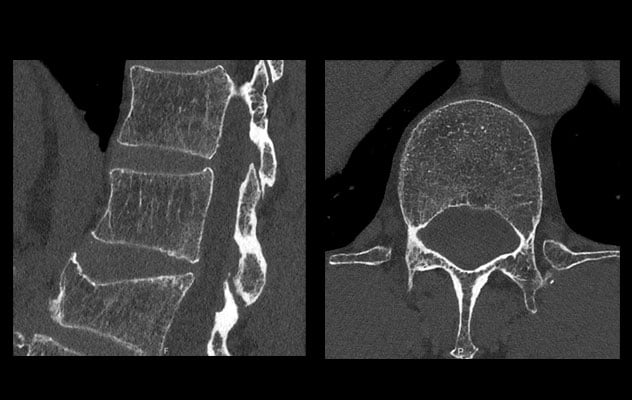
Testing also can include photon-counting detector CT scans. Unlike conventional CT — which measures the combined energy of many X-rays after they are converted into light — photon-counting CT directly counts individual X-ray photons and captures information about their energy. This allows the scanner to produce images with very high spatial resolution and lower image noise, often at a lower radiation dose.
 Diagnostic clarity
Ultra-high-resolution photon-counting detector CT of the upper lumbar spine demonstrates a vertebral compression fracture with exquisite visualization of the trabecular microarchitecture.
"These advantages are especially valuable for spine care," says Francis Baffour, M.D., a diagnostic radiologist at Mayo Clinic's campus in Minnesota. "The vertebral body cortical and trabecular detail can be seen with exceptional clarity. This improves how well radiologists and surgeons can evaluate fractures, pars defects, fusion status and subtle changes around the bone-implant interface."
Dr. Baffour notes that the spectral instrumentation from photon-counting detector CT can substantially reduce metal artifacts from screws, rods and cages. "That gives surgeons a clear assessment of the hardware and adjacent anatomy in patients who have already undergone spinal instrumentation," he says. Mayo Clinic is one of the few centers that uses photon-counting detector CT scans for patient care.
Other testing might include:
- Gait mechanics evaluation, which can be done remotely using a wearable monitor, to allow clinicians to assess patients' real-world function.
- CT bone strength evaluation for osteoporosis, which provides clearer information than standard dual-energy X-ray absorptiometry (DEXA) and can be used for patients with previously implanted spinal hardware.
Patients with compromised bone health are referred to Mayo Clinic endocrinologists specializing in bone metabolism. "We have one of the largest groups of these specialists, including nationally recognized experts," Dr. Elder says. "They can determine what is causing poor bone health and recommend the optimal anabolic medication to improve bone mineral density."
Multidisciplinary surgical expertise
Once evaluations are complete, spine center specialists outline treatment options. "We generally first present the least invasive options to patients and then develop treatment plans in coordination with their wishes," Dr. Elder says.
When surgery is needed, spine center specialists together discuss the best approach. As a quaternary center, Mayo Clinic has neurosurgeons and orthopedic surgeons with experience in the gamut of spinal surgeries. Vascular, thoracic and plastic surgeons also are available if needed. "Our group is capable of managing complex surgical issues," Dr. Helgeson says. "The collaboration between departments is very strong."
Mayo Clinic Spine Center's anesthesiologists have deep experience with complex spinal surgeries. A large in-house neuromonitoring team tracks patients' neurological status. Robot-assisted navigation helps ensure correct placement of spinal instrumentation. Postoperative care is provided by Mayo Clinic musculoskeletal and spinal cord injury rehabilitation specialists.
"It's very rare to have world-class expertise for every aspect of spinal care from start to finish," Dr. Elder says.
Mayo Clinic physician-researchers also are studying ways to improve spine care. Specific efforts include clinical studies of new procedures, instrumentation, bone grafts and nonoperative care. This work aims to improve patient-centered care.
"Spinal conditions are complex and we always put the needs of the patient first," Dr. Helgeson says. "The goal is to take people from a place of significant pain and dysfunction and return them to as normal a quality of life as we can."
For more information
Mayo Clinic Spine Care. Mayo Clinic.
Refer a patient to Mayo Clinic.