Descripción general
Metastatic pancreatic cancer is cancer that has spread from the pancreas to another part of the body. It also is called stage 4 pancreatic cancer and sometimes stage IV cancer.
The pancreas is an organ behind the lower part of the stomach. It makes enzymes that help the body digest food. It also makes hormones such as insulin that help control blood sugar. Most pancreatic cancers begin in cells that line the ducts that carry digestive enzymes out of the pancreas. This type of cancer is called pancreatic ductal adenocarcinoma.
Cancer becomes metastatic when cancer cells break away from the original tumor. They travel through the bloodstream or lymph system and begin growing elsewhere in the body.
Metastatic pancreatic cancer most often involves the liver. It also can spread to the lining of the abdomen, called the peritoneum, and to the lungs. Other sites can include distant lymph nodes and, less often, bones or other organs. Patterns vary from person to person.
Pancreatic cancer is often first diagnosed at a later stage. This is because the cancer may not cause symptoms until after it has gotten large or spread to other organs.
When the cancer is advanced and has spread, it typically can't be cured. But treatment may help slow the growth of the cancer. Treatment also can ease symptoms. Sometimes, pancreatic cancer responds to treatment for longer than expected. Your outlook depends on many factors, including where the cancer has spread, your overall health, the cancer's biology and how treatment affects the cancer.
Cáncer de páncreas
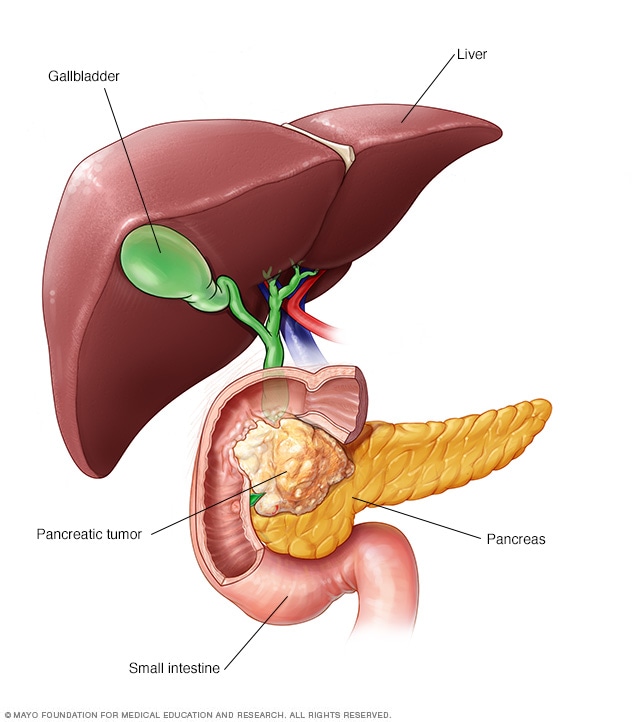
Cáncer de páncreas
El cáncer de páncreas es un tipo de cáncer que se forma en las células del páncreas.
Síntomas
Symptoms of metastatic pancreatic cancer may come from the tumor in the pancreas and from tumors in other organs.
Cancer in the pancreas, liver and peritoneum
Pancreatic cancer usually spreads to nearby areas first, most often the liver. Symptoms may include:
- Pain. Growing cancer may press on nerves in the belly, causing pain that can become serious. Belly pain may spread to the sides or back.
- Weight loss without trying. People with pancreatic cancer might lose weight as the cancer uses more of the body's energy. Nausea and vomiting caused by cancer treatment or cancer pressing on the stomach might make it hard to eat. Sometimes the body has trouble getting nutrients from food because the pancreas isn't making enough digestive juices.
- Jaundice. Pancreatic cancer that blocks the flow of bile made by the liver can cause jaundice. Jaundice is marked by yellowing of the skin and the whites of the eyes. It can cause itching, dark urine and pale stools.
- Buildup of fluid in the belly. Pancreatic cancer can spread to the inner lining of the belly, called the peritoneum. This can cause a buildup of fluid in the belly, known as ascites.
Cancer in the lungs, bones and other organs
Pancreatic cancer that has spread to more-distant parts of the body may cause:
- Shortness of breath and chest discomfort. This can happen if cancer spreads to the lungs.
- Pain and weakness in bones. Less commonly, pancreatic cancer may spread to the bones, causing pain and weakness in the bone structure.
- Enlarged lymph nodes. Sometimes, the cancer spreads to distant lymph nodes. This can lead to enlarged lymph nodes, especially above the collarbones.
It is much less common for pancreatic cancer to appear in the brain, skin and other organs.
When to seek care
Call your healthcare team if you have new or worsening symptoms or if symptoms are keeping you from eating, drinking or sleeping. Often, there is treatment that can help ease symptoms.
Call your care team right away if you have:
- New or worsening jaundice.
- Repeated vomiting or trouble keeping down fluids.
- Rapid weight loss.
- New or severe pain.
- New swelling in the belly.
- Fever or signs of infection, especially during cancer treatment.
- New swelling, a change in skin color or pain in an arm or a leg. This could be a sign of a blood clot.
- New shortness of breath.
Get emergency medical care for symptoms that may be life-threatening, such as severe breathing trouble, fever, dizziness, loss of consciousness or a seizure.
Causas
It's not clear what causes pancreatic cancer to spread. When cancer cells spread, the process is called metastasis.
Pancreatic cancer happens when cells in the pancreas develop changes in their DNA. In cancer cells, the changes in DNA tell the cancer cells to make many more cells quickly. Cancer cells can keep living when healthy cells would die. As a result, too many cells build up. They may form a clump of cells called a tumor. The tumor can grow to invade and destroy healthy tissue in the pancreas.
In time, cancer cells in the pancreas can move into nearby organs such as the liver and the inner lining of the belly, called the peritoneum. Cancer cells also can move into nearby blood vessels and lymph nodes. From there, these cells can travel through the bloodstream or lymph system to other parts of the body, such as the lungs and, sometimes, the bones. Pancreatic cancer cells that form tumors in other organs are still called pancreatic cancer, not lung cancer or bone cancer.
Factores de riesgo
Metastatic pancreatic cancer has the same risk factors as pancreatic cancer in general. These include:
- Family history of DNA changes and conditions that can raise cancer risk. Examples of DNA changes that can be inherited include changes in the BRCA2 and PALB2 genes. Conditions include familial atypical multiple mole melanoma (FAMMM) syndrome, Peutz-Jeghers syndrome and Lynch syndrome.
- Family history of pancreatic cancer, especially when it involves multiple blood relatives, such as parents, grandparents or cousins.
- Swelling of the pancreas that lasts over time, called pancreatitis.
- Older age. Most people with pancreatic cancer are 65 or older.
- Smoking.
- Type 2 diabetes.
- Obesity.
Sept. 05, 2026