Broken leg Diagnosis and treatment
Diagnosis
During the physical exam, a healthcare professional checks the injured area for pain, swelling, an unusual shape or an open wound.
X-rays typically show where a bone is broken and whether nearby joints are injured. Sometimes, more-detailed images are needed, such as from a computerized tomography scan or magnetic resonance imaging. These imaging tests are called CT and MRI for short. For example, if your healthcare professional thinks you may have a stress fracture, you may need a CT scan or MRI. Stress fractures typically don't show up clearly on X-rays.
Treatment
Treatment for a broken leg depends on the type and location of the fracture. Stress fractures typically heal with rest and immobilization. But other types of fractures may need surgery for best healing. Fractures are identified as one or more of the following:
- Open fracture. The bone pierces through the skin. This is serious and needs immediate treatment to prevent infection.
- Closed fracture. The broken bone does not pierce the skin, leaving the skin intact.
- Incomplete fracture. The bone is cracked but not fully broken into separate pieces.
- Complete fracture. The bone is fully broken into two or more separate pieces.
- Displaced fracture. The bone fragments are not properly aligned. Surgery may be needed to realign them.
- Greenstick fracture. The bone is cracked but not completely broken, like bending a fresh, green stick. This type of fracture typically happens in children because their bones are softer and more flexible.
Setting the leg
Treatment for a broken leg typically begins in an emergency room or urgent care clinic. Healthcare professionals examine the injury and use a splint to keep the leg still and supported. If the bone is out of place, called a displaced fracture, the care team may need to gently move the pieces back into the correct position before applying a splint or cast. This process is called reduction. In many cases, a splint is used first to allow swelling to go down. Once swelling improves, a cast is placed to hold the leg in position while it heals.
Immobilization
For a broken bone to heal properly, it needs to stay still. A splint or cast typically is used to keep the bone from moving. This is called immobilization. You may need to use crutches or a cane to keep weight off your injured leg for at least six weeks.
Medications
A pain reliever you can buy without a prescription, such as acetaminophen (Tylenol, others) or ibuprofen (Advil, Motrin IB, others), or a combination of the pain relievers, can reduce pain and inflammation. If you're experiencing serious pain, your healthcare professional may prescribe stronger pain medicines.
Therapies
After your cast or splint is removed, you'll likely need physical therapy or exercises to help lessen stiffness and get your leg moving again. Since you haven't been using your leg for a while, even the muscles in uninjured areas may feel weak or tight. Rehab can help with this, but full recovery from a serious injury may take several months or longer.
Surgery and other procedures
Most broken bones heal with a cast or splint to keep them still. But in some cases, surgery is needed to hold the bones in the right position using metal plates, rods or screws. Surgery is more likely if you have:
- More than one fracture.
- A fracture that is unstable or out of alignment.
- Loose bone pieces that could enter a joint.
- Damage to nearby ligaments.
- A fracture that goes into a joint.
- A fracture caused by a crushing injury.
Some injuries are treated with a metal frame outside the leg, attached to the bone with pins, to keep it stable while it heals. This is called external fixation. The frame typically is removed after about 6 to 8 weeks. There's a small risk of infection around the surgical pins.
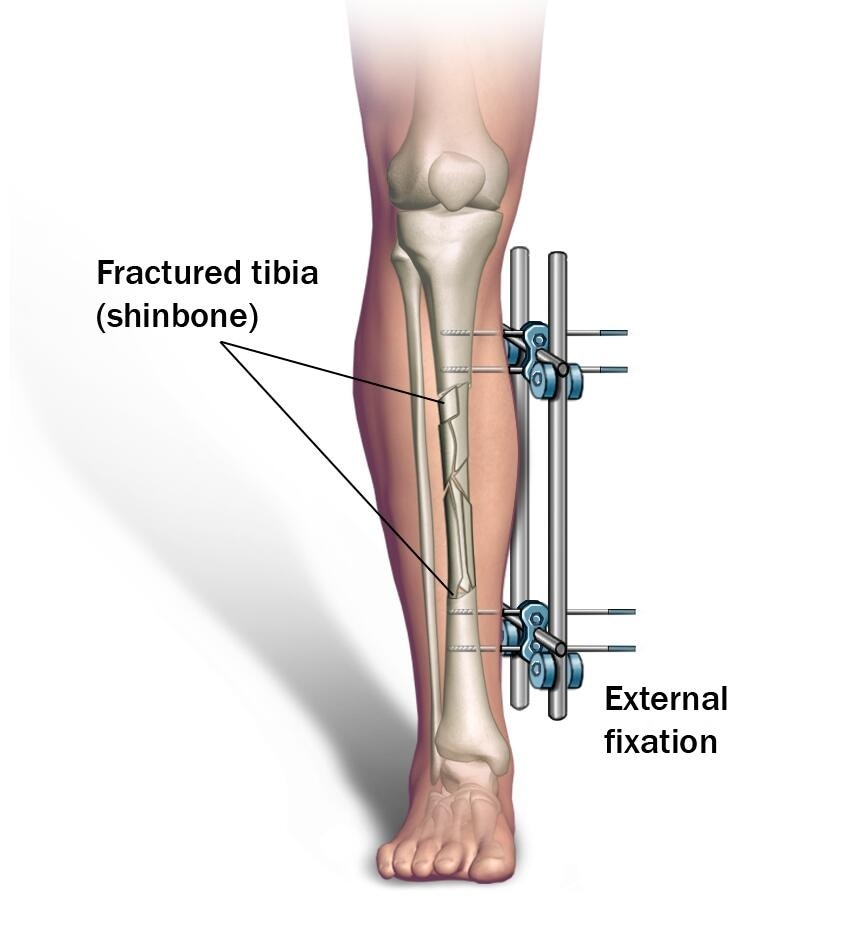
External fixation of the shinbone
External fixation stabilizes a fractured shinbone. A metal frame is attached to the bone with surgical pins placed through the skin. This frame helps keep the bone in the correct position while it heals.
Clinical trials
Explore Mayo Clinic studies testing new treatments, interventions and tests as a means to prevent, detect, treat or manage this condition.
Preparing for your appointment
Depending on how serious the break is, your healthcare professional may refer you to an orthopedic surgeon for further evaluation and treatment.
What you can do
Make a list that includes:
- Details about the symptoms and the incident that caused them.
- Information about past medical conditions.
- All the medicines and dietary supplements you take.
- Questions to ask your healthcare professional.
For a broken leg, some basic questions to ask include:
- What tests are needed?
- What is the best course of action?
- Is surgery necessary?
- What are the alternatives to the primary treatment you're suggesting?
- What restrictions need to be followed?
- Should I see a specialist?
- What pain medicines do you recommend?
Don't hesitate to ask any other questions you have.
What to expect from your doctor
Your healthcare professional is likely to ask you questions, including:
- How and when did your injury occur?
- Were there any other injuries or areas of pain?
- Have you had broken bones in the past or a history of osteoporosis?
- Do you have any numbness, tingling or loss of sensation to the injured area?
- Were you able to get up and stand or walk, bearing weight on your leg, after your injury?
- How serious is the pain from your injury?
- What, if anything, seems to improve the pain?
- What, if anything, appears to worsen the pain?
For injuries to children, the evaluation often includes routine questions to rule out concerns for intentional injury or child abuse.
CON-20370395
Mayo Clinic does not endorse companies or products. Advertising revenue supports our not-for-profit mission.
Advertising & Sponsorship
Mayo Clinic Press
Check out these best-sellers and special offers on books and newsletters from Mayo Clinic Press.
