Overview
Left ventricular assist device (LVAD)
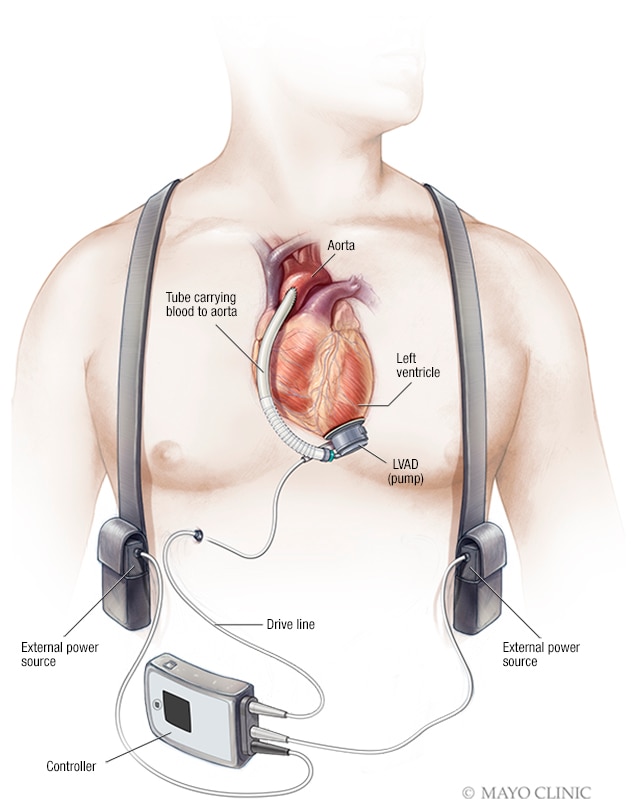
Left ventricular assist device (LVAD)
A left ventricular assist device (LVAD) is put into your chest. It helps pump blood from the left ventricle of your heart to the rest of your body. You wear a control unit and a battery pack outside your body. They connect to the LVAD through a port in your skin.
A ventricular assist device (VAD) helps pump blood from one or both lower chambers of the heart to the rest of the body. It is used to treat a weakened heart or heart failure. A VAD may be used to help the heart work while waiting for other treatments, such as a heart transplant. Sometimes a VAD is used for lifelong support.
VADs often require open-heart surgery and have serious risks. However, a VAD can be lifesaving for some people with severe heart failure.
Types
The type of heart ventricular assist device used depends on which lower heart chamber needs support. Some types are designed for long-term use, including after you leave the hospital. They often are placed into the body with open-heart surgery. These are called durable VADs.
You also may hear them called durable mechanical circulatory support devices.
Temporary VADs provide shorter term support while you are in the hospital. They may be placed through a blood vessel or surgically and often work outside the body.
A VAD may support the left ventricle, the right ventricle or both.
- Left ventricular assist device (LVAD). An LVAD is the most common type of durable VAD. It supports the left ventricle and sends blood to the body. Most durable LVADs used today are continuous-flow devices, which means they move blood continuously. Patients with these devices are able to go home.
- Right ventricular assist device (RVAD). An RVAD supports the right ventricle, which sends blood to the lungs. RVADs often provide temporary support, especially during or after LVAD surgery. Depending on the type, the pump may be outside the body or placed into the body through a blood vessel. An RVAD may be durable. Patients with durable RVADs are able to go home. An RVAD may be used by itself when only the right side of the heart needs mechanical support, but this is very uncommon.
- Biventricular assist device (BiVAD). A BiVAD supports both lower chambers of the heart. An LVAD and an RVAD can be used at the same time to provide biventricular support. The pump that supports the right ventricle may be temporary or used long term.
Some people with an LVAD also have an implantable cardioverter-defibrillator (ICD). They do different jobs. A VAD helps pump blood. An ICD monitors the heart's electrical rhythm and can deliver a shock if it detects a dangerously fast heartbeat.
Products & Services
Why it's done
A ventricular assist device (VAD) helps the heart pump blood when one or both lower chambers are too weak to pump enough on their own. A durable VAD may be an option for people with advanced heart failure that remains severe despite treatment. Typically, a durable VAD is considered for people who are expected to live less than two years without VAD support, heart transplant or another advanced therapy.
Right heart function is especially important before an LVAD. The right ventricle must send enough blood through the lungs to fill the left side of the heart for the LVAD to work well.
Right heart failure does not always rule out a VAD. But it can change which type of support your care team recommends. If the right ventricle is very weak and does not improve with treatment, the care team may recommend a temporary RVAD, support for both ventricles or a heart transplant, if eligible.
Why an LVAD is done
Your care team may recommend an LVAD for one of these reasons:
- You're waiting for a heart transplant. An LVAD may be used while you wait for a donor heart to become available. This is called a bridge to transplant. It is removed when you receive a new heart. An LVAD also may help other organs in the body work better while you're waiting for a heart transplant. LVADs can sometimes lower high pressure in the lungs. High lung pressures can prevent a person from getting a heart transplant.
- Heart transplant isn't an option. An LVAD may provide long-term support for the rest of your life. This is called destination therapy and may improve your quality of life.
- Your heart may be able to recover. An LVAD may support your heart until it can pump enough blood on its own again. This is called a bridge to recovery.
To decide if an LVAD is the right treatment for your condition, and to choose the best device, your care team considers:
- The severity of your heart failure.
- Other serious medical conditions you have.
- How well the main pumping chambers of your heart are working.
- Your ability to safely take blood thinners.
- The support available from family, friends or other people in your life.
- Your mental health and ability to take care of a VAD.
Why an RVAD is done
Your care team may recommend an RVAD if the right ventricle cannot pump enough blood to the lungs. An RVAD may be used by itself when severe right-sided heart failure does not improve with medicines or temporary mechanical support. Long-term RVAD use by itself is uncommon.
A temporary RVAD also may be used during or after LVAD surgery if the right ventricle needs extra support. After LVAD surgery, a temporary RVAD can help pump blood to the lungs while the right ventricle recovers.
Why a BiVAD is done
Your care team may recommend a BiVAD when both sides of the heart are too weak to pump enough blood. A BiVAD supports both ventricles when support of only the left or right ventricle would not be enough.
Your care team also may recommend a BiVAD if you have an LVAD, but the right side of the heart continues to fail.
Ejection fraction and deciding on a VAD
There is no single ejection fraction (EF) number that means you need a VAD. EF is the percentage of blood the left ventricle pumps out with each heartbeat. An EF of 30% or lower is one sign heart doctors use to diagnose advanced heart failure. But EF is only one part of the diagnosis.
Advanced heart failure can happen with a higher EF. Your care team also looks at symptoms, response to treatment, hospital stays, ability to exercise, organ function and other signs.
Heart rhythm conditions and VAD
Some people with heart rhythm conditions, such as ventricular tachycardia, may receive an LVAD. The care team considers how often the rhythm occurs, whether treatment can control it and how well the right ventricle works. If dangerous ventricular rhythms continue despite treatment, a total artificial heart or heart transplant may be considered instead of an LVAD or a BiVAD.
Risks
The risks of a heart ventricular assist device depend partly on the type of device and how it is placed. Some ventricular assist devices (VADs) require heart surgery, while some temporary RVADs can be placed through blood vessels. Your care team explains which risks apply to you.
Possible risks and complications of a VAD include:
- Bleeding. Bleeding can happen during or after surgery. Blood-thinning medicines used with many durable VADs also can increase the risk of bleeding.
- Blood clots. As blood moves through the device, blood clots may form. A blood clot can slow or block blood flow. This can cause problems with the device or a stroke.
- Infection. With many durable VADs, the power source and controller are located outside the body. A wire connects them to the implanted pump through a small opening in your skin. Germs can enter through this opening and cause an infection at the site or in your blood.
- Device problems. While rare, a VAD can stop working correctly or have a problem with a pump, tube, cable or power connection, depending on the device. A device problem needs prompt medical attention. Sometimes a pump must be replaced.
- Right heart failure after LVAD placement. An LVAD supports the left side of the heart. Sometimes the right ventricle is too weak to keep enough blood moving through the lungs and back to the left side of the heart. Medicines or a temporary RVAD may be needed.
- Heart rhythm concerns. Heartbeats that are not regular are called arrhythmias. They can occur with an LVAD. Some arrhythmias, such as ventricular tachycardia, need treatment with medicines, an ICD or a procedure called catheter ablation. This procedure uses heat or cold energy to create tiny scars in the heart.
Your care team watches closely for these complications during and after the procedure. Before you leave the hospital with a durable VAD, you and your caregiver or support person learn how to care for the device and what to do if a problem occurs.
How you prepare
How you prepare depends on the type of ventricular assist device (VAD) and how it will be placed. Most durable VADs require open-heart surgery. Some temporary RVADs can be placed through blood vessels instead of surgery.
Before the procedure, your healthcare team will:
- Tell you what to expect before, during and after the procedure.
- Explain the possible risks of VAD surgery.
- Discuss your goals, concerns and treatment preferences.
- Ask if you have an advance directive.
- Assess the support you may need after surgery.
- Give you instructions for recovery and device care.
You can prepare for VAD surgery by talking with the people who may help you with your hospital stay and the help you may need at home as you recover.
Food and medications
Bring a list of all the medicines you take with you to the hospital. Include any medicine allergies. Your healthcare team reviews your medicines before surgery.
You usually need to stop eating or drinking for several hours before surgery. Your healthcare team gives you specific instructions.
Transportation and work
Before surgery, plan who can help with transportation and device care after you leave the hospital. Ask your care team when you may drive and return to work. The timing depends on your recovery and the type of work you do.
Clothing and personal items
Bring these items with you to the hospital:
- A copy of your advance directive if you have one.
- Eyeglasses, hearing aids or dentures, if you have them.
- Personal care items such as a toothbrush, a hairbrush or comb, and shaving equipment.
- Loose-fitting, comfortable clothing.
- Items that may help you relax such as portable music players or books.
Do not wear:
- Contact lenses.
- Dentures.
- Eyeglasses.
- Jewelry.
- Nail polish.
What you can expect
Before the procedure
Before a ventricular assist device (VAD) procedure, your care team checks your heart and other organs and determines which type of support you need. The testing depends on the type of VAD and your condition.
Before you receive an LVAD, your care team checks how well the right ventricle is working. The right ventricle must send enough blood through the lungs to fill the left side of the heart and the LVAD. An echocardiogram and heart pressure measurements during a right heart catheterization help the care team judge how well the right ventricle may work after surgery.
If you're getting a durable VAD, you may need to stay in the hospital for a few days before the surgery. While you're in the hospital, you may have other treatments for your weakened heart or heart failure.
During this time, tests are done to make sure a durable VAD is still your best treatment option. Tests may include:
- Blood tests. Different blood tests check your blood cell counts, how well your blood clots, and how well the heart, liver, kidneys and other organs are working.
- Electrocardiogram (ECG or EKG). This quick and painless test records the electrical signals in the heart. It shows how the heart is beating.
- Chest X-ray. A chest X-ray shows the size and shape of the heart. It can help your healthcare team diagnose some lung conditions.
- Echocardiogram. Sound waves create pictures of the beating heart. This test shows the structure of the heart and heart valves. It also shows how blood flows through the heart. An echocardiogram can help your healthcare team decide whether a VAD is the right treatment option for you.
- Right heart catheterization. A healthcare professional places a long, thin tube, called a catheter, in a blood vessel and guides it to the heart. The test measures pressures and blood flow in the heart. These measurements help the care team judge how well each side of the heart is working and what type of support may be needed.
Before your procedure, you can talk to your care team about any concerns and what to expect.
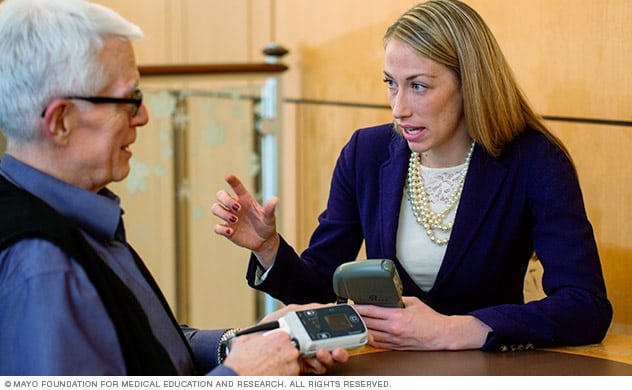 Ventricular assist device coordinator consultation at Mayo Clinic
A ventricular assist device (VAD) coordinator talks with a person about a ventricular assist device.
During the procedure
Getting a durable heart ventricular assist device often requires open-heart surgery. The surgery usually takes three or more hours. The exact steps and length depend on the device, the surgical approach and whether other heart procedures are needed.
During surgery, you can expect the following:
- A member of your healthcare team may shave hair from your chest around the surgical area.
- You get medicines through an IV. The medicines make you sleep and prevent you from feeling pain during the surgery.
- You are connected to a machine that helps you breathe during your surgery. This machine is called a ventilator.
- Your heart may be stopped using medicines during the surgery. If so, you'll be connected to a heart-lung bypass machine. The machine keeps oxygen-rich blood flowing through your body during surgery.
For many durable VAD surgeries, the surgeon makes a cut down the center of the chest. The surgeon separates the chest bone to better view the heart and then places the device. Surgeons can place some VADs using smaller incisions.
Durable VADs have several parts. The exact setup depends on the type of device.
- An LVAD takes blood from the left ventricle through an inflow tube. The pump sends blood through an outflow tube to the body's main artery, called the aorta. The aorta sends blood to the rest of the body.
- An RVAD takes blood from the right side of the heart or a large vein and sends it to the pulmonary artery, which carries blood to the lungs. The exact connection depends on the type of RVAD.
- A BiVAD supports both sides of the heart. The left-sided pump sends blood to the aorta, and the right-sided pump sends blood to the pulmonary artery. The exact setup varies and may include temporary or durable right-sided support.
For many implanted durable VADs, a wire passes through the skin and connects the pump to a controller and power source outside the body.
If a heart-lung bypass machine is used, you are taken off the machine after the VAD is in place and working properly.
During and after surgery, the care team closely watches blood flow, heart pressures and device function. The care team can quickly treat any problems.
After the procedure
You stay in the hospital after durable VAD surgery. How long you stay in the hospital depends on your health before the surgery and how quickly you recover. Your stay may last a week, several weeks or longer. Before your procedure, your care team explains what to expect.
In the hospital, your healthcare team watches you for complications. A tube drains urine from your bladder. Other tubes drain fluid and blood from your heart and chest.
During recovery, it's common to receive:
- Fluids and medicines given by IV.
- Antibiotics to prevent infections.
- Blood-thinning medicine to prevent blood clots.
- Medicines to help manage your pain.
Tell your care team if you have pain or if the pain medicine is not helping. Good pain control can make it easier to breathe deeply, cough and start moving. These steps may help lower the risk of complications.
As you recover in the hospital, your healthcare team helps you become more active and regain strength. Team members help you sit up, get out of bed and walk. If you need more time to improve your strength, a short stay at a rehabilitation center may be recommended.
If you have a temporary RVAD, you stay in the hospital while the device supports your heart. Your care team checks how well the right ventricle is recovering. The device may be removed when the right ventricle can provide enough blood flow without it. You may need to stay in the hospital after the device is removed while you continue to recover.
Leaving the hospital
Before you leave the hospital with a durable VAD, your healthcare team teaches you and your caregiver or support person how to use and care for the device, including how to dress the wire and how to protect the wire from pulling. You learn:
- How to change the dressing and care for the skin where the VAD wire leaves your body.
- What to do if there are signs or symptoms of infection, including fever, pain, a change in skin color or drainage.
- How to keep the device charged. It's important to always have spare batteries with you.
- How to check the controller for dirt and the batteries for damage.
- What to do if the VAD isn't working properly.
- How to shower without damaging the device.
- What to do if the device's alarm goes off.
The surgical team also checks how well your chest incision and wire exit site are healing. Follow the instructions you receive for wound care and tell your care team about drainage, increasing pain, or a change in skin color around an incision or the wire exit site.
Recovery continues after you leave the hospital. You may need time to rebuild your strength and endurance. Your care team helps you gradually increase activity and tells you when you can safely return to daily life activities, such as driving, exercising, going to work or being sexually active. Your care team may refer you to cardiac rehabilitation for monitored exercise and rehabilitation. You also will also likely get tips on how to safely travel with a VAD.
Don't hesitate to talk with your healthcare team if you have any concerns about living with a ventricular assist device.
Results
The goal of VAD treatment is to improve blood flow. For many people with advanced heart failure, a durable LVAD can improve physical ability and quality of life and help them live longer. The amount of improvement differs from person to person.
After getting a durable VAD, you have regular checkups to look for complications and make sure the device is working as it should. Your care team checks your blood pressure, device settings and symptoms.
Many people with a durable VAD take blood-thinning medicine to help prevent blood clots. If you take one, you may need regular blood tests to check its effects.
Other follow-up tests may include echocardiograms and right-heart catheterization to check how well the VAD is working.
Long-term outlook
There is no single life expectancy for a person with a ventricular assist device (VAD). Your long-term outlook depends on your health before the procedure and how your health changes afterward.
Other factors include:
- Your age.
- How ill you are before the surgery.
- How well your kidneys and liver work.
- Heart rhythm conditions.
- Complications during or after implantation.
- How well other treatments help your heart failure and other health conditions.
Follow your care team's guidance to support your health while you have a VAD.
- Take medicines as directed.
- Follow your eating and exercise plans.
- Do not smoke or vape.
Ask your care team for guidance about alcohol and other substances, especially if you are waiting for a heart transplant.
Ejection fraction after an LVAD
There is no single ejection fraction (EF) number that everyone should reach after getting an LVAD. Your care team follows your heart function over time, often with echocardiograms. Changes in EF over time can be more useful than one measurement by itself.
After LVAD surgery, EF can be difficult to measure. It is only one part of follow-up. Echocardiography also checks the size of the left ventricle, how well the right ventricle is working, the heart valves, and how the heart and pump respond to VAD settings.
VADs and heart transplants
If you have a VAD to help your heart pump blood while you wait for a heart transplant, you need to stay in close contact with your healthcare team while you're on the waiting list. Your care team may ask you to stay near the hospital in case a donor heart becomes available.
Your care team monitors you closely while you are on the transplant list. Your team regularly checks your:
- Symptoms.
- Blood pressure.
- Heart function.
- VAD settings.
The team may change your medicines, device settings or other treatments as your health needs and goals change.
Coping and support
If you're feeling anxious or frustrated about living with a VAD, consider talking to your care team or a counselor. Connecting with others in a support group may help lower stress and anxiety. In a support group, you can share your thoughts and feelings with others who have similar experiences.
Ask your VAD program about support groups for people with VADs and their caregivers. Other people living with VADs may share practical ways to manage day-to-day life with the device.
Exercise
Cardiac rehabilitation
After getting a durable ventricular assist device (VAD), your care team may recommend a personalized exercise and education program. The program is called cardiac rehabilitation. It often includes supervised exercise, heart-healthy diet tips and emotional support.
Supervised exercise training is a crucial part of the recovery and can improve exercise capacity and quality of life in people with durable VADs.
Sept. 03, 2026