Overview
What is stomach cancer? A Mayo Clinic expert explains
Learn more about stomach cancer from oncologist Mohamad (Bassam) Sonbol, M.D.
Learn more about stomach cancer from oncologist Mohamad (Bassam) Sonbol, M.D.
I'm Dr. Bassam Sonbol, an oncologist at Mayo Clinic. In this video we'll cover the basics of stomach cancer: What is it? Who gets it? The symptoms, diagnosis, and treatment. Whether you're looking for answers for yourself or someone you love, we're here to give you the best information available. Stomach cancer, also called gastric cancer, can happen in any part of the stomach. However, in the U.S., most stomach cancers occur in the gastroesophageal junction, which is where the esophagus - the tube that carries chewed up food - meets the stomach. There are several different types of stomach cancers, but most are curable if detected at an early stage. What once was the leading cause of cancer death is now well down on the list thanks to the advancement in technology and scientific research. In fact, new cases of stomach cancers have dropped by about 1.5% every year for the last 10 years.
Who gets it?
Stomach cancer more commonly affects older people. The average age of those diagnosed with stomach cancer is 68. Around 60% of cases occur in patients older than 65, and there is a slightly higher lifetime risk of stomach cancer in men. However, it can affect anyone. Stomach cancer tends to develop slowly over time, usually over many years. What happens is small changes occur in the DNA of the stomach cells, telling them to over multiply and then they accumulate, forming abnormal growth called tumors. There are several known risk factors that could increase your risk of developing stomach cancer, for instance, smoking doubles your risk of stomach cancer, family history of stomach cancer, infection with H. pylori, long-term stomach inflammation, gastroesophageal reflux disease, or stomach polyps. Eating a diet high in salty and smoked foods or low in fruits and vegetables can be also a risk. And there is some correlation between higher weight and risk, as well.
What are the symptoms?
Stomach cancer can present itself in several different ways, such as difficulty swallowing, feeling bloated after eating, feeling full after only eating a small amount of food, heartburn, indigestion, nausea, stomach pain, unintentional weight loss, and vomiting. If you have any signs and symptoms that worry you, make an appointment with your doctor. Your doctor may investigate the more common causes of these symptoms first or refer you to a specialist, like a gastroenterologist or an oncologist, like me.
How is it diagnosed?
To determine if you have stomach cancer, your doctor may start with an upper endoscopy, where a tiny camera is passed through the throat and into the stomach. If your doctor finds something suspicious, they remove some tissue for a biopsy, where the cells gets sent to a lab for further analysis. Your doctor may also run some imaging tests, like CT scan or a special x-ray called a barium swallow. Identifying the extent of the cancer helps your doctor determine the best treatment. To determine the stage, they will run more tests, like blood tests, endoscopic ultrasound, CT scan, or a PET scan. In some cases, your doctor may recommend laparoscopic surgery, where the doctor inserts a special camera directly into the abdomen.
How is it treated?
Creating a treatment plan for stomach cancer is a collaborative effort between doctors from different specialties. Our goal is to make the best treatment plan for your overall health and personal well-being. There are five main treatment options for stomach cancer: Surgery to remove all of the cancerous tissue and probably some of the healthy tissue around it. Chemotherapy, which uses drugs that journey throughout the body, destroying any cancer cells in its path. Radiation therapy, which uses high-powered beams of energy to target cancer cells. Targeted drug therapy, focusing on blocking specific weaknesses present within cancer cells. And immunotherapy, a drug treatment that helps your immune system recognize which cells are dangerous and attack them.
What now?
Finding out you have cancer can be really overwhelming and difficult. It can help to find spaces where other people understand what you're going through. Try connecting with cancer survivors online or in your community. Learning about your condition can help you make confident decisions about your care. If you'd like to learn more about stomach cancer, watch our other related videos or visit mayoclinic.org. We wish you well.
Gastroesophageal junction and stomach
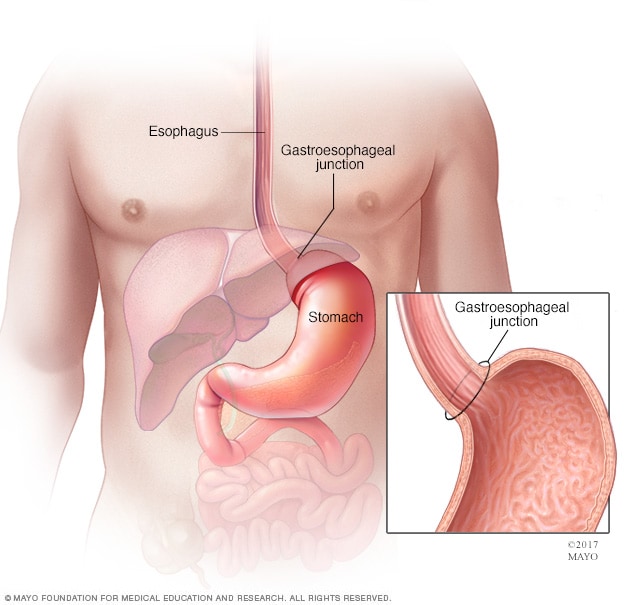
Gastroesophageal junction and stomach
The stomach is a muscular sac in the middle of the upper abdomen that helps break down and digest food. Food you eat passes down your esophagus, through the gastroesophageal junction and into the stomach.
Stomach cancer
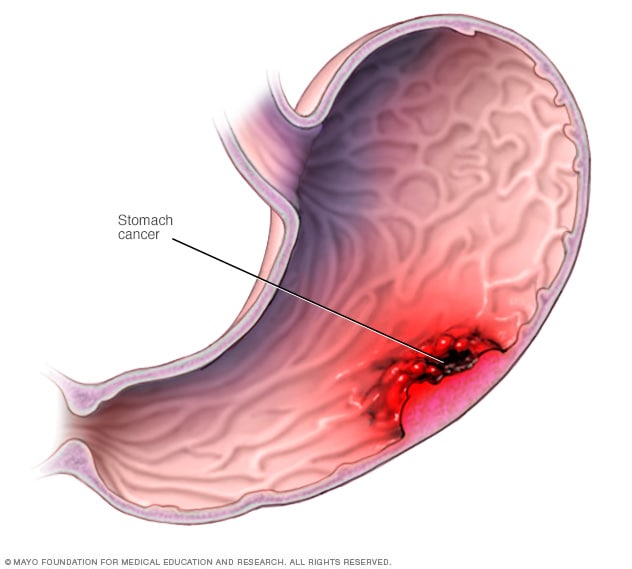
Stomach cancer
Stomach cancer most commonly begins in the cells that line the inside of the stomach.
Stomach cancer, also called gastric cancer, is a growth of cells that starts in the stomach. It is a type of gastrointestinal cancer. The stomach is in the upper middle part of the belly, just below the ribs. The stomach helps to break down and digest food.
If you've been diagnosed with stomach cancer, there are several factors that affect treatment options. These include where the cancer started, how far it has grown or spread, and the type of cell involved.
When stomach cancer occurs in people in the United States, it tends to start in a different part of the stomach than it does in other areas of the world. In the U.S., stomach cancer often happens in the part of the stomach closest to the esophagus. The esophagus is the tube that carries food you swallow to the stomach. The area where the esophagus and stomach meet is called the gastroesophageal junction. In places where stomach cancer is common, it's more likely to start in other parts of the stomach. Stomach cancer isn't common in the United States. It happens much more often in certain parts of the world, such as East Asia, Eastern Europe and South America.
Treatment can sometimes cure stomach cancer. A cure is most likely when the cancer is found before it spreads beyond the stomach. When stomach cancer has grown through the stomach wall or spread to other parts of the body, treatment is aimed at controlling the cancer, relieving symptoms and helping people live longer. Advances in research continue to improve stomach cancer treatment.
Products & Services
Types
The type of stomach cancer you have is based on the type of cell where the cancer began. Examples of stomach cancer types include:
- Adenocarcinoma. Stomach adenocarcinoma, also called gastric adenocarcinoma, starts in gland cells in the stomach. This is the most common type of stomach cancer. Nearly all cancers that start in the stomach are stomach adenocarcinomas.
- Gastrointestinal stromal tumor (GIST). GISTs are different from adenocarcinomas because they start in nervelike cells that are found in the wall of the stomach and other digestive organs. GIST is the most common type of soft tissue sarcoma that affects the stomach. Soft tissue sarcomas are cancers that start in tissue that surrounds and supports other body structures.
- Neuroendocrine tumor. Neuroendocrine tumors are cancers that start in the neuroendocrine cells. Neuroendocrine cells have traits similar to nerve cells, which send and receive signals from the brain, and endocrine cells, which make hormones. Carcinoid tumors are a type of neuroendocrine tumor.
- Lymphoma. Lymphoma is a cancer that starts in immune cells. The body's immune system fights germs and other things that shouldn't be in the body. Lymphoma can sometimes start in the stomach if the body sends immune cells there. This might happen if the body is trying to fight an infection. Most lymphomas that start in the stomach are a type of non-Hodgkin lymphoma, such as diffuse large B-cell lymphoma and marginal zone lymphoma.
In diffuse stomach cancers, the cancer cells don't form a mass. They spread throughout the stomach wall. Some diffuse stomach adenocarcinomas can form cells filled with mucus. That makes them look like a ring when viewed through a microscope. Those are called signet ring cells.
There are no well-established differences in stomach cancer symptoms between men and women. But the type of stomach cancer can differ by sex. For example, cancers that begin in the upper part of the stomach near the esophagus tend to be more common in men. Also, stomach cancer in general is more common in men. Among people with stomach cancer, women may be more likely than men to have a cancer that starts in the lower part of the stomach. Signet ring cell cancers also may be more common in women.
Symptoms
Signs and symptoms of stomach cancer may include:
- Belly pain.
- Feeling bloated after eating.
- Feeling full after eating small amounts of food.
- Feeling very tired.
- Heartburn.
- Indigestion.
- Losing weight without trying.
- Nausea and vomiting.
- Not feeling hungry when you would expect to be hungry.
- Trouble swallowing.
Stomach cancer doesn't always cause symptoms in its early stages. Also, symptoms don't seem to differ between women and men. When stomach cancer symptoms appear, they may include indigestion and pain in the upper part of the belly. Symptoms can feel mild or vague. Or you may feel full after eating just a small amount. But there's no single way stomach cancer feels. Also, most of the time mild symptoms like these that come and go aren't caused by stomach cancer.
Symptoms might not happen until the cancer is advanced. Later stages of stomach cancer might cause symptoms such as feeling very tired, losing weight without trying and vomiting blood.
Stomach cancer that spreads to other parts of the body is called metastatic stomach cancer. It causes symptoms specific to where it spreads. For example, when cancer spreads to the lymph nodes it might cause lumps you can feel through the skin. Cancer that spreads to the liver may block the bile ducts and cause yellowing of the skin and whites of the eyes. This condition is known as jaundice, and it may cause itching or other skin reactions. If cancer spreads within the belly, it might cause fluid to fill the belly. The belly might look swollen.
When to see a doctor
If you have symptoms that worry you, make an appointment with a doctor or other healthcare professional. Many conditions can cause symptoms that are like the ones caused by stomach cancer. Your healthcare professional might test for those other causes first before testing for stomach cancer.
Causes
It's not clear what causes stomach cancer. Healthcare professionals believe most stomach cancers start when something hurts the inside lining of the stomach. Examples include having an infection in the stomach and eating a lot of salty foods. Not everyone with these risk factors gets stomach cancer, though. So more research is needed to find out exactly what causes it.
A long-lasting infection with bacteria called H. pylori can be linked to some types of stomach cancer. But not everyone with H. pylori gets stomach cancer.
Stomach cancer starts when cells in the stomach get changes in their DNA. A cell's DNA holds the instructions that tell the cell what to do. In healthy cells, the DNA tells the cells to grow and multiply at a set rate. The DNA also tells the cells to die at a set time.
In cancer cells, the DNA changes give different instructions. The changes tell the cancer cells to grow and multiply quickly. Cancer cells can keep living when healthy cells would die. This causes too many cells.
The cancer cells might form a mass called a tumor. The tumor can grow to invade and destroy healthy body tissue. It might start to grow deeper into the wall of the stomach. In time, cancer cells can break away and spread to other parts of the body. When cancer spreads, it's called metastatic cancer.
Risk factors
Factors that increase the risk of stomach cancer include:
- A diet high in salty foods.
- A diet low in fruits and vegetables.
- Family history of stomach cancer.
- Family history of genetic syndromes that increase the risk of stomach cancer and other cancers, such as hereditary diffuse gastric cancer, Lynch syndrome, juvenile polyposis syndrome, Peutz-Jeghers syndrome and familial adenomatous polyposis.
- Growths of noncancerous cells in the stomach, called polyps.
- Infection in the stomach caused by H. pylori.
- Stomach-removal surgery, called gastrectomy.
- Smoking.
- Swelling and irritation of the inside of the stomach, called gastritis.
Heavy alcohol use may increase the risk of stomach cancer. Research hasn't clearly linked light or moderate alcohol use with stomach cancer, but alcohol is known to cause many other cancers and guidelines recommend limiting alcohol intake.
Prevention
There's no sure way to prevent stomach cancer. Some risk factors, such as inherited gene changes, can't be changed. But there are steps you can take to lower the risk of stomach cancer.
To lower the risk of stomach cancer:
- Treat H. pylori infections. If you have this infection, get treatment to prevent complications.
- Don't smoke. If you smoke, quit. If you don't smoke, don't start. Smoking increases your risk of stomach cancer and many other types of cancer. Quitting smoking can be very hard, so ask your healthcare professional for help.
- Eat plenty of fruits and vegetables. Try to include fruits and vegetables in your diet each day. Choose a variety of colorful fruits and vegetables.
- Reduce the amount of salty foods you eat. Protect your stomach by limiting these foods.
- Tell your healthcare professional if stomach cancer runs in your family. People with a strong family history of stomach cancer might have stomach cancer screening. Screening tests can detect stomach cancer before it causes symptoms.
Aug. 22, 2026