Overview
Breast anatomy
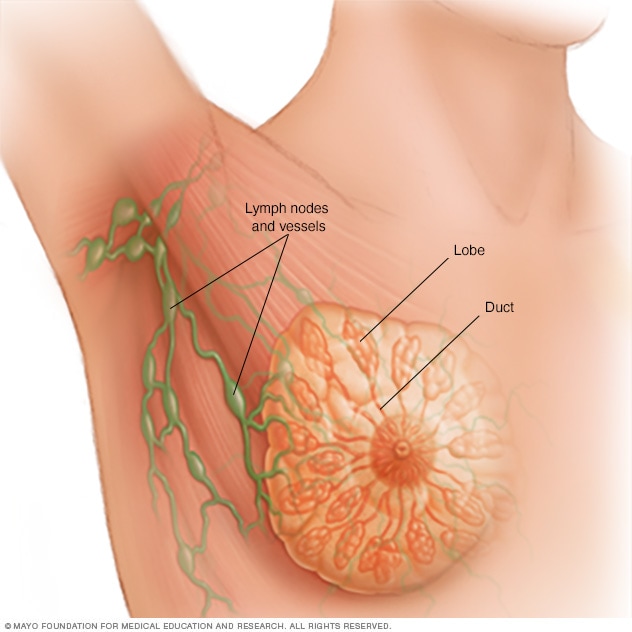
Breast anatomy
Each breast contains 15 to 20 lobes of glandular tissue, arranged like the petals of a daisy. The lobes are further divided into smaller lobules that produce milk for breastfeeding. Small tubes, called ducts, conduct the milk to a reservoir that lies just beneath the nipple.
Ductal carcinoma in situ (DCIS) is a very early form of breast cancer. It causes a growth of cancer cells inside a milk duct in the breast. The cancer cells haven't spread into the breast tissue. The term "in situ" means in its original place. Because the cancer cells remain inside the duct, DCIS is sometimes called noninvasive, preinvasive or stage 0 breast cancer.
Sometimes cancer that starts as DCIS can become invasive breast cancer. The cancer cells may break through the duct and grow into the surrounding breast tissue. When this happens, the cancer is called invasive ductal carcinoma. For most people with ductal carcinoma in situ, this never happens.
DCIS raises the risk of developing invasive breast cancer. But most people diagnosed with ductal carcinoma in situ never develop invasive breast cancer. Because healthcare professionals can't always predict whether DCIS will become invasive, they usually recommend treatment. Deciding which treatments to have involves a careful discussion of the benefits and risks with your healthcare team.
Treatment for DCIS often involves surgery. Some people also have radiation therapy or estrogen blocker therapy to lower the risk that the cancer will return.
DCIS has a name that's similar to lobular carcinoma in situ (LCIS), but these are different conditions. LCIS causes a growth of cells in the milk-producing glands, called lobules. LCIS is not considered breast cancer. Instead, it's a condition that increases the risk of developing breast cancer in the future.
Ductal carcinoma in situ can occur on its own or be found along with invasive breast cancer. When DCIS is found with invasive breast cancer, it's treated as invasive cancer. If the invasive area is very small, healthcare professionals may call it DCIS with microinvasion. Even with only this small area of invasion, it's treated as invasive cancer rather than noninvasive DCIS.
Products & Services
Types
Ductal carcinoma in situ (DCIS) has different types. The types describe how the cells grow within a breast duct. These patterns of growth include the following:
- Comedo DCIS has areas of dead cells in the center of the growth of cancer cells. These areas of dead cells are called comedo necrosis.
- Cribriform DCIS has small openings within the growth of cells, making a pattern that looks like a sieve.
- Micropapillary DCIS has small fingerlike projections that extend from the area of cancer.
- Papillary DCIS has fingerlike projections that extend from the area of cancer. The projections contain blood vessels.
- Solid DCIS causes cancer cells to completely fill the duct.
Results from a biopsy or surgery often include the growth pattern of the DCIS. But this pattern is only one part of the diagnosis. Healthcare professionals often rely more on other features, such as the grade and hormone receptor status, to estimate the risk of recurrence and make treatment plans.
Symptoms
Ductal carcinoma in situ (DCIS) often doesn't cause any symptoms.
The cancer is usually found on a mammogram. It appears as tiny flecks of calcium in the breast tissue. These are calcium deposits, often referred to as calcifications.
Sometimes DCIS can cause symptoms such as:
- A breast lump.
- Nipple discharge that is bloody, watery or yellow in color. The discharge often comes out on its own, without squeezing the breast or nipple. It tends to come from one opening in one nipple.
When to see a doctor
Make an appointment with a doctor or other healthcare professional if you notice a change in your breasts. Changes to look for may include a lump, an area of puckered or otherwise unusual skin, a thickened region under the skin, and nipple discharge.
Ask your healthcare professional when to consider breast cancer screening and how often to have it. Most healthcare professionals recommend routine breast cancer screening beginning in your 40s.
Causes
The exact cause of ductal carcinoma in situ (DCIS) often isn't known. Healthcare professionals know this cancer starts when changes happen in the DNA inside cells that line a milk duct. But exactly what causes these DNA changes isn't always known.
How DNA changes lead to cancer
A cell's DNA holds the instructions that tell a cell what to do. In healthy cells, the DNA gives instructions to multiply at a set rate. The instructions also tell the cells to die off at a set time. In cancer cells, changes happen in the DNA. The changes alter the instructions for multiplying and dying. The result is that the cells multiply faster than healthy cells. And they can keep living when healthy cells would die. In DCIS, this causes too many cancer cells to build up inside a milk duct.
How DNA changes occur
For most people, the DNA changes that lead to DCIS happen by chance. Sometimes DNA changes that increase the risk are passed from parents to children. Healthcare professionals say these changes are inherited or hereditary.
Not everyone with an inherited DNA change develops DCIS or another form of breast cancer. And most people diagnosed with DCIS don't have an inherited DNA change. It's likely that the cancer develops because of a mix of genetic, environmental and lifestyle factors. More research is needed to understand exactly why these DNA changes happen.
How DCIS becomes invasive
The DNA changes that lead to DCIS cause cancer cells to grow inside a milk duct. At first the cancer cells stay inside the duct. They haven't developed the ability to break through the wall of the duct.
Ductal carcinoma in situ often remains confined to the duct. But sometimes it grows into nearby breast tissue and becomes invasive. Healthcare professionals don't know why this happens in some people. Most people with DCIS never develop invasive breast cancer.
Risk factors
Several factors may increase the risk of ductal carcinoma in situ (DCIS). It is an early form of breast cancer, and it shares many of the same risk factors with invasive breast cancer.
Risk factors related to your personal medical history and your family's medical history include:
- A family history of breast cancer. If a parent, sibling or child had breast cancer, your risk is increased. The risk is higher if your family has a history of getting breast cancer at a young age. The risk also is higher if you have multiple family members with breast cancer. Still, most people diagnosed with breast cancer don't have a family history of the disease.
- A personal history of breast cancer. If you've had cancer in one breast, you have an increased risk of getting cancer in the other breast.
- A personal history of breast conditions. Certain breast conditions are markers for a higher risk of breast cancer. These conditions include lobular carcinoma in situ (LCIS) and atypical hyperplasia of the breast. If you've had a breast biopsy that found one of these conditions, you have an increased risk of breast cancer.
- Increasing age. The risk of breast cancer goes up as you get older.
- Inherited DNA changes that increase cancer risk. Certain DNA changes that increase the risk of breast cancer can be passed from parents to children. The most well-known changes are called BRCA1 and BRCA2. These changes can greatly increase your risk of breast cancer and other cancers, but not everyone with these DNA changes gets cancer.
- Radiation exposure. Radiation treatments to the chest as a child or young adult raise the risk of breast cancer.
Risk factors related to reproductive history and hormone exposure include:
- Beginning your period at a younger age. Beginning your period before age 12 increases the risk of breast cancer.
- Beginning menopause at an older age. Beginning menopause after age 55 increases the risk of breast cancer.
- Being female. Women are much more likely than men are to get breast cancer. But anyone with breast tissue can get breast cancer, including men.
- Having your first child at an older age. Giving birth to your first child after age 35 may increase the risk of breast cancer.
- Having never been pregnant. Having been pregnant one or more times lowers the risk of breast cancer. Never having been pregnant increases the risk.
Other risk factors include:
- Dense breast tissue. Breast tissue is made up of fatty tissue and dense tissue. Fatty tissue is made of fat. Dense tissue is made of milk glands, milk ducts and fibrous tissue. If you have dense breasts, you have more dense tissue than fatty tissue in your breasts. Having dense breasts increases the risk of developing breast cancer and makes it harder to detect cancer on a mammogram. Talk with your healthcare team about other tests you might have in addition to mammograms to look for breast cancer.
- Alcohol use. Drinking alcohol increases the risk of breast cancer. There is no safe amount of alcohol when it comes to breast cancer. The more alcohol you drink, the greater your risk.
- Obesity. Obesity increases the risk of breast cancer.
Prevention
There's no sure way to prevent ductal carcinoma in situ (DCIS). However, some healthy lifestyle choices may help lower your risk of DCIS and other forms of breast cancer. Screening tests and breast awareness can't prevent breast cancer, but they may help detect it early, when treatment is more likely to be successful.
Ways to lower your risk of breast cancer
- Consider preventive medicines. Talk with your healthcare professional about your risk of breast cancer. People with a high risk might consider preventive medicines that help lower the risk of breast cancer.
-
Drink alcohol in moderation, if at all. For breast cancer prevention, there is no safe amount of alcohol. If you're concerned about your breast cancer risk, you may choose to not drink alcohol.
If you choose to drink alcohol, limit how often you drink and keep the amount small. For overall health, drink one or fewer drinks a day. Do not drink every day. The less you drink, the better.
- Exercise most days of the week. Aim for at least 30 minutes of exercise on most days of the week. If you haven't been active lately, ask your healthcare professional whether exercising is OK and start slowly.
- Maintain a healthy weight. If your weight is healthy for you, work to maintain that weight. If you need to lose weight, ask a healthcare professional about healthy ways to lower your weight. In general, try to eat fewer calories and slowly increase how much you exercise.
Ways to help detect breast cancer early
- Ask about breast cancer screening. Talk with a healthcare professional about when to begin breast cancer screening. Ask about the benefits and risks of screening. Together, you can decide what breast cancer screening tests are right for you.
-
Become familiar with your breasts. Do occasional breast self-exams so that you know what your breasts typically feel like. If there is a new change, a lump or something not typical in your breasts, report it to a healthcare professional right away.
Breast awareness through self-exams can't prevent breast cancer. But it may help you to better understand the look and feel of your breasts. This might make it more likely that you'll notice if something changes.
Aug. 08, 2026
- Niederhuber JE, et al., eds. Cancer of the breast. In: Abeloff's Clinical Oncology. 6th ed. Elsevier; 2020. https://www.clinicalkey.com. Accessed March 1, 2024.
- Townsend CM Jr, et al. Diseases of the breast. In: Sabiston Textbook of Surgery: The Biological Basis of Modern Surgical Practice. 21st ed. Elsevier; 2022. https://www.clinicalkey.com. Accessed March 1, 2024.
- Breast cancer. National Comprehensive Cancer Network. https://www.nccn.org/guidelines/guidelines-detail?category=1&id=1419. Accessed June 1, 2026.
- Abraham J, et al., eds. Breast cancer. In: The Bethesda Handbook of Clinical Oncology. 6th ed. Kindle edition. Wolters Kluwer; 2023. Accessed March 1, 2024.
- Collins LC, et al. Breast ductal carcinoma in situ: Epidemiology, clinical manifestations, and diagnosis. https://www.uptodate.com/contents/search. Accessed June 3, 2026.
- Distress management. National Comprehensive Cancer Network. https://www.nccn.org/guidelines/guidelines-detail?category=3&id=1431. Accessed March 1, 2024.
- Record SM, et al. How to navigate the treatment spectrum from multimodality therapy to observation alone for ductal carcinoma in situ. Surgical Oncology Clinics of North America. 2023; doi:10.1016/j.soc.2023.05.011.
- Breast cancer prevention (PDQ) – Patient version. National Cancer Institute. https://www.cancer.gov/types/breast/patient/breast-prevention-pdq. Accessed March 1, 2024.
- In situ. Dorland's Medical Dictionary Online. https://www.dorlandsonline.com. Accessed June 5, 2026.
- Klimberg VS, et al., eds. Bland and Copeland's The Breast: Comprehensive Management of Benign and Malignant Diseases. 6th ed. Elsevier; 2024. https://www.clinicalkey.com. Accessed June 3, 2026.
- Collins LC, et al. Ductal carcinoma in situ: Treatment and prognosis. https://www.uptodate.com/contents/search. Accessed June 1, 2026.
- Collins LC, et al. Microinvasive breast carcinoma. https://www.uptodate.com/contents/search. Accessed June 3, 2026.
- Bleiweiss IJ. Pathology of breast cancer. https://www.uptodate.com/contents/search. Accessed June 3, 2026.
- Dabbs DJ. Ductal carcinoma in situ. In: Breast Pathology. 3rd ed. Elsevier; 2024. https://www.clinicalkey.com. Accessed June 5, 2026.
- Protocol for the examination of biopsy specimens from patients with ductal carcinoma in situ (DCIS) of the breast. College of American Pathologists. https://www.cap.org/protocols-and-guidelines/cancer-reporting-tools/cancer-protocol-templates. Accessed June 4, 2026.
- Cribriform. Dorland's Medical Dictionary Online. https://www.dorlandsonline.com. Accessed June 5, 2026.
- Delaloge S, et al. Ductal carcinoma in situ of the breast: Finding the balance between overtreatment and undertreatment. The Lancet. 2024; doi:10.1016/S0140-6736(24)00425-2.
- Protocol for the examination of resection specimens from patients with ductal carcinoma in situ (DCIS) of the breast. College of American Pathologists. https://www.cap.org/protocols-and-guidelines/cancer-reporting-tools/cancer-protocol-templates. Accessed June 4, 2026.
- Tumor grade. National Cancer Institute. https://www.cancer.gov/about-cancer/diagnosis-staging/diagnosis/tumor-grade. Accessed April 16, 2026.
- Worni M, et al. Trends in treatment patterns and outcomes for ductal carcinoma in situ. Journal of the National Cancer Institute. 2015; doi:10.1093/jnci/djv263.
- Breast SPOREs. National Cancer Institute. https://dctd.cancer.gov/research/spores/focus-area/breast. Accessed April 17, 2026.
- Member institutions. Alliance for Clinical Trials in Oncology. https://www.allianceforclinicaltrialsinoncology.org/main/public/standard.xhtml?path=%2FPublic%2FInstitutions. Accessed April 17, 2026.
- Andreas A, et al., eds. The breast. In: Grainger & Allison's Diagnostic Radiology: A Textbook of Medical Imaging. 7th ed. Elsevier; 2021. https://www.clinicalkey.com. Accessed July 1, 2026.
- AskMayoExpert. Nipple discharge. Mayo Clinic; 2024.
Related
Associated Procedures
Products & Services
Ductal carcinoma in situ (DCIS)