Diagnosis
Breast cancer diagnosis often begins with an exam. Your healthcare professional also may ask about your symptoms and medical history. Imaging tests can look for changes in the breast tissue. To confirm whether there is cancer, a sample of tissue is removed from the breast for testing.
Sometimes breast cancer diagnosis starts when a screening mammogram finds something concerning. Most mammogram guidelines recommend that women start breast cancer screening in their 40s and repeat it every year or two. If you have a family history of breast cancer or other risk factors that raise your risk, you may think about starting sooner or having screening more often. Talk about your breast cancer screening options with your healthcare team.
Breast exam
During a breast exam, a healthcare professional looks at the breasts for anything that's not typical. This might include changes in the skin or to the nipple. Then the health professional feels the breasts for lumps. The health professional also feels along the collarbones and around the armpits for lumps.
Mammogram
Receiving a mammogram
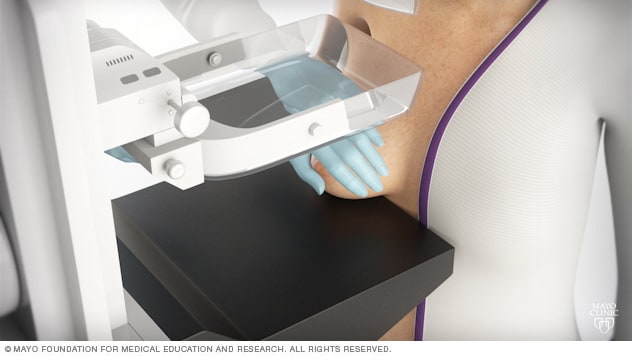
Receiving a mammogram
During a mammogram, you stand in front of an X-ray machine designed for mammography. A technician places your breast on a platform and positions the platform to match your height. The technician helps you position your head, arms and torso to allow a clear view of your breast.
A mammogram is an X-ray of the breast tissue. Mammograms are commonly used to screen for breast cancer. If a screening mammogram finds something concerning, you might have another mammogram to look at the area more closely. This more-detailed mammogram is called a diagnostic mammogram. It's often used to look closely at both breasts.
Breast ultrasound
Ultrasound uses sound waves to make pictures of structures inside the body. A breast ultrasound may give your healthcare team more information about a breast lump. For example, an ultrasound might show whether the lump is a solid mass or a fluid-filled cyst. The healthcare team uses this information to decide what tests you might need next.
Breast MRI
Breast MRI
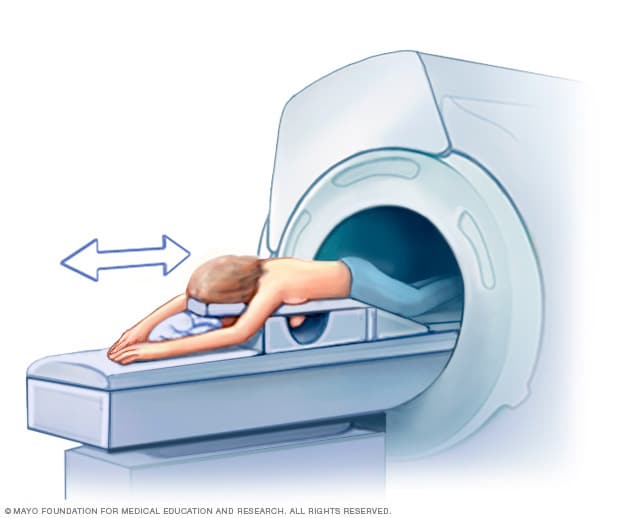
Breast MRI
Getting a breast MRI involves lying face down on a padded scanning table. The breasts fit into a hollow space in the table. The hollow has coils that get signals from the MRI. The table slides into the large opening of the MRI machine.
MRI machines use a magnetic field and radio waves to create pictures of the inside of the body. A breast MRI can make more-detailed pictures of the breast. Sometimes this method is used to look closely for any other areas of cancer in the affected breast. It also might be used to look for cancer in the other breast. Before a breast MRI, you usually receive an injection of contrast material. The contrast helps the tissue show up better in the images.
Breast biopsy
Core needle biopsy
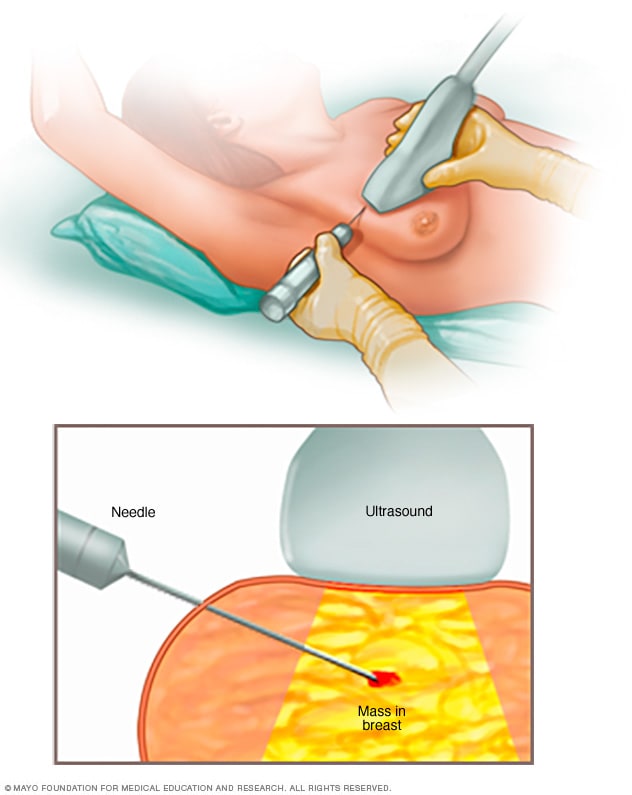
Core needle biopsy
A core needle biopsy uses a long, hollow tube to obtain a sample of tissue. The sample is sent to a lab for testing by doctors who specialize in analyzing blood and body tissue, called pathologists.
A biopsy is a procedure to remove a sample of tissue for testing in a lab. For a breast biopsy, a healthcare professional puts a needle through the skin and into the breast tissue. The health professional guides the needle using images created with X-rays, ultrasound or another type of imaging. Once the needle reaches the right place, the health professional uses the needle to draw out tissue from the breast. A marker may be placed in the spot where the tissue sample was removed. This small metal marker shows up on imaging tests. It helps your healthcare team mark the area of concern.
Lab testing
The tissue sample from a biopsy goes to a lab for testing. Tests can show whether the cells in the sample are cancerous. Other tests give more details about the cells. The testing is done by pathologists. Pathologists are doctors who look for disease in cells, fluids and tissue removed from the body.
Results are often given in a pathology report. The results may show:
- Cell type. The results show whether the cancer cells are ductal cells, lobular cells or other kinds of cells.
- Cell grade. The grade of the breast cancer cells is based on how the cells look under a microscope. The grade tells the healthcare team whether the cancer is likely to grow slowly or quickly.
- Hormone receptor status. Most breast cancer cells use the hormones estrogen and progesterone to help them grow. Cells that do this have receptors that help them catch the hormones circulating in the bloodstream. If testing finds receptors for one or both hormones, the cancer is hormone receptor (HR) positive. If testing doesn't find receptors, then the cancer is HR negative.
- HER2 status. Some breast cancer cells use a protein called human epidermal growth factor receptor 2 (HER2) to help them grow. Healthy breast cells make some HER2, but the cancer cells can make a lot more. If tests show the cancer cells have extra copies of the HER2 gene or increased levels of the HER2 protein, the cancer is HER2 positive. If testing doesn't find these, the cancer is HER2 negative.
- Ki-67 score. Ki-67 is a protein that marks how fast the cancer cells divide. This is called the proliferation rate. The Ki-67 score goes from 0% to 100%. A higher score suggests a higher rate of dividing cells and faster growth.
The healthcare team uses the results from lab tests to decide on the cancer's stage, understand the prognosis and make a treatment plan.
Staging tests
Once your healthcare team diagnoses your breast cancer, you may have other tests to figure out the extent of the cancer. This is called the cancer's stage. Your healthcare team uses your cancer's stage to understand your prognosis.
Tests and procedures used to stage breast cancer may include:
Not everyone needs all of these tests. Your healthcare team picks the right tests based on your specific situation.
More Information
Grades
A cancer's grade is a number that tells the healthcare team how different the cancer cells look from healthy cells. Breast cancer grades go from 1 to 3.
To decide on the grade, doctors in the lab, called pathologists, use a microscope to look at cancer cells from a biopsy. If the cancer cells look similar to healthy cells, then the cancer cells are low grade. Low-grade cancer grows slowly. If the cancer cells look very different from healthy cells, then the cancer cells are high grade. High-grade cancer grows quickly.
The grades of breast cancer include:
- Grade 1. Grade 1 is a low grade. The cancer cells look similar to healthy cells. Grade 1 breast cancer typically grows slowly and has a low risk of spreading. It's sometimes called well-differentiated cancer.
- Grade 2. Grade 2 is an intermediate grade. The cancer cells look a little different from healthy cells. Grade 2 breast cancer grows more quickly than grade 1 cancer. It also has a higher risk of spreading. Sometimes it's called moderately differentiated cancer.
- Grade 3. Grade 3 is a high grade. The cancer cells look very different from healthy cells. Grade 3 breast cancer is considered a fast-growing cancer. It has the highest risk of spreading. Sometimes it's called poorly differentiated cancer.
The grade helps the healthcare team understand the prognosis and make a treatment plan. High-grade cancers are more likely to spread, so they may need more-intense treatment. Grade 1 or 2 breast cancer cells are more likely to have hormone receptors. These cancers are likely to be treated with estrogen blocker therapy. Grade 3 cancers are more likely to respond to chemotherapy.
Treatment
Breast cancer treatments include surgery, radiation therapy and medicines. Medicines used to treat breast cancer include estrogen blocker therapy, chemotherapy, targeted therapy and immunotherapy.
For early-stage breast cancers, treatment often starts with surgery to remove the cancer. Many people have other treatments after surgery, such as radiation and medicines. Some people receive medicines before surgery.
When breast cancer is found early, it often can be cured. A cure is less likely when the cancer spreads to other parts of the body.
If the cancer spreads, treatment usually starts with medicines. Medicines can slow the growth of the cancer and help you live longer. If the first treatment stops working, the care team may adjust the medicines or try new medicines. Newer treatments and personalized treatment approaches are helping many people live longer with advanced breast cancer.
Your treatment plan depends on your particular breast cancer. Your healthcare team considers the stage of the cancer, how quickly it's growing, whether the cancer cells are sensitive to hormones and whether the cells make extra HER2. Your care team also considers your overall health and what you prefer.
Here's how aspects of your cancer may affect your treatment options:
- Ductal versus lobular. Invasive lobular carcinomas are more likely to be hormone receptor (HR) positive and HER2 negative, so these cancers usually are treated with estrogen blocker therapy. Invasive ductal carcinomas vary more in their HR status and HER2 status.
- Low grade versus high grade. Low-grade cancers are likely to be HR positive. They are more likely to be treated with estrogen blocker therapy. High-grade cancers are more likely to be treated with chemotherapy.
- HR positive versus HR negative. The HR status tells the healthcare team whether estrogen blocker therapy might work against the cancer. HR positive cancers, including estrogen receptor positive breast cancers, are treated with estrogen blocker therapy. HR negative cancers usually are not.
- HER2 positive versus HER2 negative. HER2 positive cancers often are treated with anti-HER2 targeted therapy. HER2 negative cancers usually aren't. Some cancers have a low level of HER2 but not enough to be called positive. These cancers are called HER2 low. They are sometimes treated with medicines used for HER2 positive cancer.
- Triple-negative cancer. Triple-negative breast cancer is HR negative and HER2 negative. Estrogen blocker therapy and anti-HER2 therapy generally aren't used for this cancer. It's more likely to be treated with chemotherapy and immunotherapy medicines.
There are many options for breast cancer treatment. You don't have to make these decisions on your own. Your healthcare team can help explain your options and work with you to choose a treatment plan that fits your needs and goals. Consider seeking a second opinion from a breast specialist in a breast center or clinic. Some people also find it helpful to talk with others who have faced similar breast cancer treatment decisions.
Breast cancer surgery
Lumpectomy
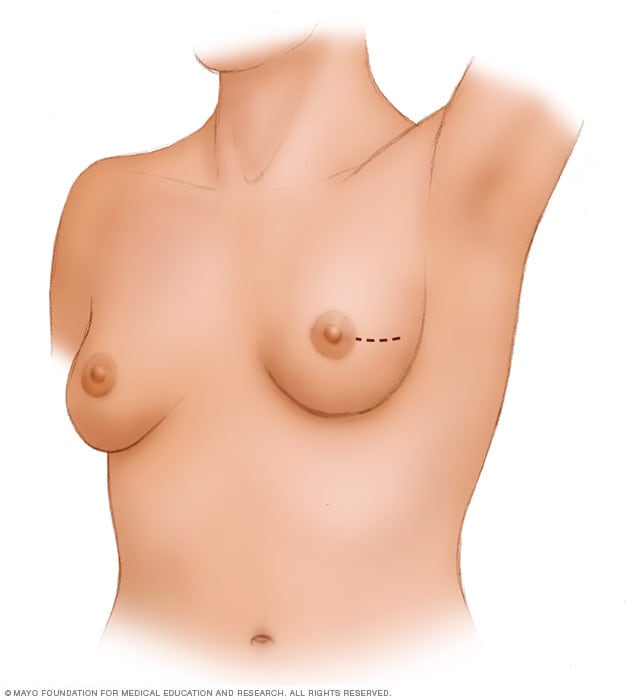
Lumpectomy
A lumpectomy involves removing the cancer and some of the healthy tissue that surrounds it. This illustration shows one possible incision that can be used for this procedure, though your surgeon will determine the approach that's best for your particular situation.
Mastectomy

Mastectomy
During a total mastectomy, the surgeon removes the breast tissue, nipple, areola and skin. A total mastectomy also is called a simple mastectomy. Other mastectomy procedures may leave some parts, such as the skin or the nipple. Surgery to create a new breast is optional. It can be done at the same time as mastectomy surgery or it can be done later.
Sentinel node biopsy
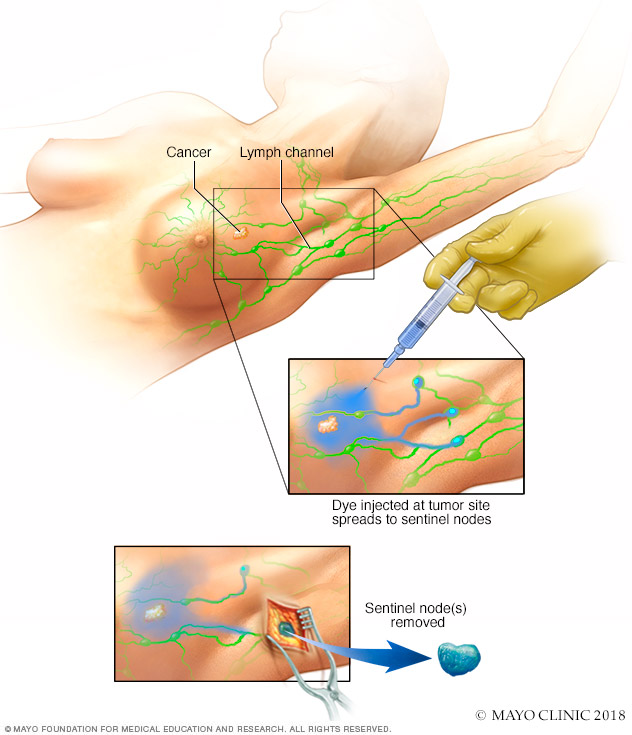
Sentinel node biopsy
Sentinel node biopsy identifies the first few lymph nodes into which a tumor drains. The surgeon uses a harmless dye and a weak radioactive solution to locate the sentinel nodes. The nodes are removed and tested for signs of cancer.
Breast cancer surgery typically involves a procedure to remove the breast cancer and, sometimes, a procedure to remove some nearby lymph nodes. The main surgical procedures used to treat breast cancer include:
- Lumpectomy. A lumpectomy is surgery to remove the breast cancer and some of the healthy tissue around it. It allows you to maintain most of your breast. Other names for this surgery are breast-conserving surgery and wide local excision. Most people have radiation therapy after lumpectomy.
- Mastectomy. A mastectomy is surgery to remove all breast tissue from a breast. Total mastectomy, also called simple mastectomy, removes all of the breast, including the lobules, ducts, fatty tissue and some skin, including the nipple and areola. Other procedures include skin-sparing mastectomy, which leaves the skin, and nipple-sparing mastectomy, which leaves the areola, nipple and skin.
- Lymph node surgery. Lymph node surgery removes nearby lymph nodes to check them for cancer. When breast cancer spreads, it most often goes to the lymph nodes under the arm. A sentinel node biopsy removes some of those lymph nodes for testing. An axillary lymph node dissection removes most of the underarm lymph nodes.
- Double mastectomy. Some people who have cancer in one breast may choose to have their other breast removed, even if it doesn't have cancer. Removing both breasts during the same surgery is called a double mastectomy. It might be an option if you have a high risk of getting cancer in the other breast. The risk might be high if you have a strong family history of cancer or have DNA changes that increase the risk of cancer.
Complications of breast cancer surgery depend on the procedures you choose. All operations have a risk of pain and infection. Removing lymph nodes in the armpit carries a risk of arm swelling, called lymphedema.
You may choose to have breast reconstruction after mastectomy surgery. Breast reconstruction is surgery to restore shape to the breast. Options might include reconstruction with a breast implant or reconstruction using your own tissue. Consider asking your healthcare team for a referral to a plastic surgeon before your breast cancer surgery.
Radiation therapy
Radiation therapy
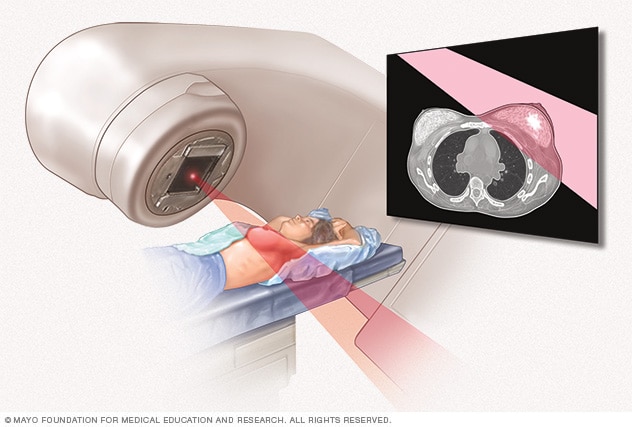
Radiation therapy
External beam radiation uses high-powered beams of energy to kill cancer cells. Beams of radiation are precisely aimed at the cancer using a machine that moves around your body.
Radiation therapy treats cancer with powerful energy beams. The energy can come from X-rays, protons or other sources.
Radiation therapy for breast cancer often uses external beam radiation. During this type of radiation therapy, you lie on a table while a machine moves around you. The machine directs radiation to precise points on your body.
Radiation therapy is often used after breast cancer surgery. It can kill any cancer cells that might be left after surgery. The radiation lowers the risk of the cancer coming back.
Side effects of radiation therapy include feeling very tired and having a sunburnlike rash where the radiation is aimed. The breast may be painful or feel more firm.
Chemotherapy
Chemotherapy treats cancer with strong medicines. Many chemotherapy medicines exist. Chemotherapy for breast cancer often involves a combination of chemotherapy medicines. Most are given through a vein. Some are available in pill form.
Chemotherapy for breast cancer is often used after surgery. It can kill any cancer cells that might remain and lower the risk of the cancer coming back.
Sometimes chemotherapy is given before breast cancer surgery. This may help shrink the cancer so that surgery is possible or so that you might consider a less invasive surgery. It also gives the care team a chance to see how well the medicines work.
When the cancer spreads to other parts of the body, chemotherapy may help control it.
Chemotherapy side effects depend on which medicines you receive. Common side effects include hair loss, nausea, feeling very tired and mouth sores.
Estrogen blocker therapy
Estrogen blocker therapy treats breast cancer that is sensitive to hormones. This means the cancer cells have proteins called receptors. The receptors bind to the hormones estrogen and progesterone. The cancer grows in response to these hormones. Healthcare professionals call these cancers hormone receptor positive. Most breast cancers are sensitive to hormones.
Estrogen blocker therapy also is called endocrine therapy and hormone therapy for breast cancer.
Estrogen blocker therapy treatments can include:
- Medicines that block or destroy hormone receptors. These medicines are called selective estrogen receptor modulators.
- Medicines that lower hormone production. These medicines are called aromatase inhibitors.
- Surgery or medicines to stop the ovaries from making hormones.
Estrogen blocker therapy often is used after surgery and other treatments. It can lower the risk that the cancer will come back.
If the cancer spreads to other parts of the body, estrogen blocker therapy can help control it.
Estrogen blocker therapy side effects depend on the treatment you receive. The side effects can include hot flashes and night sweats.
Targeted therapy
Targeted therapy uses medicines that attack specific chemicals in the cancer cells. By blocking these chemicals, targeted treatments can cause cancer cells to die.
Some treatments target cancer cells that make extra HER2. Breast cancer that makes extra HER2 is called HER2 positive breast cancer. Other targeted therapy medicines attack other proteins in the body that help cancer cells grow. Your cancer cells may be tested to see whether these medicines might help you.
Targeted therapy medicines may be used before surgery to shrink the cancer and make it easier to remove. Some are used after surgery to lower the risk that the cancer will come back. Others are used only when the cancer has spread to other parts of the body.
Side effects of targeted therapy differ greatly by the medicine. In general, this treatment can cause diarrhea, mouth sores and nail changes. There also can be changes in how well the liver works.
Immunotherapy
Immunotherapy is a treatment with medicine that helps the body's immune system kill cancer cells. The immune system fights off diseases by attacking germs and other cells that shouldn't be in the body. Cancer cells survive by hiding from the immune system. Immunotherapy helps the immune system cells find and kill the cancer cells.
Immunotherapy might be an option for treating cancer that's triple negative. Triple-negative breast cancer means that the cancer cells don't have hormone receptors and don't make extra HER2. This treatment may be used before and after surgery.
Immunotherapy side effects include diarrhea, feeling very tired and rash.
Palliative care
Palliative care is a special type of healthcare that helps you feel better when you have a serious illness. If you have cancer, palliative care can help relieve pain and other symptoms. A team of healthcare professionals gives palliative care. This team can include doctors, nurses and other specially trained health professionals. Their goal is to improve the quality of life for you and the people who care about you.
Palliative care specialists work with you, your family and your healthcare team to help you feel better. They provide added support while you have cancer treatment. You can have palliative care at the same time as treatment for cancer, such as surgery, chemotherapy or radiation therapy.
When palliative care is used with other appropriate treatments, people with cancer may feel better and live longer.
More Information
More Information
Alternative medicine
No alternative medicine treatments have been found to cure breast cancer. But complementary and alternative medicine therapies for cancer may help you cope with side effects of treatment.
Alternative medicine for fatigue
Many people with breast cancer have fatigue during and after treatment. This feeling of being very tired and worn down can continue for years. When combined with care from your healthcare team, complementary and alternative medicine therapies may help relieve fatigue.
Talk with your healthcare team about trying these options.
- Expressing your feelings. Find an activity that allows you to write about or discuss your emotions. Examples include writing in a journal, participating in a support group or talking to a counselor.
- Gentle exercise. If you get the OK to exercise from your healthcare team, choose a gentle activity that you enjoy. Add more exercise as you feel up to it. Consider walking, swimming and yoga.
- Managing stress. Take control of the stress in your daily life. Try stress-reduction techniques such as muscle relaxation, visualization, and spending time with friends and family.
- Other options. Acupuncture treatments and massage may help with fatigue. Get the OK from your healthcare team first to make sure these are safe for you.
Coping and support
Learning you have breast cancer can be unexpected, and it's natural to have questions about what comes next. You may be receiving a lot of information and facing decisions about surgery, radiation and medical treatments. It's common to have a range of feelings that may change from day to day, and it can take time to process everything. As you move forward, here are some ideas that might be helpful.
Learn enough to make decisions about your care
If you'd like to know more about your breast cancer, ask your healthcare team for the details of your cancer. Write down the type, stage and hormone receptor status. Ask for good sources of information where you can learn more about your treatment options.
Knowing more about your cancer and your options may help you feel more confident when making treatment decisions. Still, some people don't want to know the details of their cancer. If this is how you feel, let your care team know that too.
Find a good listener
Finding someone who is willing to listen to you talk about your hopes and fears can be helpful as you manage a cancer diagnosis. This could be a friend or family member. A counselor, medical social worker or clergy member also may offer helpful guidance and care.
Talk with others who have been diagnosed with breast cancer
You may find it helpful and encouraging to talk to others who have been diagnosed with breast cancer. Ask your healthcare team about local support groups, or contact the American Cancer Society or another cancer organization in your area to find resources. Find support online through Mayo Clinic Connect, a community where you can connect with others for support, practical information and answers to everyday questions.
Let friends and family help
Your friends, family or other people you trust can provide a crucial support network for you during your cancer treatment. As you begin telling people about your breast cancer diagnosis, you'll likely get many offers for help. Think ahead about things you may want help with. Examples include listening when you want to talk or helping you with preparing meals.
Preparing for your appointment
Make an appointment with a doctor or other healthcare professional if you have any symptoms that worry you. If an exam or imaging test shows you might have breast cancer, your healthcare team likely will refer you to a specialist.
Specialists who care for people with breast cancer include:
- Breast medicine specialists.
- Breast surgeons.
- Genetic counselors.
- Oncologists. These doctors specialize in treating cancer.
- Plastic surgeons.
- Radiation oncologists. These doctors treat cancer with radiation.
- Radiologists. These doctors specialize in diagnostic tests, such as mammograms.
What you can do
Here are some things you can do to prepare.
- Write down any symptoms you're experiencing. Include symptoms even if they don't seem related to the reason you scheduled the appointment.
- Write down key personal information. Include any major stresses or recent life changes.
- Write down your family history of cancer. Note any family members who have had cancer. Note how each member is related to you, the type of cancer, the age at diagnosis and whether each person survived.
- Make a list of all medicines, vitamins or supplements that you're taking.
- Keep all records that relate to your cancer diagnosis and treatment. Organize them in a binder, folder or digitally. Take your records with you to your appointments.
- Take a family member or friend along if possible. Sometimes it can be difficult to remember all the information provided during an appointment. Someone who goes with you may remember something that you missed or forgot.
- Write down questions to ask your healthcare professional.
Your time with your healthcare professional is limited. Prepare a list of questions so that you can make the most of your time together. List your questions from most important to least important in case time runs out.
Questions to ask about your diagnosis include:
- What type of breast cancer do I have?
- What is the stage of my cancer?
- Can you explain my pathology report to me? Can I have a copy for my records?
- Do I need any more tests?
Questions to ask about treatments include:
- What treatment options are available for me?
- What are the benefits from each treatment you recommend?
- What are the side effects of each treatment option?
- How will each treatment affect my daily life? Can I continue working?
- Is there one treatment you recommend over the others?
- What would you recommend to a friend or family member in my situation?
- How quickly do I need to make a decision about cancer treatment?
- What happens if I don't want cancer treatment?
Other questions to ask include:
- What will cancer treatment cost?
- Does my insurance plan cover the tests and treatment you're recommending?
- Should I seek a second opinion? Will my insurance cover it?
- Are there any brochures or other printed material that I can take with me? What websites or books do you recommend?
- Are there any clinical trials or newer treatments that I should consider?
In addition to the questions that you've prepared, don't hesitate to ask other questions you think of during your appointment.
What to expect from your doctor
Be prepared to answer some questions about your symptoms and your health, such as:
- When did your symptoms start?
- Have your symptoms been continuous or occasional?
- How severe are your symptoms?
- Has a mammogram ever detected something concerning?
- Have you ever had a breast biopsy?
Sept. 01, 2026
- Breast cancer facts and figures. American Cancer Society. https://www.cancer.org/research/cancer-facts-statistics/breast-cancer-facts-figures.html. Accessed Aug. 14, 2026.
- Klimberg VS, et al., eds. Bland and Copeland's The Breast: Comprehensive Management of Benign and Malignant Diseases. 6th ed. Elsevier; 2024. https://www.clinicalkey.com. Accessed Aug. 14, 2026.
- Dabbs DJ. Breast Pathology. 3rd ed. Elsevier; 2024. https://www.clinicalkey.com. Accessed Aug. 18, 2026.
- Cancer stat facts: Female breast cancer. National Cancer Institute. https://seer.cancer.gov/statfacts/html/breast.html. Accessed Aug. 14, 2026.
- Breast cancer. RadiologyInfo.org. https://www.radiologyinfo.org/en/info/breast-cancer. Accessed Aug. 14, 2026.
- Aster JC, et al., eds. Neoplasia. In: Robbins, Cotran & Kumar Pathologic Basis of Disease. 11th ed. Elsevier; 2026. https://www.clinicalkey.com. Accessed Aug. 14, 2026.
- Bleiweiss IJ. Pathology of breast cancer. https://www.uptodate.com/contents/search. Accessed Aug. 18, 2026.
- DeVita VT Jr, et al., eds. Breast cancer. In: DeVita, Hellman, and Rosenberg's Cancer: Principles and Practice of Oncology. 12th ed. ProQuest Ebook Central. Wolters Kluwer; 2023. Accessed Aug. 14, 2026.
- Cutaneous presentations of breast cancer. VisualDx. https://www.visualdx.com. Accessed Aug. 14, 2026.
- Tyler DS, et al., eds. Diseases of the breast. In: Sabiston Textbook of Surgery: The Biological Basis of Modern Surgical Practice. 22nd ed. Elsevier; 2026. https://www.clinicalkey.com. Accessed Aug. 14, 2026.
- Basappa SN, et al. Breast cancer mode of detection in a population-based cohort. Mayo Clinic Proceedings. 2023; doi:10.1016/j.mayocp.2022.10.010.
- AskMayoExpert. Breast cancer screening and options for supplemental screening in the dense breast. Mayo Clinic; 2024.
- Breast cancer risk reduction. National Comprehensive Cancer Network. https://www.nccn.org/guidelines/guidelines-detail?category=2&id=1420. Accessed Aug. 14, 2026.
- Breast cancer screening and diagnosis. National Comprehensive Cancer Network. https://www.nccn.org/guidelines/guidelines-detail?category=2&id=1421. Accessed Aug. 14, 2026.
- Breast cancer. National Comprehensive Cancer Network. https://www.nccn.org/guidelines/guidelines-detail?category=1&id=1419. Accessed Aug. 14, 2026.
- Tumor grade. National Cancer Institute. https://www.cancer.gov/about-cancer/diagnosis-staging/diagnosis/tumor-grade. Accessed Aug. 14, 2026.
- Protocol for the examination of biopsy specimens from patients with invasive carcinoma of the breast. College of American Pathologists. https://www.cap.org/protocols-and-guidelines/cancer-reporting-tools/cancer-protocol-templates. Accessed Aug. 14, 2026.
- Template for reporting results of biomarker testing of specimens from patients with carcinoma of the breast. College of American Pathologists. https://www.cap.org/protocols-and-guidelines/cancer-reporting-tools/cancer-protocol-templates. Accessed Aug. 14, 2026.
- Ki-67 proliferation index. National Cancer Institute. https://www.cancer.gov/publications/dictionaries/cancer-terms/def/ki-67-proliferation-index. Accessed Aug. 14, 2026.
- American College of Surgeons. Breast. In: AJCC Cancer Staging System. American College of Surgeons; 2026. https://online.statref.com. Accessed Aug. 14, 2026.
- Mastectomy. National Cancer Institute. https://www.cancer.gov/types/breast/treatment/surgery/mastectomy. Accessed Aug. 18, 2026.
- Radiation for breast cancer. National Cancer Institute. https://www.cancer.gov/types/breast/treatment/radiation. Accessed Aug. 18, 2026.
- Chemotherapy for breast cancer. National Cancer Institute. https://www.cancer.gov/types/breast/treatment/chemotherapy. Accessed Aug. 18, 2026.
- Hormone therapy for breast cancer. National Cancer Institute. https://www.cancer.gov/types/breast/treatment/hormone-therapy. Accessed Aug. 18, 2026.
- Targeted therapy for breast cancer. National Cancer Institute. https://www.cancer.gov/types/breast/treatment/targeted-therapy. Accessed Aug. 18, 2026.
- Immunotherapy for breast cancer. National Cancer Institute. https://www.cancer.gov/types/breast/treatment/immunotherapy. Accessed Aug. 18, 2026.
- Palliative care. National Comprehensive Cancer Network. https://www.nccn.org/guidelines/guidelines-detail?category=3&id=1454. Accessed Aug. 14, 2026.
- Cancer stat facts: Female breast cancer subtypes. National Cancer Institute. https://seer.cancer.gov/statfacts/html/breast-subtypes.html. Accessed Aug. 14, 2026.
- Abraham J, et al., eds. Breast cancer. In: The Bethesda Handbook of Clinical Oncology. 6th ed. ProQuest Ebook Central. Wolters Kluwer; 2023. Accessed Aug. 14, 2026.
- Rock CL, et al. American Cancer Society nutrition and physical activity guide for cancer survivors. CA: A Cancer Journal for Clinicians. 2022; doi:10.3322/caac.21719.
- Cancer-related fatigue. National Comprehensive Cancer Network. https://www.nccn.org/guidelines/guidelines-detail?category=3&id=1424. Accessed Aug. 14, 2026.
- Breast SPOREs. National Cancer Institute. https://dctd.cancer.gov/research/spores/focus-area/breast. Accessed Aug. 14, 2026.
- Greenup RA, et al. The effect of hospital volume on breast cancer mortality. Annals of Surgery. 2018; doi:10.1097/SLA.0000000000002095.
- Member institutions. Alliance for Clinical Trials in Oncology. https://www.allianceforclinicaltrialsinoncology.org/main/public/standard.xhtml?path=%2FPublic%2FInstitutions. Accessed Aug. 14, 2026.
Related
Associated Procedures
News from Mayo Clinic
Products & Services