Sept. 15, 2026
Mayo Clinic's subspecialized neurologists have the experience needed to provide precise diagnosis and treatment for patients with the range of movement disorders, including complex conditions.
"The neurologists treating these patients are all fellowship-trained in movement disorders," says D Campbell Dewey, M.D., a movement disorders neurologist at Mayo Clinic in Jacksonville, Florida. "That expertise helps us clarify a diagnosis. We're also able to provide advanced therapeutic options for patients who have had incomplete success or tolerance issues with their initial therapy."
Every year, Mayo Clinic treats about 16,000 patients with movement disorders. Movement disorder neurologists enterprise-wide work closely with other subspecialized neurologists, neuroradiologists, neurosurgeons, physical medicine and rehabilitation specialists, and occupational and physical therapists.
"We are very intertwined across and within specialties. It's easy to dialogue with colleagues down the hall or at our other campuses," Dr. Dewey says. "That makes a world of difference for patients who have spent years not getting a clear diagnosis or traveling to multiple centers."
State-of-the-art testing
Precise diagnosis of movement disorders can be challenging, due to the variety and overlap of symptoms. Mayo Clinic uses sophisticated testing, including 7T MRI, which provides more than eight times the resolution of conventional 3T MRI.
Advanced MRI protocols are developed in-house by Mayo Clinic neuroradiologists and physicists. One example is a protocol that uses multiecho gradient echo sequences with magnetization transfer pulse at 7T to image neuromelanin in the substantia nigra. Diminished neuromelanin in that region is one of the earliest markers of Parkinson's disease. The sequence also can reveal elevated iron deposition, another feature of Parkinson's disease.
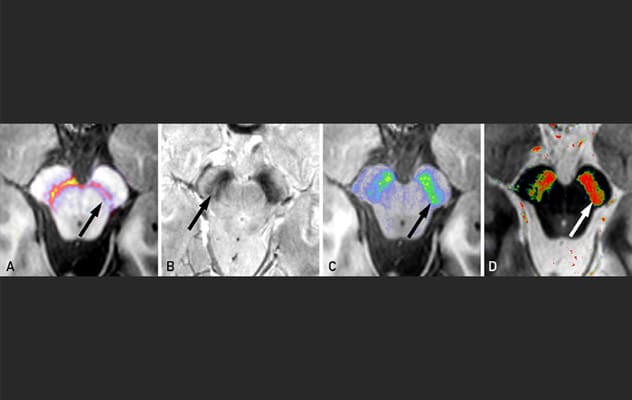 Visualizing Parkinson's disease signs in vivo
Advanced MRI scans leading to a diagnosis of Parkinson's disease for a patient in her 50s. A. 7T neuromelanin-weighted MRI shows asymmetric loss of neuromelanin in the left substantia nigra pars compacta (arrow). B. 7T susceptibility-weighted MRI shows a normal "swallow tail sign" on the right (arrow), which is lost on the left due to iron deposition. C. and D. R2* and T2* 7T images show asymmetrically increased iron deposition in the left pars compacta (arrows).
"7T MRI is a promising modality for the diagnosis of Parkinson's disease. It allows us to directly visualize the histopathological changes in the substantia nigra in vivo, owing to a substantial increase in signal-to-noise ratio, contrast and spatial resolution," says Erik H. Middlebrooks, M.D., a neuroradiologist at Mayo Clinic's campus in Florida.
At Mayo Clinic, neuroradiologists focus on specific conditions. That means the radiologist reading a scan has deep experience with the nuances of movement disorders, which is important for interpreting not only MRI but also dopamine transporter (DAT) scans.
"I can't count the number of times I've had patients come to me with what they think is an abnormal DAT scan. But it doesn't match the patient's clinical exam, and our neuroradiologists check and agree that the DAT scan is normal," Dr. Dewey says.
Another tool is minimally invasive skin biopsies that test for alpha-synuclein abnormalities, a biomarker of Parkinson's disease. Dr. Dewey notes that correct interpretation of this test also requires experience and expertise.
"We have seen patients who believe they have Parkinson's disease based on an inaccurate reading of this testing," he says. "Movement disorders cover a broad array. When the diagnosis is unclear or uncertain, it's beneficial for patients to be evaluated by a specialized movement disorders neurologist."
Advanced, personalized treatment
Mayo Clinic is committed to offering the most up-to-date therapies available for movement disorders. Botulinum toxin injections are considered first line therapy for focal dystonia. Mayo Clinic routinely uses electromyography guidance to help ensure accurate muscle selection. "When done appropriately, these injections often offer benefit," Dr. Dewey says.
Patients with Parkinson's disease also can be evaluated for possible initiation of subcutaneous levodopa, delivered continuously through small wearable devices similar to insulin pumps. Steady subcutaneous delivery can be particularly helpful when oral medication no longer works well due to early wear-off for patients with advanced disease.
"When the diagnosis is unclear or uncertain, it's beneficial for patients to be evaluated by a specialized movement disorders neurologist."
Neuromodulation is also a highly effective treatment for patients with dystonia, essential tremor, Parkinson's disease and dyskinesia. Mayo Clinic offers deep brain stimulation as well as minimally invasive options such as stereotactic radiosurgery. Mayo Clinic has pioneered many advancements in these procedures, allowing them to be performed with unprecedented precision and safety.
"In addition to highly specialized imaging techniques to directly visualize small brain targets for neuromodulation, we have also utilized advanced imaging techniques to map brain networks responsible for specific symptoms," Dr. Middlebrooks says. "That means we can personalize treatments for each patient, leading to the safest and most effective outcomes."
Treatment for especially complex conditions can be managed by neurologists from multiple subspecialties. At Mayo Clinic, movement disorder neurologists and neuromuscular neurologists together care for patients with rare amyotrophic lateral sclerosis-plus syndromes. "Those syndromes are much better managed in a multidisciplinary center," Dr. Dewey says.
Autoimmune neurologists might consult movement disorder neurologists about managing symptoms for patients with multiple sclerosis or autoimmune cerebellar ataxia. "We also see patients with nonspecific movement problems whose imaging indicates an autoimmune component," Dr. Dewey says. "That access to autoimmune neurologists is important because autoimmune conditions are time sensitive and patients shouldn't have to wait months to see another neurologist."
The goal is efficient, compassionate and personalized care. "We take the time to talk with patients," Dr. Dewey says. "Many patients travel to see us, and we want to listen to them and answer their questions. That's a big part of the overall patient experience that we can offer."
For more information
Refer a patient to Mayo Clinic.