Feb. 25, 2026
Orthopedic oncology surgeons with specialized training at Mayo Clinic in Jacksonville, Florida, offer a procedure available at only a handful of U.S. medical centers: photodynamic stabilization of skeletal metastatic disease (PBSS). This procedure stabilizes metastatic bone fractures or bones at high risk of fracture due to cancer metastasis.
"Tumors can destroy bones and break right through them," says Paul A. Rizk, M.D., an orthopedic oncology surgeon at the Florida campus who performs the procedure. "These patients often are not good candidates for total joint arthroplasty due to larger and more morbid surgery, yet they need to be stabilized so they can get on with the rest of their cancer treatments."
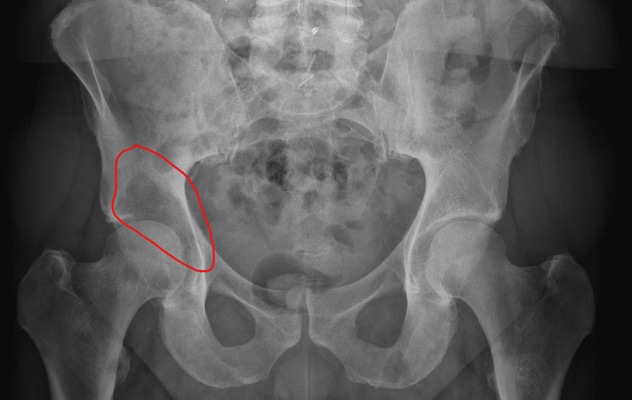 Pretratamiento
El hueso de la cadera se daña por metástasis.
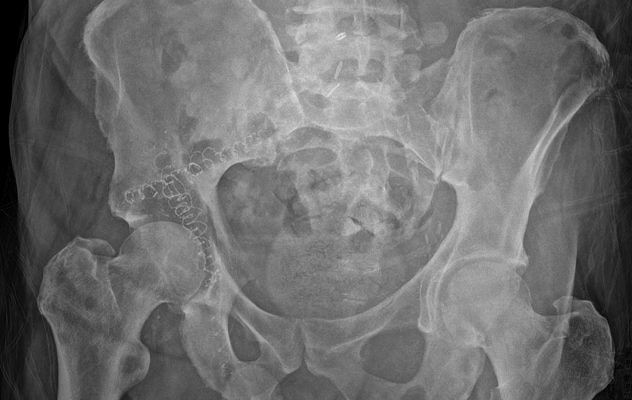 Postratamiento
El hueso de la cadera se repara mediante un sistema de estabilización fotodinámica del hueso.
Despite their ineligibility for traditional surgery, often patients with skeletal metastatic disease are eligible for this minimally invasive procedure. To perform PBSS, the surgeon, using stealth CT and fluoroscopy for a real-time view of the fracture or near-fracture region, places a balloon catheter filled with a polymer that hardens in place to a rigid state when cured with light.
"When the balloon is at capacity, it fits every crevice inside the fracture or lesion, bridging it and stabilizing the region, and helping prevent rotation of the fracture," says Dr. Rizk. "We are trying to secure the bone from all angles so that it doesn't migrate. We're also trying to avoid any catastrophic problems, such as a bone fracture, in the middle of a patient's cancer treatment."
This procedure also allows surgeons to participate in detective work to determine the origin of fractures while repairing them and sending material to pathology to ensure that what they consider skeletal metastases are not bone cancers.
Procedure backstory and benefits
Dr. Rizk explains the quirky backstory of this procedure in which a medical device developer also had a side passion for making fly-fishing lures. These lures used cured polymers, which helped spark the idea of PBSS.
Dr. Rizk says that this procedure may fully repair fractures caused by metastatic disease to the bone or near fractures from the same source. Postrecovery, PBSS may alleviate pain, and it reduces fall risk and complications.
PBSS may be used on any bone, according to Dr. Rizk. PBSS has a wide breadth of indication from metastatic disease to trauma with fracture fixation.
Patients with metastatic bone fractures and assessing PBSS' risks, benefits
When patients experience metastatic bone fracture or a near fracture from bone metastasis — a bone at elevated risk of fracture — the indicator is almost always pain, notes Dr. Rizk.
When Dr. Rizk first sees a patient with skeletal metastatic disease, the patient may have had a cancer diagnosis for some time before the metastasis arose. In other instances, however, when Dr. Rizk finds a patient's pain is due to metastatic disease, his explanation of the findings to the patient could be the patient's first indication of the presence of cancer. Dr. Rizk says he often has to gently break the news to patients that they have cancer and that it has metastasized, threatening one of their bones.
Patients who have PBSS for skeletal metastases have life expectancies all over the board, according to Dr. Rizk, who says this is part of the equation when considering a possible PBSS procedure. But because of the percutaneous nature of the procedure, it carries much less morbidity and faster recovery.
Infection is a PBSS risk, though the procedure's results have demonstrated the risk is low, says Dr. Rizk. He says the minimal risk may be due to the small incision necessary for PBSS.
In the small number of cases in which infection develops, he says that extracting the implant can be challenging for the surgeon. This is due to the well-fixed nature of the implant within the bone.
Orthopedic surgeons also combine PBSS with other orthopedic procedures. An example of a combination procedure Dr. Rizk has found to greatly benefit patients is PBSS in the pelvic region along with total hip replacement. Radiofrequency ablation is another procedure commonly performed with PBSS, either by the same orthopedic surgeon or an interventional radiologist prior to the balloon insertion.
"We don't promise our patients pain improvement with PBSS," he says. "It can improve pain, but we can't guarantee it. Improved stability in the bone affected by metastases — that we can guarantee."
Quality-of-life improvements for patients who undergo PBSS
Dr. Rizk is enthusiastic about the potential for PBSS to improve the quality of life for patients with skeletal metastatic disease. A quality-of-life improvement may mean freedom from worry about a bone fully fracturing, the ability to stand or walk again, or regaining some use of extremities.
PBSS can eliminate pain for some but not all patients with these metastases.
"We don't promise our patients pain improvement with PBSS," he says. "It can improve pain, but we can't guarantee it. Improved stability in the bone affected by metastases — that we can guarantee."
For more information
Refer a patient to Mayo Clinic.