
Overview
Tachycardia (tak-ih-KAHR-dee-uh) is the medical term for a heart rate over 100 beats a minute. Many types of irregular heartbeats, called arrhythmias, can cause tachycardia.
A fast heart rate isn't always something to worry about. For instance, the heart may beat faster during exercise or when a person has a lot of stress.
Tachycardia may not cause any symptoms or complications. But sometimes it's a warning of a condition that needs medical care. Some types of tachycardia can lead to serious health conditions if not treated. Examples are heart failure, stroke or sudden cardiac death.
Treatment for tachycardia may include specific actions or movements, medicine, a heart procedure called cardioversion, or surgery.
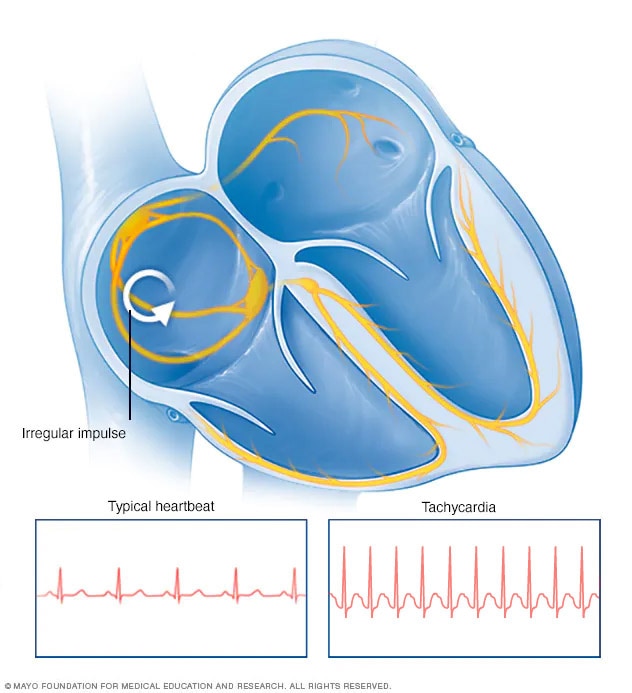
Tachycardia heartbeat
In tachycardia, an irregular electrical signal, called an impulse, starts in the upper or lower chambers of the heart. This causes the heart to beat faster.
Symptoms
Some people with tachycardia have no symptoms. The fast heartbeat may be found when a physical exam or heart tests are done for another reason.
In general, tachycardia may cause these symptoms:
- Racing, pounding heartbeat or flopping in the chest, called palpitations.
- Chest pain.
- Fainting.
- Lightheadedness.
- Fast pulse.
- Shortness of breath.
When to see a doctor
Many things can cause tachycardia. If you feel like your heart is beating too fast, make an appointment for a health checkup.
Get medical help right away if you have:
- Chest pain or discomfort.
- Shortness of breath.
- Weakness.
- Dizziness or lightheadedness.
- Fainting or near fainting.
A type of tachycardia called ventricular fibrillation (VFib) is an emergency. It needs to be treated right away. During VFib, blood pressure drops dramatically. The person's breathing and pulse stop because the heart is not pumping any blood to the body. This also is called cardiac arrest. The person usually falls down, also called collapses.
If this happens, do the following:
- Call 911 or the emergency number in your area.
- Start CPR. CPR helps keep blood flowing to the organs until other treatments can start.
- If you're not trained in CPR or worried about giving rescue breaths, then provide hands-only CPR. Push hard and fast on the center of the chest at a rate of 100 to 120 compressions a minute until paramedics arrive. The American Heart Association suggests doing compressions to the beat of the song "Stayin' Alive" or another song that has 100 to 120 beats a minute. You don't need to do rescue breathing.
- Have someone get an automated external defibrillator (AED) if one is nearby. An AED is a device that sends a shock to the heart to reset it's rhythm. No training is needed to use it. The AED tells you what to do. It's programmed to give a shock only when necessary.
Causes
Tachycardia is an increased heart rate for any reason. If a fast heart rate is caused by exercise or stress, it's called sinus tachycardia. Sinus tachycardia is a symptom, not a condition.
Most heart conditions can lead to different forms of tachycardia. Irregular heart rhythms, called arrhythmias, are one cause. An example is atrial fibrillation (AFib).
Health conditions and treatments that may lead to tachycardia include:
- A low number of red blood cells, called anemia.
- Changes in the level of minerals in the body, called electrolytes. Examples are potassium, sodium, calcium and magnesium.
- Fever.
- Heart attack.
- High or low blood pressure.
- Overactive thyroid gland, called hyperthyroidism.
- Some medicines.
Lifestyle habits and behaviors that may lead to tachycardia include:
- Excessive alcohol use. If you choose to drink alcohol, limit how often you drink and keep the amount small. That often means less than two drinks a day on any specific day.
- Alcohol withdrawal.
- Too much caffeine.
- Smoking or nicotine use.
- Use of illicit drugs such as cocaine or methamphetamine.
Sometimes the exact cause of tachycardia is not known.
How does the heart beat?
To understand the cause of tachycardia, it may help to know how the heart usually works.
The heart has four chambers:
- The two upper chambers are called the atria.
- The two lower chambers are called the ventricles.
Inside the upper right heart chamber is a group of cells called the sinus node. These cells make the signals that start each heartbeat.
The signals move across the upper heart chambers. Then they get to a group of cells called the AV node, where they usually slow down. Next, the signals go to the lower heart chambers.
In a healthy heart, this signaling process usually goes smoothly. The heart usually beats 60 to 100 times each minute when at rest. But in tachycardia, something makes the heart beat faster than 100 beats a minute.
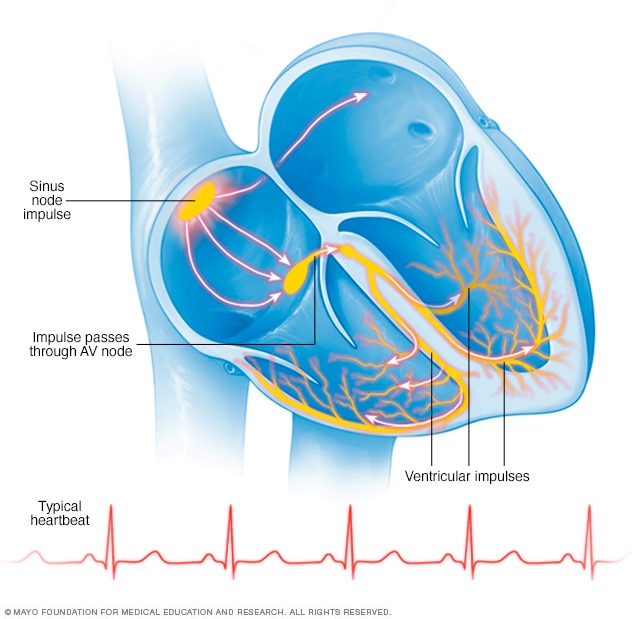
Typical heartbeat
In a typical heartbeat, a tiny cluster of cells at the sinus node sends out an electrical signal, called an impulse. The signal then travels through the atria to the atrioventricular (AV) node and then passes into the lower heart chambers called the ventricles. This causes them to squeeze and pump out blood.
Risk factors
In general, things that may raise the risk of irregular heart rhythms that commonly cause tachycardia include:
- Older age.
- A family history of some heart rhythm disorders.
- High blood pressure.
Lifestyle changes or treatment of heart conditions may lower the risk of tachycardia.
Complications
When the heart beats too fast, it may not pump enough blood to the body. As a result, the organs and tissues may not get enough oxygen.
Complications of tachycardia depend on:
- The type of tachycardia.
- How fast the heart is beating.
- How long the fast heartbeat lasts.
- Whether you have other heart conditions.
Possible complications of tachycardia may include:
- Blood clots that can cause a heart attack or stroke. Blood-thinning medicine may be used to lower this risk.
- Fainting a lot or unconsciousness.
- Heart failure.
- Sudden cardiac death. This is usually only associated with ventricular tachycardia or ventricular fibrillation.
Prevention
The best way to prevent tachycardia is to keep the heart healthy. Have regular health checkups. If you have heart disease, follow your treatment plan. Take all medicines as told.
Try these tips to prevent heart disease and keep the heart healthy:
- Don't smoke.
- Choose foods that are low in salt and saturated fat.
- Exercise at least 30 minutes a day on most days of the week.
- Keep a healthy weight.
- Reduce and manage stress.
- Manage high blood pressure, high cholesterol and diabetes.
- Get good sleep. Adults should try to get 7 to 9 hours daily.
Talk to your healthcare team before using any medicines. Some cold and cough medicines have stimulants that may start a fast heartbeat. Illicit drugs such as cocaine and methamphetamine are other stimulants that can cause changes in the heartbeat.