
Overview
A spinal cord tumor is a growth of cells that forms in or around the spinal cord. The spinal cord extends downward from the base of the brain. It's made up of nerve cells and groups of nerves that carry messages between the brain and the rest of the body. The bones of the spine surround and protect the spinal cord.
Spinal cord tumors also are called intradural tumors or spinal tumors.
Most spinal cord tumors aren't cancers, but some are cancerous. Spinal cord tumors that aren't cancers also are called benign spinal cord tumors. Spinal cord tumors that are cancers also are called malignant spinal cord tumors or spinal cord cancers.
Many types of spinal cord tumors exist. The different types of spinal cord tumors are often divided up by where they happen.
- Intramedullary spinal cord tumors. Intramedullary spinal cord tumors happen in the cells of the spinal cord. Examples of intramedullary spinal cord tumors include glioma, astrocytoma and ependymoma.
- Extramedullary spinal cord tumors. Extramedullary spinal cord tumors happen in the tissues around the spinal cord. These tumors can happen in the tissue that surrounds the spinal cord, called the dura. They also can happen in the nerve roots that reach out from the spinal cord. Examples of extramedullary spinal cord tumors include meningioma, neurofibroma, schwannoma and nerve sheath tumor.
Spinal cord tumors can happen anywhere along the spinal cord. Most happen in the upper back. Less often the tumors happen in the neck or lower back.
Spinal cord tumors can cause pain in the neck or back near where they are growing. They also can cause loss of function in the part of the body that's controlled by the nerves involved in the tumor.
Spinal cord tumor treatment depends on the type of tumor and where it is in the spine. Treatments may include surgery, radiation therapy and chemotherapy.
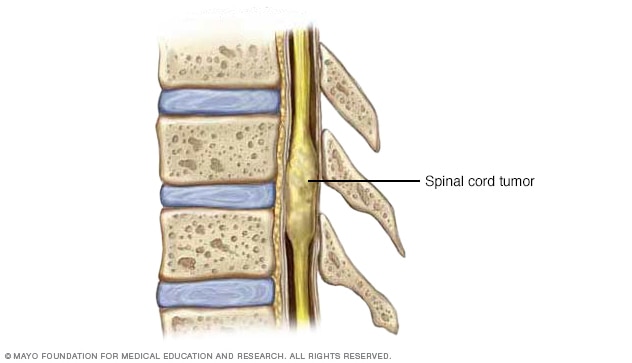
Spinal cord tumor
A spinal cord tumor is a growth of cells that forms in or around the spinal cord.
Symptoms
Spinal cord tumors may not cause signs and symptoms at first. When symptoms happen, they might start in the part of the spine near the tumor. As a spinal cord tumor grows, it can hurt nearby nerves and cause symptoms in other parts of the body.
In the spine, spinal cord tumor symptoms include:
- Pain near the spot where the tumor forms.
- Pain that feels worse at night.
- Pain that feels like it extends or shoots from the back to nearby areas.
- Pain that gets worse over time.
A spinal cord tumor that grows to hurt the nearby nerves can cause symptoms that happen along those nerves. Symptoms may include:
- Changes in feeling in one part of the body, such as being less sensitive to pain, heat and cold.
- Loss of bowel or bladder function.
- Muscle weakness in one part of the body.
- Trouble with walking, which can lead to falls.
Spinal cord tumors happen rarely in children. Symptoms of spinal cord tumors in children include:
- A new curve in the spine.
- Back or neck pain that often is worse at night.
- Changes in the way the child walks, including falling and tripping more than usual.
- Loss of mobility. For example, a child who learned to walk may seem to prefer crawling. A child who learned to stand may no longer try to stand.
- Muscle weakness.
When to see a doctor
Make an appointment with a doctor or other healthcare professional if you have any symptoms that worry you.
Causes
It's not clear what causes most spinal cord tumors. A spinal cord tumor starts as a growth of cells in or around the spinal cord. The spinal cord extends downward from the base of the brain. It's made up of nerve cells and groups of nerves that carry messages between the brain and the rest of the body. The bones of the spine surround and protect the spinal cord.
A spinal cord tumor starts when cells in the spinal cord or in the tissue around it develop changes in their DNA. A cell's DNA holds the instructions that tell the cell what to do. In healthy cells, the DNA tells the cells to grow and multiply at a set rate. The DNA also tells the cells to die at a set time.
In tumor cells, the DNA changes give different instructions. The changes tell the tumor cells to grow and multiply quickly. Tumor cells can keep living when healthy cells would die. This causes too many cells. The tumor cells form a growth that can press on the nearby nerves.
Sometimes the cells develop DNA changes that turn them into cancer cells. Cancer cells can invade and destroy healthy body tissue.
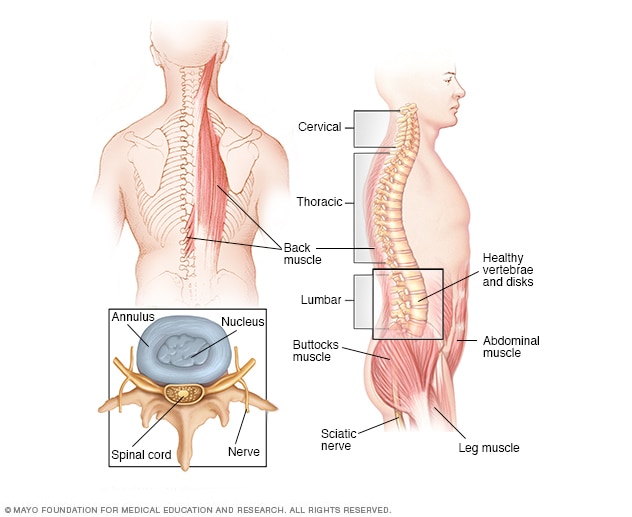
Spinal anatomy
The spinal anatomy of a typical adult
Risk factors
Spinal cord tumors are more common in people who have:
- Neurofibromatosis type 1. Neurofibromatosis type 1 is a genetic condition that causes changes in skin pigment and tumors in nerve tissue. The tumors can grow anywhere in the nervous system, including the brain, spinal cord and nerves.
- Neurofibromatosis type 2. Neurofibromatosis type 2 is a genetic condition that often causes multiple brain tumors and spinal tumors.
- Von Hippel-Lindau disease. Von Hippel-Lindau disease is a rare, multisystem disease that causes blood vessel tumors. These tumors are called hemangioblastomas. They can happen in the brain, retina and spinal cord. This disease also can cause other types of tumors in the kidneys or adrenal glands.
There is no way to prevent spinal cord tumors.
Complications
Spinal cord tumors can press on nerves. This may lead to a loss of movement or feeling. These changes typically affect parts of the body that are below the tumor. Changes might include weakness in the legs and difficulty walking. There might be changes in bowel and bladder functions.
The changes in function and feeling may never go away. But spinal cord tumor treatment may help prevent further loss of function. Sometimes function comes back with treatment.