
Overview
Scorpion stings are painful but rarely life-threatening. Healthy adults usually don't need treatment for scorpion stings. Young children and older adults are most at risk of serious complications.
Scorpions are arthropods — a relative of insects, spiders and crustaceans. Bark scorpions — the only scorpion species in the U.S. with venom strong enough to cause serious symptoms — are generally about 1.6 to 3 inches (4 to 8 cm) long, including a segmented tail with a stinger that can deliver venom. They're found mainly in the desert Southwest. Worldwide, of more than 2,000 species of scorpions, about 100 produce venom serious enough to be fatal.
Scorpions have eight legs and a pair of lobster-like pinchers and a tail that curves up. They're generally more active at night. They usually won't sting unless provoked or attacked. Most stings occur when they're accidentally grabbed or stepped on or brushed against the body.
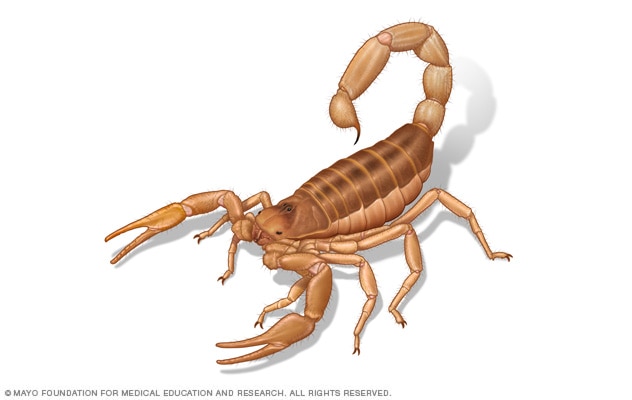
Bark scorpion
The bark scorpion is commonly found in the desert Southwest part of the U.S.
Symptoms
Symptoms at the site of a scorpion sting may include:
- Pain, which can be intense.
- Numbness and tingling.
- Slight swelling.
- Warmth.
Symptoms of a serious reaction that affects the whole body include:
- Trouble breathing.
- Muscle twitching or jerking.
- Unusual movements of the head, neck or eyes.
- Drooling.
- Sweating.
- Slurred speech.
- Nausea and vomiting.
- High blood pressure (hypertension).
- Fast heart rate (tachycardia).
- Being restless or hard to calm. Young children may cry and be difficult to comfort.
Even if you had a mild allergic reaction to a sting before, a future sting could cause a severe allergic reaction called anaphylaxis. Anaphylaxis is life-threatening and needs emergency medical care. Symptoms include hives, trouble breathing, nausea and vomiting.
When to see a doctor
Contact your local poison control center at once if a child is stung by a scorpion. To reach a poison control center in the U.S., call Poison Help at 800-222-1222. Also, seek medical care if you've been stung and begin to have a hard time breathing or have other symptoms that continue for more than a week. If you're concerned about a scorpion sting, you also can call your local poison control center for advice.
Causes
A scorpion sting is caused by the stinger in a scorpion's tail. When a scorpion stings, its stinger can release venom. The venom contains a complex mix of toxins that affect the nervous system. These are called neurotoxins.
Risk factors
Your risk of a scorpion sting rises if you:
- Live or travel where scorpions are. In the U.S., scorpions mainly live in the desert Southwest, primarily Arizona, New Mexico and parts of California. Worldwide, they're found most often in Mexico, North Africa, South America, the Middle East and India. And you might bring them home with you. That's because scorpions can hide in clothing, luggage and shipping containers.
- Work, hike or camp where scorpions are. Bark scorpions live under rocks and logs. They also live under tree bark, which is how they get their name. You're more likely to come into contact with one when you're working outside, hiking or camping.
Complications
Older adults and young children are most likely to die of untreated venomous scorpion stings. The cause is usually heart or lung failure that occurs some hours after the sting. Very few deaths from scorpion stings have been reported in the U.S.
Rarely, scorpion stings can cause a serious allergic reaction called anaphylaxis.
Prevention
Scorpions tend to avoid contact. If you live in an area where scorpions are common, consider these steps to prevent chance encounters:
- Remove piles of rocks or lumber from around your house, and don't store firewood against the house or inside.
- Keep grass closely mowed, and prune bushes and overhanging tree branches that can provide scorpions with a path to your roof.
- Caulk cracks, install weatherstripping around doors and windows, and repair torn screens.
- Inspect and shake out gardening gloves, clothing and boots that haven't been used for a while.
- Take steps when you're traveling. When you're in areas where venomous scorpions are common — especially if you're camping or staying in rustic accommodations — wear shoes. Also, shake out your clothing, bedding, gear and packages often.
Scorpions glow under a black light, so you might want to use one at night to look at what's around you. If you find a scorpion, use tongs to gently move it away from people.