
Diagnosis
To detect an ulcer, your healthcare professional may first take a medical history and do a physical exam. You also may need tests, such as:
-
Laboratory tests for H. pylori. A blood, stool or breath test can show whether H. pylori is in your body.
For the breath test, you drink or eat something that contains radioactive carbon. H. pylori breaks down the substance in your stomach. Later, you blow into a bag, which is then sealed. If you have H. pylori, your breath sample has the radioactive carbon in the form of carbon dioxide.
If you take an antacid or an antibiotic, tell your healthcare professional. You may need to stop the medicine for a time. Both can affect test results.
-
Endoscopy. During this procedure, your healthcare professional uses a long, flexible tube with a tiny camera, called an endoscope, to look at the upper part of your digestive system. Endoscopy involves passing the endoscope, down your throat and into your esophagus, stomach and small intestine to look for ulcers.
If there's an ulcer, your health professional may remove a small tissue sample for study in a lab. This is called a biopsy. A biopsy also can show whether H. pylori is in your stomach lining.
You're more likely to have endoscopy if you are older, have signs of bleeding, or have had recent weight loss or trouble eating and swallowing. If the endoscopy shows an ulcer in your stomach, you're likely to have a follow-up endoscopy after treatment. This can show if the ulcer has healed.
- Upper gastrointestinal series. Sometimes called a barium swallow, this series of X-rays of the upper digestive system makes pictures of your esophagus, stomach and small intestine. During the series of X-rays, you swallow a white liquid that has barium. The liquid coats your digestive tract and makes an ulcer easier to see.
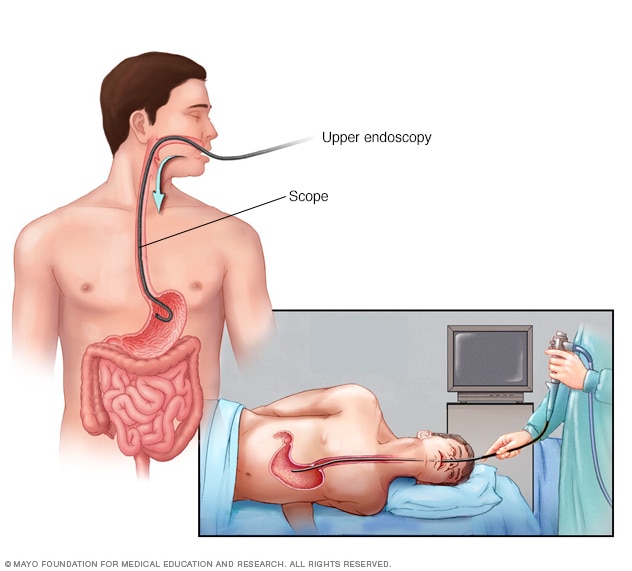
Endoscopy
An endoscopy procedure involves inserting a long, flexible tube called an endoscope down your throat and into your esophagus. A tiny camera on the end of the endoscope allows views of your esophagus, stomach and the beginning of your small intestine, called the duodenum.
Treatment
Treatment for peptic ulcers involves killing the H. pylori germ, if needed. Treatment also might involve stopping NSAIDs or lowering the amount, if possible, and taking medicine to help the ulcer heal.
Medicines can include:
- Antibiotics to kill H. pylori. If you have H. pylori in your digestive tract, your healthcare professional may suggest a mix of antibiotics. These may include amoxicillin (Amoxil, Larotid), clarithromycin (Biaxin XL), metronidazole (Flagyl, Likmez), tinidazole (Tindamax), tetracycline and levofloxacin.
-
Medicines that block acid. Proton pump inhibitors (PPIs) reduce stomach acid. PPIs include omeprazole (Prilosec), lansoprazole (Prevacid), rabeprazole (Aciphex), esomeprazole (Nexium) and pantoprazole (Protonix).
Most people take PPIs in pill form. In the hospital, treatment for a bleeding ulcer may involve a PPI given through a vein in the arm. This is known as intravenous delivery.
Long-term or high-dose use of proton pump inhibitors may increase your risk of hip, wrist and spine fracture. Ask your healthcare professional whether a calcium supplement may reduce this risk.
- Medicines to reduce stomach acid. Acid blockers, also called histamine (H-2) blockers, help relieve ulcer pain and help with healing. Acid blockers include famotidine (Pepcid AC), cimetidine (Tagamet HB) and nizatidine (Axid AR).
- Antacids that counter the effects of stomach acid. These can relieve pain quickly. But they aren't used to heal ulcers. Side effects can include constipation or diarrhea, depending on the main ingredients in the antacids.
- Medicines that protect the lining of the stomach and small intestine. These are called cytoprotective agents. They include the prescription medicines sucralfate (Carafate) and misoprostol (Cytotec).
Follow-up after treatment
Treatment for peptic ulcers often leads to ulcer healing. But if your symptoms are severe or if you have them even with treatment, your healthcare professional may suggest endoscopy. This procedure can rule out other possible causes for your symptoms.
If your healthcare professional finds an ulcer during endoscopy, you may need another endoscopy after your treatment to make sure your ulcer has healed.
Ulcers that don't heal
Peptic ulcers that don't heal with treatment are called refractory ulcers. Reasons for an ulcer not healing include:
- Not taking medicines as prescribed.
- Having a type of H. pylori that resists antibiotics.
- Often using pain relievers, such as NSAIDs, that increase the risk of ulcers.
Less often, refractory ulcers may be a result of:
- A lot of stomach acid, such as happens in Zollinger-Ellison syndrome.
- An infection other than H. pylori.
- Stomach cancer.
- Other conditions that may cause ulcerlike sores in the stomach and small intestine, such as Crohn disease.
Treatment for refractory ulcers most often involves getting rid of factors that keep the ulcer from healing and trying other antibiotics. If you smoke, your healthcare professional may suggest you quit. Smoking can slow ulcer healing.
A serious complication from an ulcer, such as bleeding or a hole in the stomach, may need treatment with endoscopy or surgery. But because there are many medicines that work well, people with peptic ulcers need surgery far less often than in the past.
Self-care
You may find relief from the pain of a stomach ulcer if you:
- Switch pain relievers. If you use pain relievers regularly, ask your healthcare professional whether acetaminophen (Tylenol, others) might work for you.
- Control stress. Stress may make the symptoms of a peptic ulcer worse. Think about what causes your stress and what you can do to ease it. There are many ways to cope with stress. These include exercise, spending time with friends, deep breathing, writing in a journal or meditating.
- Don't smoke. Smoking may harm the lining of the stomach, raising the chance of getting an ulcer. Smoking also increases stomach acid.
- Limit or avoid alcohol. Too much alcohol can irritate and eat away the mucous lining in your stomach and intestines. This can cause the lining to inflame and bleed.
Preparing for your appointment
Make an appointment with your main healthcare professional if you have symptoms that worry you. Your health professional may send you to a specialist in the digestive system, called a gastroenterologist.
Here's information to help you get ready for your appointment.
What you can do
When you make the appointment, ask if there's anything you need to do in advance, such as restrict your diet or stop certain medicines.
Make a list of:
- Your symptoms, when they began and whether they're worse when your stomach is empty.
- Key personal information, including any other medical concerns, major stresses or recent life changes. Include family history of peptic ulcers, H. pylori infection and cancer in the digestive tract.
- All medicines, vitamins or supplements you take, including doses. Be sure to include any pain relievers you use, how much you take and how often you take them.
- Write down questions to ask your healthcare professional.
For peptic ulcers, some questions to ask include:
- What's the most likely cause of my symptoms?
- What tests do I need? How do I prepare for them?
- Is my condition likely to go away or to last?
- What treatment do you suggest?
- Do I need to restrict my diet?
- I have other medical conditions. How can I manage these along with ulcers?
Be sure you ask all the questions you have.
What to expect from your doctor
Your healthcare professional might ask:
- Do you always have symptoms, or do they come and go?
- How bad are your symptoms?
- Are your symptoms worse when you're hungry?
- Does anything seem to improve your symptoms?
- Does anything make your symptoms worse?
- Do you have nausea? Have you been vomiting?
- Have you ever vomited blood or black material?
- Have you noticed blood in your stool or black stools?
What you can do in the meantime
While you wait for your appointment, don't use tobacco or alcohol or eat spicy foods to help ease your discomfort.
Alternative medicine
Products containing bismuth may help with symptoms of a peptic ulcer. There also is some evidence that zinc can help heal ulcers.
Talk to your healthcare professional before using any alternative medicine for peptic ulcers.