
Overview
Mastitis is swelling and redness, called inflammation, of breast tissue. It sometimes involves an infection. Besides causing swelling and redness, mastitis causes breast pain and warmth. An infection also can cause fever and chills.
Mastitis most often affects people who are breastfeeding. This is called lactation mastitis. But mastitis can happen to people who aren't breastfeeding.
Lactation mastitis can cause you to feel run down, making it hard to care for your baby. Sometimes mastitis causes people to wean their babies earlier than they meant to. But continuing to breastfeed is better for you and your baby. This is true even if you're taking an antibiotic.
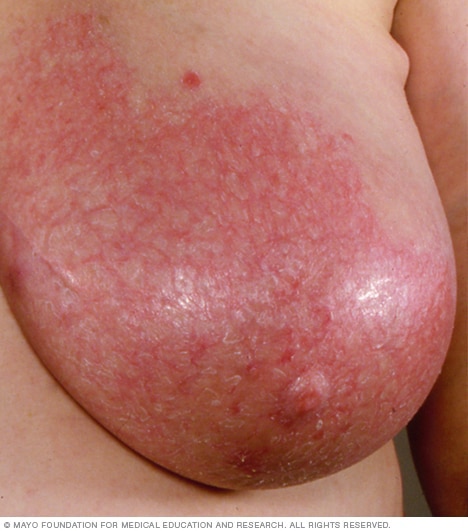
Mastitis
Mastitis, which mainly affects people who are breastfeeding, causes redness, swelling and pain in one or both breasts. The redness may be harder to see on Black or brown skin.
Symptoms
Symptoms of mastitis can appear suddenly. They may be in one or both breasts. Symptoms may include:
- Breast tenderness or warmth.
- Breast swelling.
- Thickening of breast tissue, or a breast lump.
- Pain or a burning feeling all the time or while breastfeeding.
- Skin redness, often in a wedge-shaped pattern. The redness may be harder to see on Black or brown skin.
- Feeling ill.
- Fever of 101 degrees Fahrenheit (38.3 degrees Celsius) or greater.
When to see a doctor
See your healthcare professional if you have breast symptoms that worry you.
Causes
Milk that is trapped in the breast is the main cause of mastitis. Other causes include:
- A blocked milk duct. If a breast doesn't empty all the way during feedings, one of the milk ducts can get clogged. Then milk backs up, leading to breast infection.
- Germs going into the breast. Germs from the skin's surface and baby's mouth can enter the milk ducts. This can happen through a crack in the skin of the nipple or through a milk duct opening. Germs can grow in milk that stays in a breast that isn't emptied.
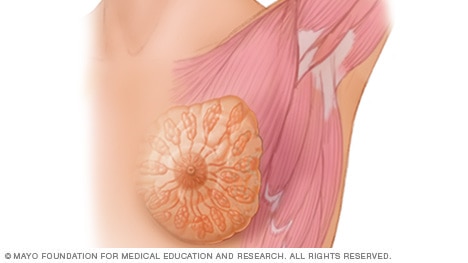
Female breast anatomy
The structure of the female breast is complex — including fat, glandular and connective tissue, as well as lobes, lobules, ducts, lymph nodes, blood vessels and ligaments.
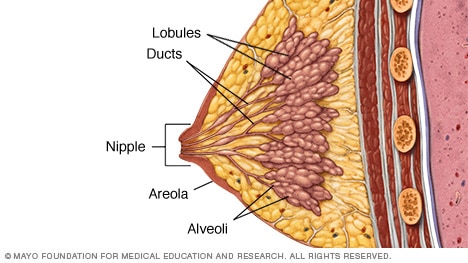
Lobules and ducts
Each breast has a number of sections (lobules) that branch out from the nipple. Each lobule holds tiny, hollow sacs (alveoli). The lobules are linked by a network of thin tubes (ducts). If you're breast-feeding, ducts carry milk from the alveoli toward the dark area of skin in the center of the breast (areola). From the areola, the ducts join together into larger ducts ending at the nipple.
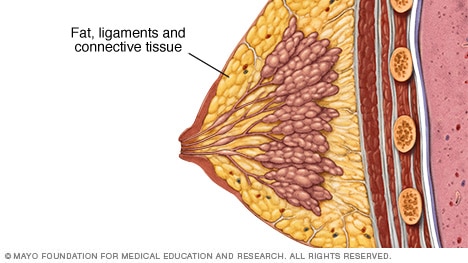
Fat, ligaments and connective tissue
Spaces around the lobules and ducts are filled with fat, ligaments and connective tissue. The amount of fat in your breasts largely determines their size. The actual milk-producing structures are nearly the same in all women. Female breast tissue is sensitive to cyclic changes in hormone levels. Most women's breast tissue changes as they age, with more fat relative to the amount of dense tissue.
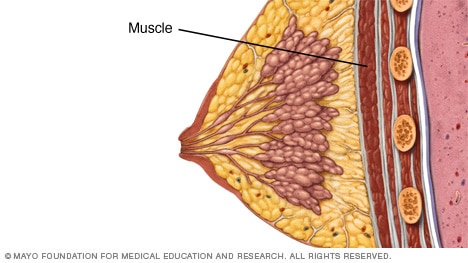
Muscles
The breast has no muscle tissue. Muscles lie underneath the breasts, however, separating them from your ribs.
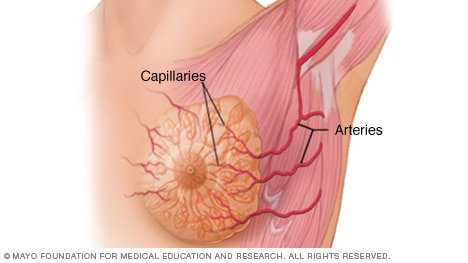
Arteries and capillaries
Oxygen and nutrients travel to breast tissue through the blood in your arteries and capillaries — thin, fragile blood vessels.
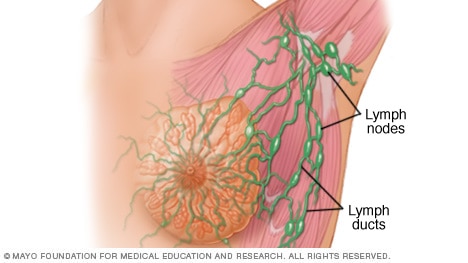
Lymph nodes and lymph ducts
The lymphatic system is a network of lymph nodes and lymph ducts that helps fight infection. Lymph nodes — found under the armpit, above the collarbone, behind the breastbone and in other parts of the body — trap harmful substances that might be in the lymphatic system and safely drain them from the body.
Risk factors
Risk factors for mastitis include:
- Having a history of mastitis.
- Having sore or cracked nipples.
- Putting pressure on a breast that restricts milk flow. Wearing a tight bra or using a tight seat belt can cause pressure.
- Not nursing correctly.
- Being overly tired or stressed.
- Eating poorly.
- Smoking.
Complications
Mastitis that isn't treated or that is due to a blocked duct can cause pus to build up in the breast. This is called an abscess. An abscess most often needs to be drained surgically.
To avoid this complication, talk with your healthcare professional as soon as you get symptoms of mastitis. You may need to take a course of antibiotics.
Prevention
Before you start breastfeeding, think about meeting with a breastfeeding specialist, called a lactation consultant. This can help you avoid complications such as mastitis.
Lower your chances of getting mastitis by following these tips:
- Feed your baby on demand or let out milk with your hand, called expressing, often.
- Fully drain the milk from your breasts while breastfeeding.
- Let your baby empty one breast all the way before switching to the other breast during feeding.
- Change the position you use to breastfeed from one feeding to the next.
- Make sure your baby latches on well during feedings.
- If you smoke, talk with your healthcare professional about how to quit.