
Overview
Inflammatory bowel disease (IBD) refers to a group of long-term conditions that cause inflammation in the digestive tract. The digestive tract is the part of the body that breaks down and absorbs food.
IBD is not the same as irritable bowel syndrome (IBS). IBS does not cause the inflammation or intestinal damage seen with IBD.
The most common types of IBD include:
- Ulcerative colitis. This causes inflammation and sores, called ulcers, in the lining of the colon and rectum.
- Crohn's disease. This causes inflammation in the digestive tract. It often affects the small intestine and the colon, but it can affect other parts too. It may reach deeper layers of the bowel wall.
IBD often comes and goes. There may be times when symptoms get worse. These are called flare-ups. There also may be times when symptoms get better or go away. This is called remission.
For some people, IBD causes mild symptoms. For others, it can be more serious and may lead to complications.
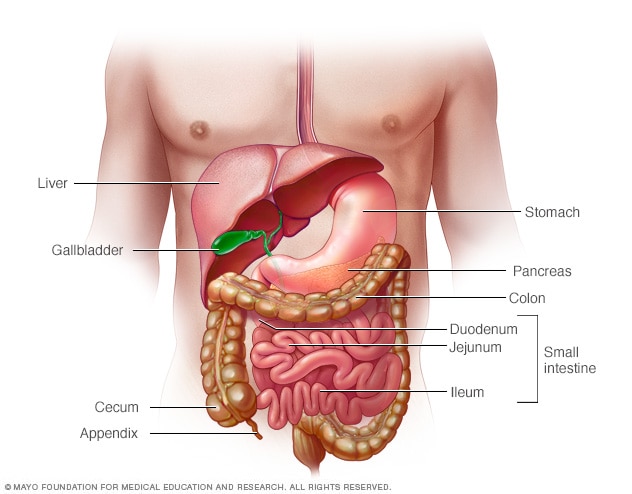
Digestive system
Crohn's disease and ulcerative colitis are both forms of inflammatory bowel disease. Crohn's disease most commonly affects the last part of the small intestine, called the ileum, and parts of the colon. Ulcerative colitis affects only the colon.
Symptoms
Symptoms of inflammatory bowel disease depend on where the inflammation is and how severe it is.
Common symptoms include:
- Diarrhea.
- Belly pain and cramping.
- Blood in the stool.
- Loss of appetite.
- Weight loss without trying.
- Feeling very tired.
Some people notice early signs before a flare-up, such as feeling more tired than usual, changes in bowel habits or a loss of appetite.
When to see a doctor
See a healthcare professional if your bowel habits change or if you have symptoms of IBD. Get care soon if you have:
- Diarrhea that does not stop or signs of dehydration.
- Severe belly pain.
- Blood in the stool that does not go away.
- Fever or signs of infection.
- Weight loss without trying.
Causes
The exact cause of inflammatory bowel disease is not known. Diet and stress do not cause IBD, but they may make symptoms worse for some people. Experts think several factors may play a role.
- Immune system. One possible cause is change in the function of the immune system.
- Genes. Several genetic markers have been associated with IBD. Traits passed down in families also seem to play a role, as IBD is more common in people who have family members with the disease. However, most people with IBD don't have this family history.
Risk factors
Risk factors for inflammatory bowel disease include:
- Age. Most people who get IBD are diagnosed before they're 30 years old. But some people don't get the disease until their 50s or 60s.
- Patient population. IBD is more common in white people, but it can occur in anyone. The number of people with IBD is increasing in all races and ethnicities.
- Family history. You're at higher risk if you have a blood relative — such as a parent, sibling or child — with the disease.
- Cigarette smoking. Cigarette smoking is the most important controllable risk factor for severe Crohn's disease.
IBD can affect people at any stage of life, including children and those who are pregnant. Specialized care may be needed in these situations.
Complications
Ulcerative colitis and Crohn's disease have some complications in common and others that are specific to each condition. Some complications can happen with both conditions, although some are more common with one type than the other. The risk of complications often depends on how long the disease has been active and how well it is controlled.
Complications found in both conditions may include:
-
Colon cancer. Having ulcerative colitis or Crohn's disease that affects most of your colon can increase your risk of colon cancer. Screening for cancer with a colonoscopy usually starts about 8 to 10 years after the IBD diagnosis is made. It may be repeated every 1 to 5 years depending on the findings.
If you also have primary sclerosing cholangitis (PSC) and colonic disease, colon cancer screening is recommended every year starting at diagnosis. This is due to an elevated risk of colon cancer. Ask a healthcare professional whether you need to have this test done sooner and more frequently.
- Skin, eye and joint inflammation. Certain conditions may occur during IBD flare-ups. They include arthritis, skin lesions and eye inflammation called uveitis.
- Treatment side effects. Certain medicines for IBD are associated with a risk of infections. Some carry a small risk of developing certain cancers. Corticosteroids can be associated with a risk of osteoporosis, high blood pressure and other conditions.
- Primary sclerosing cholangitis, a rare, long-term disease of the liver involving inflammation and scarring within the bile ducts.
- Severe dehydration from diarrhea.
Crohn's disease also may lead to:
- A blockage in the bowel, called an obstruction. Crohn's disease affects the full thickness of the bowel wall. Over time, parts of the bowel can thicken and narrow, which may block the flow of digestive contents. Surgery may be needed to remove the diseased part of the bowel.
- Malnutrition. Diarrhea, belly pain and cramping may make it difficult for you to eat or for your intestine to absorb enough nutrients to keep you nourished. It's also common to develop anemia due to low iron or vitamin B-12 caused by the disease.
- Fistulas. Fistulas are tunnels between body parts that are not usually connected. Fistulas near or around the anal area are the most common kind. In some cases, a fistula may become infected and form a pocket of pus known as an abscess.
- Anal fissure. This is a small tear in the tissue that lines the anus or in the skin around the anus where infections can occur. It's often associated with painful passing of stool and may lead to a fistula around the anus.
Ulcerative colitis also may lead to:
- Toxic megacolon. Ulcerative colitis may cause the colon to rapidly widen and swell, a serious condition known as toxic megacolon. This can increase the risk of a hole in the colon, also called a perforation.