
Overview
Fuchs dystrophy is a condition in which fluid builds up in the clear tissue at the front of the eye, called the cornea. This causes your cornea to swell and thicken, leading to glare, blurred or cloudy vision, and eye discomfort.
Fuchs (fewks) dystrophy usually affects both eyes. It may cause your vision to get worse over time. The disease often starts in the 30s and 40s, but many people with Fuchs dystrophy don't develop symptoms until they reach their 50s or 60s.
Some medicines and self-care steps may help relieve symptoms of Fuchs dystrophy. When advanced disease causes more-serious vision problems, cornea transplant surgery is the best way to restore vision.
Fuchs dystrophy
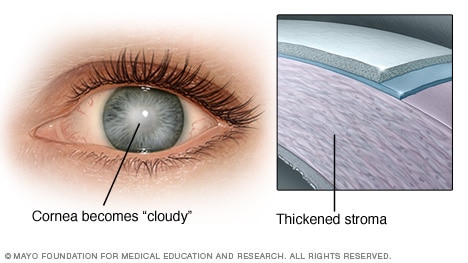
With Fuchs dystrophy, the body of the cornea begins to thicken, and the cornea becomes cloudy. The body of the cornea also is called stroma.
Symptoms
As Fuchs dystrophy gets worse, symptoms often affect both eyes. Symptoms may include:
- Blurred or cloudy vision, sometimes described as a lack of clear vision.
- Changes in vision throughout the day. Symptoms are worse in the morning when you wake up and slowly get better during the day. As the disease gets worse, blurred vision may take longer to get better or does not get better at all.
- Glare, which can decrease your vision in dim and bright light.
- Seeing halos around lights.
- Pain or grittiness from tiny blisters on the surface of your cornea.
When to see a doctor
If you have some of these symptoms, and especially if they get worse over time, see an eye care professional. The eye care professional may refer you to a corneal specialist. If symptoms develop suddenly, call for an urgent appointment. Other eye conditions that cause the same symptoms as Fuchs dystrophy also require treatment right away.
Causes
The cells lining the inside of the cornea are called endothelial cells. Those cells help maintain a healthy balance of fluid within the cornea and keep the cornea from swelling. In Fuchs dystrophy, the endothelial cells slowly die or do not work well, causing fluid buildup within the cornea. The fluid buildup, called edema, causes thickening of the cornea and blurred vision.
Fuchs dystrophy tends to run in families. The genetic basis of the disease is complex. Family members can be affected to different degrees or not at all.
Risk factors
Some factors make it more likely that you'll develop Fuchs dystrophy They include:
- Sex. Fuchs dystrophy is more common in women than in men.
- Genetics. Having a family history of Fuchs dystrophy increases your risk.
- Age. There is a rare early-onset type of Fuchs dystrophy that starts in childhood. Most cases start in the 30s and 40s, but many people with Fuchs dystrophy don't develop symptoms until their 50s or 60s.