
Overview
Farsightedness, also called hyperopia, is a common vision condition in which distant objects are clear, but close objects look blurry.
People with extreme farsightedness may only be able to clearly see distant objects. Those with mild farsightedness may be able to clearly see closer objects.
Farsightedness usually is present at birth and tends to run in families. You can easily correct farsightedness with eyeglasses or contact lenses. Another treatment option is surgery.
Symptoms
Farsightedness symptoms include:
- Nearby objects appear blurry.
- You need to squint to see clearly.
- You have eyestrain, including burning eyes and aching in or around the eyes.
- You have general eye discomfort or a headache after doing close tasks, such as reading, writing, computer work or drawing, for a time.
When to see a doctor
If your farsightedness is pronounced enough that you can't perform a task as well as you wish or if your quality of vision affects your enjoyment of activities, see an eye doctor. An eye doctor can check the degree of your farsightedness and offer options to correct your vision.
Since it may not always be obvious that you're having trouble with your vision, the American Academy of Ophthalmology recommends the following schedule for regular eye exams:
Adults
If you're at high risk of certain eye diseases, such as glaucoma, get a dilated eye exam every 1 to 2 years, starting at age 40.
If you don't wear glasses or contacts, have no symptoms of eye trouble, and are at a low risk of developing eye diseases, such as glaucoma, get an eye exam at the following intervals.
- First exam at 40.
- Every 2 to 4 years between ages 40 and 54.
- Every 1 to 3 years between ages 55 and 64.
- Every 1 to 2 years beginning at age 65.
If you wear glasses or contacts or you have a health condition that affects the eyes, such as diabetes, you'll likely need to have your eyes checked regularly. Ask your eye doctor how often you need to schedule your appointments. But if you notice problems with your vision, schedule an appointment with your eye doctor as soon as possible, even if you've recently had an eye exam. Blurred vision, for example, may suggest you need a prescription change, or it could be a sign of another problem.
Children and adolescents
Children need to be screened for eye disease and have their vision tested by a pediatrician, an ophthalmologist, an optometrist or another trained screener at the following ages and intervals.
- Starting in the newborn phase and during routine checkups.
- Age 3 years.
- Before first grade and every 1 to 2 years during school years, at well-child visits, or through school or public screenings.
Causes
Your eye has two parts that focus images:
- The cornea is the clear, dome-shaped front surface of your eye.
- The lens is a clear structure about the size and shape of an M&M's candy.
In a typically shaped eye, each of these focusing elements has a perfectly smooth curvature, like the surface of a marble. A cornea and lens with such curvature bend (refract) all incoming light to make a sharply focused image directly on the retina, at the back of your eye.
A refractive error
If your cornea or lens isn't evenly and smoothly curved, light rays aren't refracted properly, and you have a refractive error.
Farsightedness happens when your eyeball is shorter than usual or your cornea is curved too little. The effect is the opposite of nearsightedness.
Other refractive errors
In addition to farsightedness, other refractive errors include:
- Nearsightedness, also called myopia. Nearsightedness usually happens when your eyeball is longer than usual or your cornea is curved too steeply. Instead of being focused precisely on your retina, light is focused in front of your retina, resulting in a blurry appearance for distant objects.
- Astigmatism. This happens when your cornea or lens is curved more steeply in one direction than it is in another. If astigmatism is not corrected, vision is blurry.
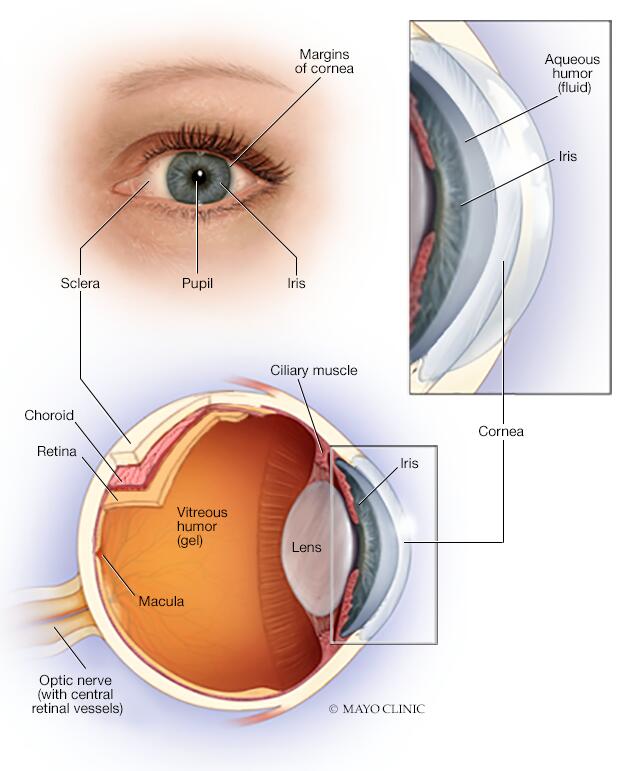
Anatomy of the eye
Your eye is a complex and compact structure measuring about 1 inch (2.5 centimeters) in diameter. It receives millions of pieces of information about the outside world, which are quickly processed by your brain.
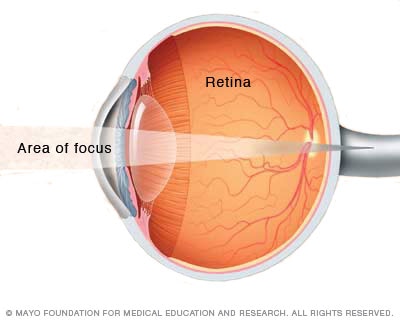
Farsightedness (hyperopia)
With typical vision, an image is sharply focused onto the surface of the retina. In farsightedness, the cornea doesn't refract light properly, so the point of focus falls behind the retina. This makes close-up objects appear blurry.
Risk factors
Farsightedness can run in families. You're more likely to be farsighted if other family members have the condition.
Complications
Complications that may accompany farsightedness include:
- Crossed eyes. Some children with farsightedness may develop crossed eyes. Specially designed eyeglasses that correct for part or all of the farsightedness may treat this condition.
- Reduced quality of life. If farsightedness is not corrected, you might not be able to perform a task as well as you wish. And your limited vision may take away from your enjoyment of everyday activities.
- Eyestrain. If farsightedness is not corrected, it may cause you to squint or strain your eyes to maintain focus. This can lead to eyestrain and headaches.
- Compromised safety. Your own safety and that of others may be jeopardized if you have a vision problem that is not corrected. This could be especially serious if you are driving a car or operating heavy equipment.