
Overview
Familial hypercholesterolemia is an inherited condition that affects the way the body processes cholesterol. As a result, people with familial hypercholesterolemia have a higher risk of heart disease and a greater risk of early heart attack.
The genetic changes that cause familial hypercholesterolemia are present from birth, but symptoms may not appear until adulthood.
There are two types of familial hypercholesterolemia. Heterozygous familial hypercholesterolemia (HeFH) is the more common type. HeFH is inherited from one parent. Homozygous familial hypercholesterolemia (HoFH) is the rare type. HoFH is inherited from both parents.
People who inherit the condition from both parents usually develop symptoms in childhood. If this rare and more-serious form is not treated, death often occurs before age 20.
Treatments for both types of familial hypercholesterolemia include a variety of medicines and healthy-lifestyle behaviors.
Symptoms
Adults and children who have familial hypercholesterolemia have very high levels of low-density lipoprotein (LDL) cholesterol in their blood. LDL cholesterol is known as "bad" cholesterol because it can build up in the walls of the arteries, making them hard and narrow.
This excess cholesterol is sometimes deposited in certain portions of the skin and some tendons. These deposits are called xanthomas. They also can cause a white, gray or blue circle around the iris of the eyes called corneal arcus or arcus senilis.
- Skin. The most common spots for cholesterol deposits to occur is on the hands, elbows and knees. They also can occur in the skin around the eyes.
- Tendons. Cholesterol deposits may thicken the Achilles tendon, along with some tendons in the hands.
- Eyes. High cholesterol levels can cause corneal arcus. This is a white or gray ring around the iris of the eye. This happens most commonly in older people, but it can occur in younger people who have familial hypercholesterolemia.
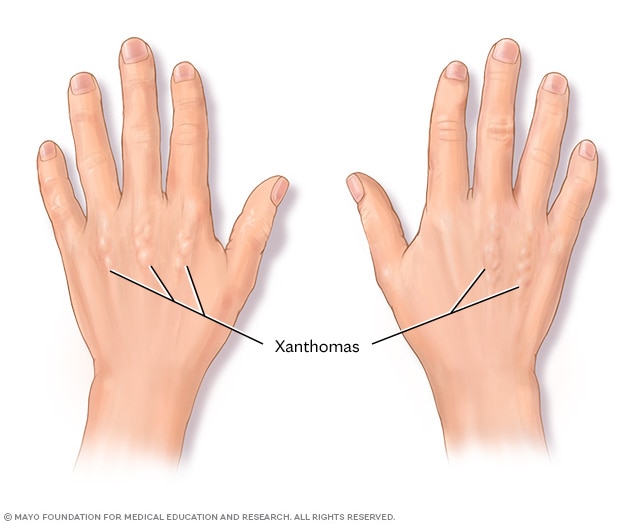
Hand xanthomas
A sign of familial hypercholesterolemia is when certain fats build up under the surface of the skin. These are called xanthomas.
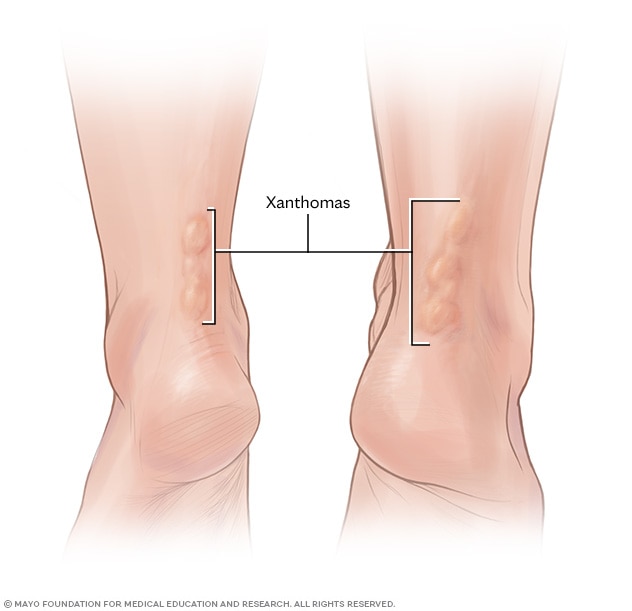
Achilles tendon xanthomas
Familial hypercholesterolemia can lead to Achilles tendon xanthoma, a condition in which certain fats build up under the surface of the skin and cause skin lesions.
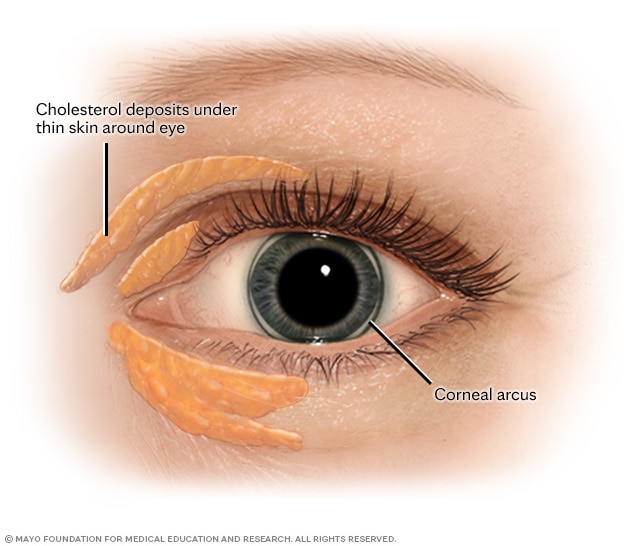
Corneal arcus
Cholesterol deposits around the eye and a white or gray ring around the iris of the eye, called corneal arcus, may be signs of familial hypercholesterolemia.
Causes
A gene alteration that's passed down from one or both parents causes familial hypercholesterolemia. People who have this condition are born with it. This gene alteration prevents the body from ridding itself of the type of cholesterol that can build up in the arteries and cause heart disease.
Risk factors
The risk of familial hypercholesterolemia is higher if one or both parents have the gene alteration that causes it. Most people who have the condition receive one affected gene. But in rare cases, a child can get the affected gene from both parents. This can cause a more serious form of the condition.
Familial hypercholesterolemia can happen in any race or ethnic group, but it may be more common in certain populations, including:
- Ashkenazi Jews.
- Some Lebanese groups.
- French Canadians.
Complications
People who have familial hypercholesterolemia have a higher risk of heart disease and death at a younger age. Heart attacks may occur before age 50 in men and age 60 in women. The rare and more serious form of the condition, if not diagnosed or treated, can cause death before age 20.