
Overview
Edema is swelling caused by too much fluid trapped in the body's tissues. Edema can affect any part of the body. But it's more likely to show up in the legs and feet.
Medicines and pregnancy can cause edema. It also can be the result of a disease, such as congestive heart failure, kidney disease, venous insufficiency or cirrhosis of the liver.
Wearing compression garments and reducing salt in the diet often relieves edema. When a disease causes edema, the disease needs treatment, as well.
Symptoms
Symptoms of edema include:
- Swelling or puffiness of the tissue right under the skin, especially in legs or arms.
- Stretched or shiny skin.
- Skin that holds a dimple, also known as pitting, after it's been pressed for a few seconds.
- Swelling of the belly, also called the abdomen, so that it's bigger than usual.
- Feeling of leg heaviness.
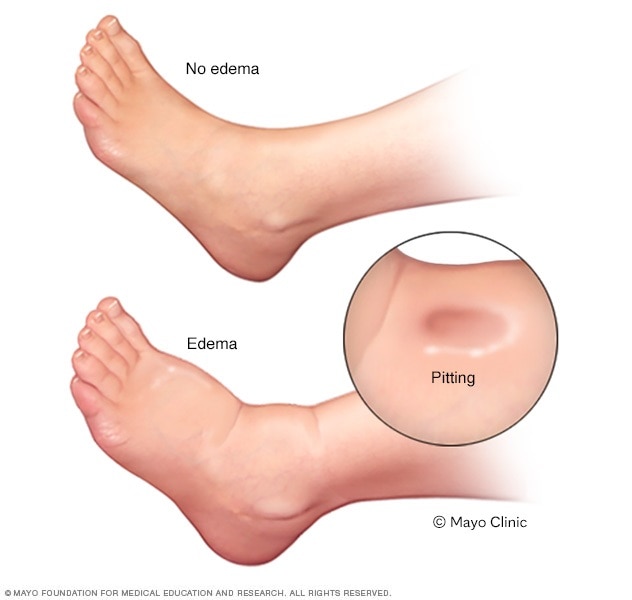
Edema in foot and ankle
Swelling of the foot, ankle and leg can be bad enough to leave a dimple, also known as a pit, in the skin after pressing on the area. This swelling, called edema, is the result of too much fluid in the tissues. Congestive heart failure or the vein not working well, also known as venous insufficiency, is often the cause.
When to see a doctor
Make an appointment to see a healthcare professional for swelling, stretched or shiny skin, or skin that holds a dimple after being pressed. See a healthcare professional right away for:
- Shortness of breath.
- Irregular heartbeat.
- Chest pain.
These can be signs of fluid buildup in the lungs, also known as pulmonary edema. It can be life-threatening and needs quick treatment.
After sitting for a long time, such as on a long flight, call your healthcare professional if you get leg pain and swelling that won't go away. Especially if the pain and swelling is on one side, these can be symptoms of a blood clot deep in the vein, also known as deep vein thrombosis, or DVT.
Causes
Edema occurs when tiny blood vessels in the body, also known as capillaries, leak fluid. The fluid builds up in nearby tissues. The leak leads to swelling.
Causes of mild edema include:
- Sitting or staying in one position for too long.
- Eating too much salty food.
- Being premenstrual.
- Being pregnant.
Edema also can be a side effect of some medicines. These include:
- High blood pressure medicines.
- Nonsteroidal anti-inflammatory medicines.
- Steroid medicines.
- Estrogens.
- Certain diabetes medicines called thiazolidinediones.
- Medicines use to treat nerve pain.
Sometimes edema can be a sign of a more serious condition. Illnesses that can cause edema include:
-
Congestive heart failure. Congestive heart failure causes one or both of the heart's lower chambers stop pumping blood well. As a result, blood can back up in the legs, ankles and feet, causing edema. It also can cause swelling in the stomach area. Congestive heart failure may cause fluid to build up in the lungs too. Known as pulmonary edema, this can lead to shortness of breath.
- Liver damage. This liver damage from cirrhosis can cause fluid to build up in the stomach area. and in the legs. This fluid buildup in the stomach area is known as ascites.
- Kidney disease. Kidney disease can cause fluid and salts in the blood to build up. Edema linked to kidney disease usually occurs in the legs and around the eyes.
- Kidney damage. Damage to the tiny, filtering blood vessels in the kidneys can result in nephrotic syndrome. In nephrotic syndrome, decreased levels of protein in the blood can lead to edema.
- Weakness or damage to veins in your legs. This condition, known as chronic venous insufficiency, harms the one-way valves in the leg. One-way valves keep blood flowing in one direction. Damage to the valves allows blood to pool in the leg veins and causes swelling.
- Deep vein thrombosis, also called DVT. Sudden swelling in one leg with pain in the calf muscle can be due to a blood clot in one of the leg veins. DVT requires medical help right away.
- Problems with the system in the body that clears extra fluid from tissues. If the body's lymphatic system is damaged, such as by cancer surgery, the lymphatic system might not drain well.
- Severe, long-term lack of protein. An extreme lack of protein in the diet over time can lead to edema.
Risk factors
The following increases the risk of edema:
- Being pregnant.
- Taking certain medicines.
- Having a long-lasting illness, such as congestive heart failure or liver or kidney disease.
- Having surgery that involves a lymph node.
Complications
If left untreated, edema can cause:
- Swelling that gets more and more painful.
- Problems walking.
- Stiffness.
- Stretched skin, which can itch.
- Increased risk of infection in the swollen area.
- Scarring between layers of tissue.
- Less blood flow.
- Less ability of the of arteries, veins, joints and muscles to stretch.
- Increased risk of skin ulcers.