
Overview
De Quervain tenosynovitis (dih-kwer-VAIN ten-oh-sine-oh-VIE-tis) is a painful condition that affects the tendons on the thumb side of the wrist. If you have de Quervain tenosynovitis, you typically feel pain when you turn your wrist, grip something or make a fist.
The exact cause of de Quervain tenosynovitis isn't known. But activities that involve repeating the same hand or wrist movements can make the condition worse. For example, gardening, playing golf or racket sports, and lifting a baby can make it worse.
Symptoms
Symptoms of de Quervain tenosynovitis include:
- Pain near the base of the thumb.
- Swelling near the base of the thumb.
- Trouble moving the thumb and wrist when gripping or pinching.
- A sticking or catching feeling when you move your thumb.
If not treated, the pain may spread into the thumb, forearm or both. Moving the thumb or wrist may make the pain worse.
When to see a doctor
Talk to your healthcare professional if you're still having pain or trouble using your thumb after trying the following:
- Resting your thumb and avoiding activities that cause pain.
- Applying ice or a cold pack to the area. Always put a thin cloth between your skin and ice.
- Taking pain medicine you can buy without a prescription, such as ibuprofen (Advil, Motrin IB, others) and naproxen sodium (Aleve). These are types of nonsteroidal anti-inflammatory medicines, also called NSAIDs.
Causes
De Quervain tenosynovitis affects the two tendons on the thumb side of the wrist. Tendons are rope like tissues that connect muscles to bones.
Doing the same hand movements over and over — such as lifting, gripping or twisting — can irritate the protective covering around these tendons. When this covering is irritated, the tendons may swell and thicken. This makes it harder for them to slide smoothly through the small tunnel that connects them to the base of the thumb.
Other causes of de Quervain tenosynovitis include:
- Inflammatory arthritis, such as rheumatoid arthritis.
- Injury to the wrist or tendons, which may lead to scar tissue that limits tendon movement.
- Fluid buildup, often caused by hormone changes during pregnancy.
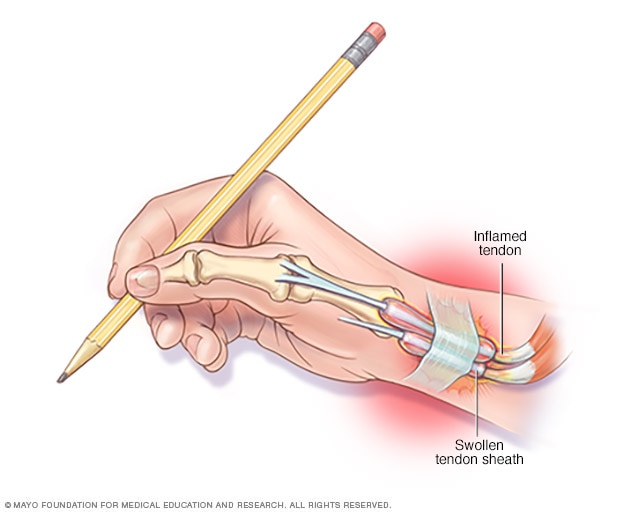
De Quervain tenosynovitis
When you grip, grasp, clench, pinch or wring anything in your hand, two tendons in your wrist and lower thumb typically glide smoothly through the small tunnel that connects them to the base of the thumb. Repeating a particular motion day after day may irritate the sheath around the two tendons, causing thickening and swelling that restricts their movement.
Risk factors
Risk factors for de Quervain tenosynovitis include:
- Age. People ages 30 to 50 are at higher risk.
- Sex assigned at birth. Women are more likely to develop this condition than men.
- Pregnancy and breastfeeding. It may be linked to being pregnant and to breastfeeding.
- Caring for a baby. Repeatedly lifting a child, especially using your thumbs for support, may increase the risk.
- Repetitive hand or wrist movements. Jobs or hobbies that involve doing the same motions over and over — such as typing, gardening or playing certain sports — can contribute to the condition.
Complications
If de Quervain tenosynovitis isn't treated, it can become hard to use your hand and wrist as you'd like. You may lose some range of motion in your wrist.