
If your doctor has recommended colon cancer screening, you might be able to choose from various colon cancer screening tests.
If you're reluctant to make a decision, remember that any discomfort or embarrassment from colon cancer screening is temporary — and detecting problems early could save your life.
Screening tests are used only if you don't have bowel symptoms. If you have signs and symptoms — such as abdominal pain, a change in bowel habits, bleeding, constipation or diarrhea — then you'll need other tests to address these problems.
If you don't have bowel symptoms, consider the following questions to help choose the colon cancer screening test that's best for you.
What preparation is involved?
Preparing for colon cancer screening can be uncomfortable or inconvenient, but it's necessary for the test to be effective. As part of your decision, consider your willingness or ability to follow the preparation instructions for specific colon cancer screening tests.
This may — to varying degrees — include avoiding solid food the day before the exam, adjusting your medications, and drinking a laxative solution or using enemas to empty your colon.
How convenient is the test?
In addition to test preparation, consider:
- How long the test will take
- How often you need to repeat the test
- Whether you'll need sedation
- How much follow-up care you'll need
- The possible need for follow-up testing to investigate a false-positive finding or to remove tissue
What about cost and insurance issues?
Find out how much each colon cancer screening test costs, as well as which tests your insurance company covers. Consider whether you're willing to pay out of pocket if necessary.
What's your attitude toward screening tests?
The more thorough the colon cancer screening test, the more likely it is to detect any cancer or precancerous polyps. Conversely, a more thorough test might also mean more-inconvenient or more-uncomfortable preparation, a slightly higher risk of serious complications, or both.
Ask yourself:
- Will you feel best if you know you've chosen the most thorough screening test possible?
- Will you worry or doubt the results if you choose a less sensitive test?
- How concerned are you about convenience, preparation or the possibility of serious complications?
What's your doctor's approach to screening tests?
Make sure that you're comfortable with the colon cancer screening test your doctor recommends. If your doctor specializes in a particular test, but you'd rather have another test, express your wishes. Your doctor might offer a referral to someone trained in the test with which you feel most comfortable.
What's your risk level?
Your risk of colon cancer might influence your choice of screening tests. If you have an increased risk of colon cancer, your doctor might recommend more-frequent colon cancer screening with colonoscopy.
Talk to your doctor about your colon cancer risk if you:
- Have a personal history of colon cancer or precancerous polyps
- Have a parent, sibling or child who has had colon cancer
- Carry a gene for a hereditary colon cancer syndrome
- Have a history of inflammatory bowel disease, such as ulcerative colitis or Crohn's disease
What are the pros and cons of each test?
Here's an overview of the most common colon cancer screening tests.
Colonoscopy
During a colonoscopy exam, a long, flexible tube (colonoscope) is inserted into the rectum. A tiny video camera at the tip of the tube allows the doctor to detect changes or abnormalities inside the entire colon.
Colonoscopy takes about 30 to 60 minutes and screening is generally repeated every 10 years if no abnormalities are found and you don't have an increased risk of colon cancer.
The pros:
- Colonoscopy is one of the most sensitive tests currently available for colon cancer screening.
- The doctor can view your entire colon and rectum.
- Abnormal tissue, such as polyps, and tissue samples (biopsies) can be removed through the scope during the exam.
The cons:
- The exam might not detect all small polyps and cancers.
- A thorough cleansing of the colon is required before the test.
- Diet changes are needed before the test, and medications may need to be adjusted.
- Sedation is almost always used, and it can take several hours to wear off.
- Because of the sedation, you'll need someone to drive you home.
- Rare complications may include bleeding from the site where a biopsy was taken or a polyp or other abnormal tissue was removed, or bleeding from a tear in the colon or rectum wall.
- Cramping or bloating might occur afterward.
Stool DNA test
The stool DNA test uses a sample of your stool to look for DNA changes in cells that might indicate the presence of colon cancer or precancerous conditions. The stool DNA test also looks for signs of blood in your stool.
For this test, you collect a stool sample at home and send it to a laboratory for testing. Stool DNA testing is typically repeated every three years.
The pros:
- The test doesn't require bowel preparation, sedation or insertion of a scope.
- You can eat and drink normally, and take your normal medications, before the test.
- The stool can be collected at home, avoiding disruption of work and daily activities.
The cons:
- The DNA stool test is less sensitive than colonoscopy at detecting precancerous polyps.
- If abnormalities are found, additional tests might be needed.
- The tests can suggest an abnormality when none is present (false-positive result).
Fecal occult blood test or fecal immunochemical test
Fecal occult blood test (FOBT) and fecal immunochemical test (FIT) are lab tests used to check stool samples for hidden (occult) blood. The tests usually are repeated annually.
The pros:
- Stool sample collection can be done at home.
- There's no need to empty the colon ahead of time.
- There's no need for sedation.
The cons:
- The tests fail to detect some polyps and cancers.
- Certain foods and medications might need to be avoided for several days before the test.
- If blood is detected, additional tests might be needed to determine the source.
- The tests can suggest an abnormality when none is present (false-positive result).
Virtual colonoscopy (CT colonography)
During a virtual colonoscopy, a CT scan produces cross-sectional images of the abdominal organs, allowing the doctor to detect changes or abnormalities in the colon and rectum. To help create clear images, a small tube (catheter) is placed inside your rectum to fill your colon with air or carbon dioxide.
Virtual colonoscopy takes about 10 minutes and is generally repeated every five years.
The pros:
- Unlike traditional colonoscopy, virtual colonoscopy doesn't require sedation or the insertion of a scope into the colon.
The cons:
- Like standard colonoscopy, a thorough cleansing of the bowel is required beforehand.
- The exam might not detect all small polyps and cancers.
- Diet changes are needed before the test, and medications may need to be adjusted.
- Radiation exposure may be a concern. However, the level of radiation used during a screening CT scan is lower than the amount used in a diagnostic CT scan.
- Since tissue samples can't be taken during the exam, a follow-up colonoscopy might be needed if an abnormality is detected.
- Cramping or bloating might occur afterward.
- The test may detect abnormalities in other abdominal organs and additional tests may be needed to determine the cause.
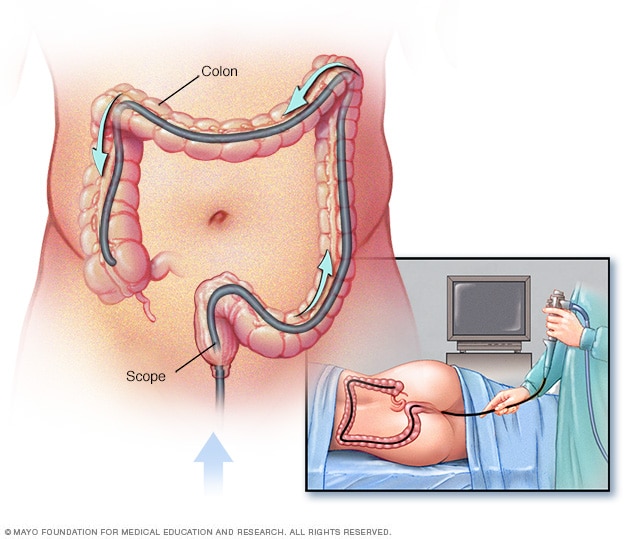
Colonoscopy exam
During a colonoscopy, a healthcare professional puts a colonoscope into the rectum to check the entire colon.

Fecal occult blood test kit
This simple fecal occult blood test kit may be used at home. First, you place the sheet of special paper on top of the water in the toilet bowl. After you have a bowel movement, you use the sampling stick to collect a small amount of stool that has been deposited on the floating paper. You then place the sampling stick with the stool sample in the collection container and snap the cap in place. You may either return the sample to your doctor or send it directly to the lab for analysis.
What's the bottom line?
Choosing a colon cancer screening test may not be an easy decision, but it's a potentially lifesaving one. Consult your doctor about your colon cancer screening options.
Commit to a screening schedule based on your personal risk factors. Remember, the earlier colon cancer is detected, the easier it is to treat.
ART-20046825