
Overview
Clubfoot describes a condition present at birth in which a baby's foot is pointed in and down. The tissues connecting the muscles to the bone are called tendons. In clubfoot, the tendons are shorter than usual, pulling the foot out of position.
Also called congenital talipes equinovarus (TAL-ih-peez e-kwie-no-VAY-rus), clubfoot is a common foot condition. It can occur in up to 1 in 1,000 babies. Most newborns with clubfoot do not have other medical conditions.
Clubfoot can be mild to severe. About half of children with clubfoot have it in both feet. If a child has clubfoot that is not treated, the child may walk on the side or top of the foot. This can cause a limp, skin sores or calluses, and problems wearing shoes.
Clubfoot will not get better without treatment. But it can be successfully treated using a specific casting technique. Usually, babies also need a minor procedure to lengthen the heel tendon. Treatment results are best with casting that begins within several weeks after birth.
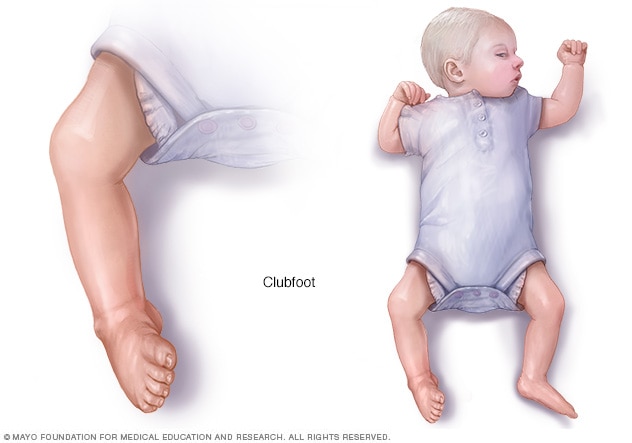
Clubfoot
In clubfoot, the front of the foot is pointed in and down. Also, the arch may be raised and the heel turned inward. The foot is typically fixed in this position. Without treatment, the child may walk on the side or top of the foot.
Symptoms
If your child has clubfoot, here's what it might look like:
- The top of the foot is usually pointed in and down. This raises the arch and turns the heel inward.
- The foot may be turned so severely that it looks like it is upside down.
- The foot or big toe may be slightly shorter than the other foot.
- The calf muscles in the leg with clubfoot are usually smaller.
At birth, clubfoot doesn't cause any discomfort or pain.
When to see a doctor
Your healthcare professional is likely to notice clubfoot during an exam soon after your child is born. You may be referred to a doctor who specializes in bone and muscle conditions in children called a pediatric orthopedic surgeon.
Causes
The cause of clubfoot is not known, but it may be due to genetics and environmental factors.
Risk factors
Boys are about twice as likely as girls to have clubfoot.
Risk factors include:
- Family history. If a child has a parent, brother or sister with clubfoot, that child is more likely to have it too.
- Part of other conditions. Sometimes clubfoot may happen with other skeletal conditions that are present at birth. One example is spina bifida, a condition that happens when the spine and spinal cord don't develop or close properly before birth. Certain conditions related to changes in chromosomes also may raise the risk of clubfoot.
- Environment. Smoking during pregnancy can raise the baby's risk of clubfoot.
- Not enough amniotic fluid during pregnancy. Amniotic fluid is the liquid that surrounds the baby in the womb. Not having enough amniotic fluid may raise the risk of clubfoot.
Complications
Clubfoot usually doesn't cause any problems until a child starts to stand and walk. Treatment can bring the foot into the proper position and help a child walk well. But a child may still have some problems with:
- Movement. The foot may be a little stiff and not bend easily.
- Leg length. The leg with clubfoot may be slightly shorter, but this usually doesn't stop a child from learning to walk.
- Shoe size. The foot may be up to 1 1/2 shoe sizes smaller than the other foot.
- Calf size. The muscles of the calf on the side with clubfoot may always be smaller than those on the other side.
- Foot shape. It's common for the foot to have a bean shape and a small inward point, even after treatment.
If clubfoot is not treated, more-serious problems can happen. These can include:
- Problems walking. When clubfoot is not treated, children with the condition can walk but may put their weight on the side of the foot or the top of the foot. This can cause sores or calluses, problems finding shoes, and a limp.
- Problems with late treatment. Delayed treatment of clubfoot can result in needing more casts and even surgery to correct the foot. Results are better with early treatment before the bones of the foot become misshapen from the poor foot position.
- Arthritis. There may be swelling and tenderness in one or more joints.
- Poor self-image. The unusual look of the foot may make body image a concern during the teen years.
Prevention
Because healthcare professionals don't know what causes clubfoot, there's no sure way to prevent it. But if you're pregnant, you can do things to have a healthy pregnancy and lower your baby's risk of problems that affect the baby's development:
- Don't smoke or spend time in places with secondhand smoke.
- Don't drink alcohol.
- Don't use legal or illegal drugs that may be sold on the streets or take medicines that aren't approved by your healthcare professional.