
Diagnosis
Most cases of cleft lip and cleft palate are seen right away at birth, so special tests aren't needed. Cleft lip and cleft palate are often seen on ultrasound before a baby is born.
Ultrasound before birth
A prenatal ultrasound is a test that uses sound waves to create pictures of the developing unborn baby. When studying the pictures, a healthcare professional may see differences in the facial structures.
Healthcare professionals may use ultrasound to find cleft lip, beginning around the 13th week of pregnancy. Sometimes a healthcare professional can find cleft lip earlier using 3D ultrasound techniques. As the unborn baby continues developing, it may be easier to diagnose cleft lip. Cleft palate that occurs alone is harder to see using ultrasound.
If an ultrasound finds cleft lip or cleft palate, parents can meet with specialists to begin planning for care before birth.
Genetic counseling
If cleft lip or cleft palate is found before birth, your healthcare professional will often recommend that you meet with a genetic counselor. If a genetic syndrome is suspected because the prenatal ultrasound shows a cleft, your healthcare professional may offer a procedure to take a sample of amniotic fluid from your uterus. This is called amniocentesis. The fluid test may show whether the unborn baby has inherited a genetic syndrome that may cause other health problems at birth.
Healthcare professionals usually offer genetic consultation to all parents who have a child born with a cleft lip or cleft palate. During genetic counseling, the results of any genetic testing are discussed, including what caused the cleft lip or cleft palate, whether future children may be at risk of being born with a cleft lip or palate, and whether more testing is needed. A medical geneticist can decide on the right testing. But the cause of cleft lip and cleft palate most often isn't known.
Treatment
The goals of treatment for cleft lip and cleft palate are to make it easier for a child to eat, speak and hear and achieve a typical look for the face.
Care for children with cleft lip and cleft palate often involves a team of healthcare professionals, including:
- Surgeons who specialize in cleft repair, such as plastic surgeons or ear, nose and throat doctors (ENTs).
- Oral surgeons.
- ENT doctors, also called otolaryngologists or otorhinolaryngologists.
- Pediatricians.
- Pediatric dentists.
- Nutrition or breastfeeding consultants.
- Pediatric sleep medicine specialists.
- Orthodontists.
- Nurses.
- Auditory or hearing specialists.
- Speech therapists and pathologists.
- Genetic counselors.
- Social workers.
- Psychologists.
- Nurse practitioners or physician assistants.
Treatment involves surgery to repair cleft lip and cleft palate and therapies to make any related conditions better.
Surgery
Surgery to correct a cleft lip and cleft palate is based on your child's situation. Following the initial cleft repair, your healthcare professional may recommend follow-up surgeries to make speech better or make the lip and nose look better.
Healthcare professionals usually do surgeries in this order:
- Cleft lip repair — between 3 and 6 months of age.
- Cleft palate repair — by 9 to 18 months (usually around 1 year) or earlier if possible. This surgery occurs after any cleft lip repair.
- Follow-up surgeries — between age 2 and the late teen years.
Cleft lip and cleft palate surgery takes place in a hospital. Your child will get medicine to go to sleep and not feel pain or be awake during surgery. Surgeons use several techniques and procedures to repair cleft lip and palate, reconstruct the affected areas, and prevent or treat related complications.
In general, procedures may include:
- Cleft lip repair. To close the separation in the lip, the surgeon makes cuts on both sides of the cleft and creates flaps of tissue. Then the surgeon stitches these flaps together, including the lip muscles. The repair should create a more usual lip appearance, structure and function. Nasal repair, if needed, is usually done at the same time.
- Cleft palate repair. Surgeons may use various procedures to close the separation and rebuild the roof of the mouth (hard and soft palate), depending on your child's situation. The surgeon makes cuts on both sides of the cleft and repositions the tissue and muscles. Then the surgeon stiches the repair closed.
- Ear tube surgery. For children with cleft palate, surgeons may place ear tubes to lower the risk of constant ear fluid that can lead to hearing loss. Ear tube surgery involves placing tiny, bobbin-shaped tubes in the eardrum to create an opening to prevent fluid buildup.
- Surgery to improve appearance. A child may need more surgeries to make the mouth, lip and nose look better.
Some children with more-severe clefts of the lip and palate may need orthodontic treatment before surgery to bring the edges of the cleft closer. Usually this involves nasoalveolar molding with an orthodontic device or special taping across the cleft.
Nasoalveolar molding is not a surgery. It is a process that involves applying tape across the cleft, and sometimes appliances that improve the shape of the nose. In patients with cleft palate, an additional prosthetic may need to be placed at the roof of the mouth to better align the structures of the upper jaw, also known as the maxilla. Consultation with a craniofacial team early on — in the first 1 to 2 weeks after birth — is important to determine if your child qualifies for nasoalveolar molding.
Surgery can improve your child's quality of life and make your child eat, breathe and talk better. Possible risks of surgery include bleeding, infection, poor healing, widening or raised scars, and short- or long-term damage to other structures.
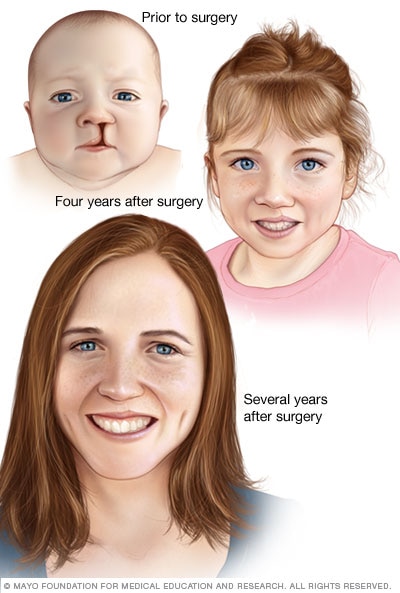
Cleft lip repaired
Surgery to repair cleft lip creates a more typical lip appearance, structure and function. Surgery is done in a way to minimize the appearance of the scar. The scar will fade over time but will always be visible.
Treatment for complications
Your healthcare professional may recommend more treatment for other functional and structural changes that cleft lip and cleft palate cause, such as:
- Feeding strategies, such as using a special bottle nipple or feeder.
- Speech therapy to make it easier to speak.
- Orthodontic adjustments to the teeth and bite, such as having braces.
- Monitoring by a pediatric dentist for tooth development and oral health from an early age.
- Monitoring and treatment for ear infections, which may include ear tubes.
- Monitoring hearing and providing hearing aids or other devices to a child with hearing loss.
- Therapy with a psychologist to help the child cope with the stress of repeated medical procedures or other concerns.
Regular screening and treatment for health problems is mostly limited to the first two decades of life, but lifelong monitoring may be needed depending on your child's individual health problems.
Preparing for your appointment
If your child was diagnosed with cleft lip, cleft palate or both, you'll need to see specialists who can help create a treatment plan for your child. Here's some information to help you get ready and what to expect from your healthcare professional.
What you can do
Before your appointment:
- Find out any restrictions before an appointment. At the time you make the appointment, ask if there's anything you need to do before the appointment, such as limit your baby's diet.
- Make a list of any symptoms your baby is having, including any that don't seem to be related to the reason for the appointment.
- Think about bringing a family member or friend along. Sometimes it can be hard to remember all the information provided during an appointment. Someone who comes with you may remember something that you missed or forgot.
- Make a list of questions to ask your healthcare professional. List your questions from most important to least important in case time runs out.
Some questions to ask your healthcare professional may include:
- Does my baby have a cleft lip, cleft palate or both?
- What caused my baby's cleft lip or cleft palate?
- What tests does my baby need?
- What is the best treatment plan?
- What are the alternatives to the treatment approach that you're suggesting?
- Are there any restrictions that my baby needs to follow?
- Should my baby see a specialist?
- Are there brochures or other printed material that I can have? What websites do you recommend?
- If I choose to have more children, is there a chance they also may have cleft lip or cleft palate?
Don't hesitate to ask other questions.
What to expect from your doctor
Your healthcare professional likely will ask you several questions, such as:
- Does your family have a history of cleft lip and cleft palate?
- Does your baby have problems while feeding, such as gagging or having milk come back up through the nose?
- Does your baby have any symptoms that worry you?
- What, if anything, seems to make your baby's symptoms better or worse?
Preparing and expecting questions will help you make the most of your appointment time and allow you to cover other points you want to talk about.
Coping and support
When the excitement of new life is met with the stress of discovering that your baby has a cleft lip or cleft palate, the experience can be emotionally demanding for the entire family.
For parents and family
When welcoming a baby with cleft lip and cleft palate into your family, keep these coping tips in mind:
- Don't blame yourself. Focus your energy on supporting and helping your child.
- Accept your emotions. It's completely normal to feel sad, overwhelmed and upset.
- Find support. Your hospital social worker can help you find community and financial resources, education and family support groups.
For your child
You can support your child in many ways. For example:
- Help your child gain confidence. Encourage confident body language, such as smiling and holding the head up with shoulders back. Urge your child to take part in decisions about medical care when at an appropriate age.
- Let your child know that you're open to talking whenever needed. If teasing, bullying or self-esteem issues arise, talking with you about it can help.
- Meet with a mental health professional if needed. This can help both you and your child learn how to cope.